
How to Manage Dirt in Entryways Before It Spreads Across Hard Floors
Hard floors make tracked-in dirt easy to notice. A few grains of soil near the door can become a faint trail through a hallway, kitchen, or living room within hours. Shoes, pet paws, bags, strollers, and rolling items all help move that debris farther from the entrance.
The mistake is waiting until the dirt has already traveled across several rooms.
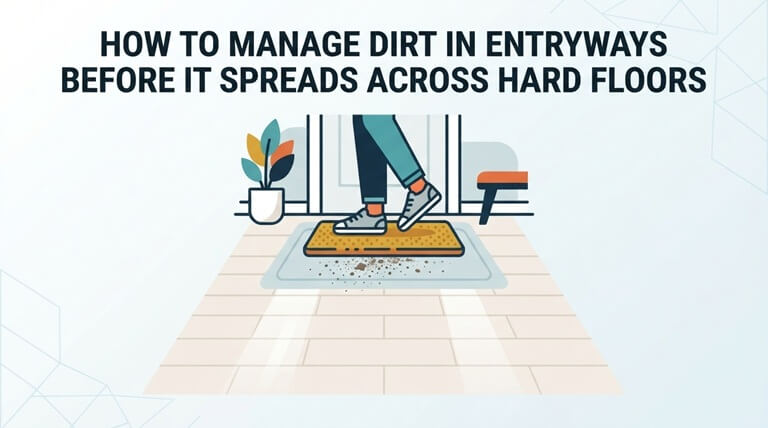
The cleaning of an entryway is more effective as a containment cleaning. The idea is to trap debris when it is still grouped close to the door, remove the moisture from the dry grit, and block the traffic that brings debris further into the house.
A few practical changes around the entrance can reduce how often larger areas of hard flooring need attention.
Identify the Main Dirt Drop Zone
Not all the areas in an entryway get dirty at the same time.
Stand at the door and observe where people stop.
Maybe it’s where you remove your shoes, put down your bags, a pet is dried, or packages are opened.
This little area is often where the most soil accumulates compared to other parts of the hallway.
When cleaning the whole entry area, focus on routine maintenance in the entry first.
Clear off and sweep away debris before it is repeatedly stepped on.
The sooner the grit is removed, the sooner it will not have the chance to spread to neighboring rooms.
Use More Than One Surface to Catch Debris
One small mat can’t clean up everything that is brought in.
Soil may remain in shoes even after making the first step across the threshold.
If the entrance is available, a surface on the outside can be a scraping surface that disposes of bigger bits, and another surface on the inside can be a mat to collect smaller bits.
Make sure materials suit the flooring and entrance configuration.
Mats should be flat and not be a trip hazard.
They must be cleaned regularly, too.
When a mat is overfilled with sand, soil, or pet hair, it begins to give back onto the shoes rather than holding it.
A dirty mat can cause problems, not solve them.
Clean Beneath Mats, Not Only Around Them
Fine particles tend to get under the edge of an entry mat, but the floor might appear safe.
Raise the mat every so often.
Check the entire surface underneath it, not just what’s visible.
Sweep or vacuum up any free grit first before cleaning any damp floor.
Check the back of the mat too!
If sand or small stones are added to the backing, the backing is again put on a clean floor, and the debris is spread again.
Let the mat and flooring completely dry before replacing with other elements.
Give Shoes a Defined Landing Place
Dirt can be carried further into a home on shoes long after people step through the door.
Soil that is in the tread can fall over a succession of rooms.
If shoes are taken off indoors in the house, have a sensible spot next to the front door for their shoes.
Keeping debris in a tray, rack, or washable surface will help keep it all in one place rather than throughout the hallway.
There is still work to be done on the storage area.
Lift shoes from time to time, shake off debris, and clean the bottom of shoes.
The shoe station is only effective if the dirt is removed from the station.
Remove Dry Grit Before Introducing Moisture
Hard flooring is no good when combined with loose soil and water.
Dry particles should, in general, be collected first.
Vacuuming is helpful around edges and textured tile, and in the small recesses found at the threshold strips.
After removing the loose material, if any marks remain on the floor, use an appropriate method for the floor type.
This order will minimize the risk of introducing abrasive particles into a damp cleaner.
It also helps to avoid soil that becomes muddy patches, which are more difficult to clear away than the original soil.
Treat the Threshold as the Containment Line
The first few feet inside the door is where a little cleaning remains a little cleaning or starts to multiply. If the floor does accumulate a lot of grit in that area, a little more than routine maintenance may be necessary on the rest of the floor. After particles have been tracked down a hallway and into adjacent rooms, the job becomes a more general floor-cleaning task.
That is the point where Yall Maid Austin Cleaning Services can fit naturally into the picture. If tracked soil is already past the front door in Austin houses, professional residential cleaning may include vacuuming edges of hard floors, picking up dry dirt from adjoining rooms, mopping surfaces as needed, and re-sweeping and vacuuming high-traffic areas, not continually sweeping the entryway.
The point of the lesson is not that all of the dirty entries need a complete house cleaning. At this early containment stage, you determine how much attention the home needs.
Create a Separate Routine for Wet Shoes
Dry dirt is different from wet dirt.
Loose grit may come out of a dusty shoe.
That grit can turn into muddy streaks and spread water much farther when it’s wet.
Set up a designated area for wet shoes during wet or muddy weather.
The surface must be able to withstand moisture and be cleaned before buildup occurs.
Don’t leave shoes that have been soaked in water for extended periods of time on moisture-prone flooring.
When water spills onto the surrounding floor surface, blot or wipe it quickly, depending on the type of floor surface.
Keeping wet shoes apart from other shoes will stop a small wet area by the entrance from becoming a wet footpath.
Watch the First Turn in the Hallway
Dirt tends to accumulate at the corners of the pathway where people turn.
Check the first corner if the entrance leads to a corridor.
There is a slight twist of the feet when people turn, and shoes can be a source of grit there.
That may cause a more obvious pileup of rubbish than the straight walking path.
When you vacuum a specific area near the turn, it can collect particles before they get blown further from the turn.
This can be particularly beneficial in a house where the front door leads into a narrow corridor rather than a large room.
Floor traffic patterns can better account for dirt distribution than floor size alone.
Pay Attention to Floor Transitions
Changes in flooring types can trap debris.
The narrow edge between tile and wood flooring, vinyl and laminate flooring, and an entrance floor and hallway floor can gather grit.
Carefully vacuum these seams.
Do not overwater them.
Transitions between flooring sections can be places where moisture can travel into joints and under the flooring.
If a strip is raised, loose, or damaged, avoid the temptation to clean around it again and again; it’s a maintenance problem.
It is easier to maintain an undamaged transition free of dirt.
Give Pet Paws Their Own Arrival Routine
Shoe-storage rules do not apply to pets.
Paws and fur can get dirty with mud and grass and get overwet with fine soil and excess moisture when entering.
Keep a towel or another pet-safe cleaning product by the door, if appropriate for the household.
Stay in front of the animal so it doesn’t get on rugs, furniture, or farther into the house.
Check the area that the pet usually stops after entering.
This small area may need cleaning more often than the rest of the entry.
Once pet debris is viewed as a predictable pattern of arrival rather than a random mess, it’s more manageable.
Keep Deliveries From Extending the Dirt Trail
Packages can also carry floor debris inside.
Boxes and delivery bags can be on porches, sidewalks, loading areas, or on vehicle floors.
If they are brought into the depths of the house, they may carry that trash in.
Select a convenient unloading location, close to the door if available.
Once opened, discard any cardboard, tape, and any noticeable grit from the package.
This helps to prevent another common source of debris from getting into the shoe traffic stream.
It also means that a shipping box will not be an unwanted source of dirt on a kitchen or dining-room floor.
Use Quick Dry Cleanup as Interception
A full-size vacuum isn’t needed for a small mess in a small entranceway.
Using the right handheld or compact vacuum will help to stop dirt from spreading if one is available.
If there is grit around, then a short pass over may be sufficient.
Correct timing is more important than time.
Cleaning up a small area around the door is much less labor-intensive than cleaning several adjoining rooms which have had particles walked about the house.
Keep the vacuum as per the manufacturer’s instructions; otherwise, fine debris will affect the pickup ability.
Avoid Using More Floor Cleaner Than Necessary
Dirt that is tracked in can encourage homeowners to use more cleaner or stronger cleaner.
Not always make for a better outcome.
Leftover product may remain on a floor surface that can cause the floor to appear dull or sticky once it’s dry on certain types of floor surfaces.
This leftover material can then cause new dirt to stick to it.
Follow the flooring manufacturer’s and cleaner’s instructions!
Use the recommended amount, not more just because you think you need to clean the floor more.
If a floor is still sticky after drying, product residue could be the problem.
Keep Entry Furniture From Blocking Floor Access
Small benches, shoe racks, baskets, and small tables can assist in creating a more functional entrance.
They can also develop potential dirt zones.
Grit can fall into the area below a bench, or behind a shoe rack that is not swept regularly.
Rotate lightweight objects that can be moved safely.
Vacuum beneath and check furniture feet prior to return to floor.
If a piece is too heavy to move easily, clean the edges that can be accessed with a suitable attachment.
Entryway storage should help to keep things from getting out of hand but shouldn’t turn storage spaces into permanent storage.
Check High-Traffic Areas After Specific Events
Entryways often need attention after activities rather than according to a rigid daily schedule.
Inspect the floor after:
- Rain or muddy weather
- Yard work
- Pet walks
- Deliveries
- Family gatherings
- Heavy foot traffic
- Moving outdoor equipment indoors
Just because it’s been another day doesn’t mean you should re-clean the entrance.
Event-based cleaning focuses on real dirt in order to keep the cleaning routine current.
It also enhances the likelihood of collecting debris before traffic conveys it further.
Let Recurring Cleaning Handle the Broader Floor Routine
Even with a good vacuum, you will not be able to pick up every particle.
Some incidental debris will move into living areas and hallways.
Routine maintenance steps are included here.
While the scheduled services will cover the rest of the hard floor areas, dust, bathroom groomicleanuphen clean-up, and other routine household cleaning, a household using Yall Maid Austin Cleaning Services for a recurring house cleaning service can still reap some benefits from cleaning bits of dirt it sees right as it walks in the door.
Two routines address different parts of the problem.
A quick door-to-door catch helps to keep dirt from spreading. What inevitably slips past that first barrier is taken care of with regular home cleaning.
Containment Is Easier Than Whole-Floor Recovery
Once it has a chance to travel, entryway dirt becomes a much bigger chore.
Identify the primary drop zone, keep mats, avoid putting moisture on dry grit, handle wet shoes separately, clean under shoe storage, watch traffic turns, and watch the first few feet beyond the door.
Hard floor use will require regular cleaning as normal.
They should not, however, be constantly recovering full rooms, as all the outdoor debris was free to travel from one entrance to the rest of the house.
If you are able to stop the dirt at the point of entry, then the rest of the floor is much more manageable.
Popular on OTW Right Now!




About The Author

Gagan Bhangu
Founder of otechworld.com and managing editor. He is a tech geek, web-developer, and blogger. He holds a master's degree in computer applications and making money online since 2015.