
The Internet Side Hustle Is Getting an AI Co-Pilot: What Changes When One Person Has a Digital Team?
The New Internet Advantage Is Not More Hours
The internet has always offered an unusual economic opportunity: one person can build something that reaches thousands or even millions of people.
A blogger can publish globally. A developer can launch an app without opening an office. A freelancer can work with clients on different continents. A creator can turn an idea into a digital product overnight.
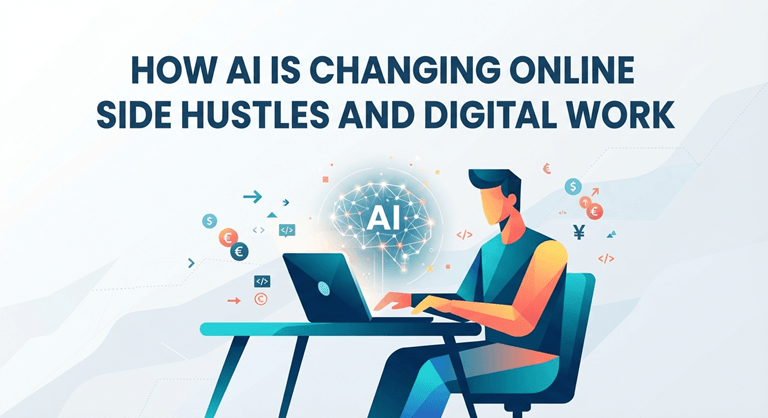
There is, however, one persistent limitation.
There are still only 24 hours in a day.
Artificial intelligence is beginning to change that constraint.
Not because AI magically creates successful businesses, but because it can reduce the time required to move from an idea to a working experiment.
For people exploring online income, that may be more important than automation itself.
From Side Hustle to Micro-Business
The traditional side hustle often begins as a simple exchange: time for money.
Freelancing is the obvious example. More hours usually mean more revenue.
Digital businesses can work differently.
A niche website, newsletter, template store, online course, software product or information service can potentially continue generating value after the initial work has been completed.
AI Changes the Starting Point
AI can help reduce the friction involved in building these assets.
A solo entrepreneur might use it to:
- Research a niche.
- Brainstorm potential products.
- Organize customer questions.
- Draft website copy.
- Analyze competitors.
- Create content outlines.
- Generate code prototypes.
- Summarize research.
- Develop marketing experiments.
The important word is prototype.
AI can help someone create the first version faster, but the market still determines whether anyone cares.
Why Multiple AI Models Are More Interesting Than One
Most people initially encounter AI through a single chatbot.
That creates the impression that “AI” is one thing.
It isn’t.
Different models can produce noticeably different results when given the same instructions. Some may be better suited to reasoning, others to creative writing, coding, summarization or general conversation.
That makes having access to multiple models particularly interesting for people building online projects.
A chat-based platform such as UseAI is built around this broader concept. A Reddit discussion about the service has specifically focused on its multiple-model approach.
For a solo entrepreneur, the value is not necessarily finding one universally “best” model.
It is having the ability to compare approaches.
The One-Person Digital Team
Imagine someone wants to launch a small online business selling productivity templates.
Before AI, they might need to perform market research, study competing products, create descriptions, build a landing page and develop promotional content.
With AI assistance, the process can become more iterative.
A Possible Workflow
1. Research
Ask AI to map customer problems and identify common questions in the niche.
2. Generate
Create several possible product concepts rather than committing immediately to one.
3. Challenge
Ask the AI to identify weaknesses in each concept.
4. Build
Turn the strongest idea into a basic product or prototype.
5. Test
Put it in front of real people.
6. Improve
Use customer feedback to determine what needs changing.
This resembles having a tiny virtual team—but with one crucial difference.
The entrepreneur remains the manager.
AI Is Better at Speed Than Certainty
This distinction is critical.
Generative AI can produce impressive output in seconds. That can create the illusion that a business problem has been solved.
It hasn’t.
An AI-generated business plan does not prove demand.
A beautifully written landing page does not guarantee conversions.
A hundred content ideas do not create an audience.
The Validation Rule
A useful principle for online entrepreneurs is:
Use AI to make experiments cheaper, not to make assumptions feel certain.
That mindset prevents one of the biggest mistakes of the AI era: confusing generated output with validated information.
The “Weekend Business Experiment”
AI makes it possible to test ideas that might previously have required weeks of preparation.
Suppose someone is considering creating a niche newsletter.
Over a weekend, they could:
- Identify three potential audience segments.
- Research the questions each group repeatedly asks.
- Develop five possible newsletter concepts.
- Create sample editions.
- Build a simple landing page.
- Ask potential readers for feedback.
- Compare which concept generates genuine interest.
The AI did not create the business.
It helped reduce the cost of discovering whether the business was worth creating.
That is a much more realistic—and useful—way to think about AI and online income.
Where AI Can Actually Save Money
For small digital ventures, economics can be surprisingly important.
Hiring specialists for every early experiment is often unrealistic.
AI can provide inexpensive assistance with tasks that would otherwise require additional time or external support.
| Business task | Potential AI contribution |
| Market research | Organize and compare information |
| Content | Draft and restructure material |
| Coding | Prototype and debug |
| Marketing | Generate and test messaging |
| Customer support | Prepare response drafts |
| Analysis | Summarize patterns and findings |
| Product development | Explore alternative concepts |
These are not replacements for professional expertise.
They are ways of increasing the amount of work one person can explore.
The Danger of Becoming an AI Content Factory
There is a darker side to this efficiency.
When producing content becomes extremely cheap, the internet can become flooded with mediocre material.
A person can generate hundreds of articles, social posts or product descriptions without creating anything genuinely useful.
This creates a new competitive advantage: taste.
When everyone can generate text, originality, expertise and the ability to understand an audience become more valuable.
AI can produce options.
Humans still have to decide which options deserve to exist.
Don’t Forget the Risks
AI tools can produce inaccurate information, make incorrect assumptions and sometimes generate convincing answers that are simply wrong.
Privacy also matters. Entrepreneurs should think carefully before placing confidential customer, financial or business information into an AI system.
And there is a less obvious risk: dependency.
If an entrepreneur stops thinking independently because AI always provides an answer, productivity may eventually decline rather than improve.
The best workflow keeps humans responsible for important decisions and uses AI for acceleration.
The Real AI Side-Hustle Advantage
The most exciting opportunity isn’t necessarily “making money with AI.”
It is making the process of building something online less expensive to experiment with.
A person with a good idea can research faster, prototype sooner, compare alternatives and learn from mistakes without needing a large team.
That does not guarantee success.
But it changes the economics of trying.
And on the internet, where successful businesses often emerge from dozens of small experiments, the ability to test more ideas with less friction may be one of the most valuable advantages AI can provide.
The future side hustle may not look like one person doing everything.
It may look like one person directing a collection of intelligent tools—while still supplying the one thing no model can reliably manufacture on demand: a genuinely good idea.
Popular on OTW Right Now!



About The Author

Gagan Bhangu
Founder of otechworld.com and managing editor. He is a tech geek, web-developer, and blogger. He holds a master's degree in computer applications and making money online since 2015.