
The Connection Between Smart Homes and Basement Waterproofing Systems
Smart home technology has come a long way from voice-controlled lights and programmable thermostats. Today, homeowners are integrating intelligent systems into nearly every aspect of their property — including areas that most people never think about until something goes wrong. The basement is one of them. As it turns out, the connection between smart home ecosystems and basement waterproofing is stronger than most homeowners realize, and understanding it could save you from a very expensive repair bill.
Why Basements Are the Weak Point in Any Smart Home Setup
The weakest space in a smart home is its weakest. You might have the most advanced security system, energy management system, and automated climate control in the house, but if your basement is leaking water, then it doesn’t matter. Moisture damage spreads. It can destroy structural integrity, reduce insulation, facilitate mold growth, and make its way into electrical systems without anyone knowing.
This is a serious issue for homeowners in the Greater Toronto Area. Spring heavy rains and snow melt, summer storms, and the freeze-thaw cycles that put constant stress on the foundation walls are all part of the season for Markham. This is why waterproofing is a smart next step for waterproofing, and it’s not a luxury.
Direct Waterproofing in Markham works with homeowners who are increasingly asking the right questions: how do I protect my foundation year-round, and how do modern tools help me do that more effectively?
How Smart Technology Integrates With Waterproofing
The integration between smart home platforms and waterproofing systems happens at several levels:
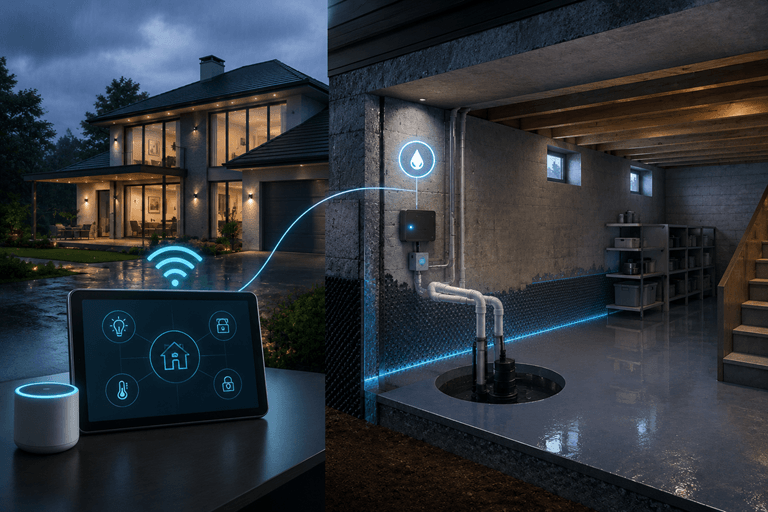
Leak and moisture sensors are the most accessible entry point. They’re small and inexpensive devices that attach to the floor in the basement, around the sump pit, or on the walls and are connected to the Wi-Fi network at home. They send a message to your mobile device when they feel moisture, anywhere, upstairs, or across the country. A lot of them connect right to the Google Home, the Amazon Alexa, or the Apple HomeKit, and so alerts can also activate other smart devices.
Sump pump monitoring systems take this a step further. Smart sump pump controllers monitor the number of times the pump is running, pump efficiency, and water level in real time. When the pump fails, or if water levels climb too high during a storm, you’ll know right away, not the next morning when you have a flooded basement. In some systems, even diagnostics are possible from a distance, meaning that a waterproofing technician can determine the performance of the pump without a visit.
Automated water shut-off valves represent another layer of smart protection. These are installed on the main water line and are used in conjunction with the leak sensors to automatically shut off water if a significant leak is detected. This is more of a solution to plumbing issues than groundwater intrusion, but it does provide some protection to finished basement areas.
The Bigger Picture: Prevention Over Reaction
But it’s not any one particular device that makes the smart home waterproofing integration truly beneficial—it’s the mind shift it fosters. When it comes to water damage, traditional homeownership is more of a reaction than a proactive approach. You see the stain in the drywall, find the wet carpet, or smell the mold, and call someone. At that time, the damage is already done.
Smart monitoring turns that upside down. If your basement is part of the intelligent system of your home, you’re creating an ever-present layer of awareness around the area most likely to silently fail. This type of coverage is particularly crucial for Markham homeowners who have finished basements, home gyms, or rental spaces in their basements, which are below grade, since the consequences of not warning are far more significant for these situations.
Pairing Technology With Professional Waterproofing
Be sure to emphasize that smart devices do not waterproof your basement. They monitor it. Despite the advancements of digital technology, the physical work – the installation of drainage systems, the application of waterproofing membranes, sealing of cracks, hydrostatic pressure control – still demands skilled professionals and materials that have proven themselves.
The best way is to do both. Smart sensors have a stable base to monitor if the basement is well-waterproofed. But smart sensors ensure that the baseline doesn’t creep off course between professional checks. They make a more reliable system as a combination than either working individually.
If you’re a homeowner in Markham who wants to safeguard your investment, it’s not too cautious to combine smart monitoring with a professional waterproofing solution.
Popular on OTW Right Now!




About The Author

Gagan Bhangu
Founder of otechworld.com and managing editor. He is a tech geek, web-developer, and blogger. He holds a master's degree in computer applications and making money online since 2015.