
The AI Homework Shortcut Is Costing Students the Exam, Not Just the Assignment
A few years ago a student who was struggling would open a textbook, send a message to a classmate, or just look at the page until suddenly it all made sense. The fact that they had struggled was the whole point. Nowadays, the student pastes the question into a chatbot, receives a clear answer within a few seconds and then goes on with their work. Although the homework appears to be completed, no real learning has taken place.
The importance of that change is that exams continue to assess what a student can produce independently within a time limit without the use of a bot in the browser; the mark obtained on the worksheet and the mark obtained on the paper are moving further apart, and parents generally only realise this when the report card is issued.
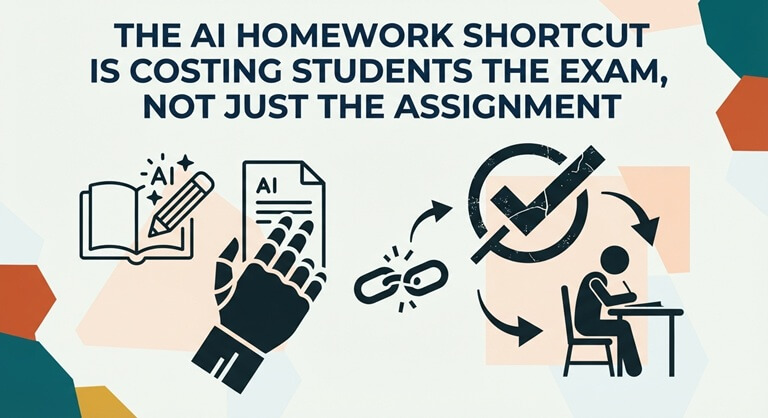
The following are the particular cases in which the shortcut fails, each in its own way.
The Essay Written Faster Than It Was Understood
The case of writing with the help of a chatbot is clear cut. The student puts in a request, makes only minor edits, and then submits the work. The resulting paper sounds good. What is lacking, however, is the thought that used to occur between the first sentence and the last.
In one experiment with university students, the ChatGPT group finished assignments in about half the time of peers who used only a search engine, but scored lower on a surprise test six weeks later. Faster in, less retained. When exam day removes the tool, the student is left holding the output with none of the understanding behind it.
The Math Problem the Student Never Actually Solved
In the case of math, the shortcut ends up being hidden for the longest time. A chatbot will go through a full solution step by step and the student will copy it down. Although the notebook appears to be correct, the ability needed to solve the next problem—the one involving different numbers and not using the bot—never gets exercised.
It is practice testing and spaced repetition that actually develop that ability, and decades of learning-science research have consistently pointed to them.
A useful primer on spaced practice lays out why short, repeated attempts at recall beat long, tool-assisted sessions for durable performance.
The Study Session That Feels Productive and Isn’t
It seems efficient to ask a chatbot to summarize a chapter since the summary is clear and the highlighting is effective, and then an hour is taken. However, the next day, almost nothing can be retrieved without asking questions.
The effect of re-reading and highlighting is poor when it comes to long-term retention, and the inclusion of a robot in the process only makes the session seem smoother, which is exactly the reason why the illusion persists. The ease of reading is not the same as being able to recall information under pressure.
Rebuild the Habits the Shortcut Replaced
To prohibit the tool is to miss the point; the proper course of action is to reinvest the effort in the areas where the tool has taken it away. The following habits carry out most of the heavy lifting:
- Closed-book recall first. Before opening notes or a chatbot, write down what you remember. Only then check what you missed.
- Short, spaced sessions. Twenty focused minutes today and twenty tomorrow beat a two-hour cram, especially for cumulative subjects.
- Timed practice papers. Sit past papers under real conditions. The exam is a performance, and performances need rehearsal.
- Use the bot to check, not to draft. Solve the problem, then ask the chatbot to critique your working. Reversing the order is what keeps the thinking on your side.
If a student has been using a shortcut and this is reflected in their marks, then having external support in the form of structured assistance is more effective than having another talk from a parent. Working with a one-on-one tutor who sits with the student, watches how they actually work through a problem, and reintroduces retrieval practice can rebuild the habits far faster than the student will alone. The exam gives credit for what has been practiced, not for what has been copied.
Popular on OTW Right Now!




About The Author

Gagan Bhangu
Founder of otechworld.com and managing editor. He is a tech geek, web-developer, and blogger. He holds a master's degree in computer applications and making money online since 2015.