
LiteLLM vs Cloudflare vs nexos.ai vs Helicone vs Portkey – Top 5 AI Gateways Compared (2026)
Key Takeaways
- Cloudflare AI Gateway brings edge caching and a free tier, since core gateway features carry no charge.
- ai replaces separate provider accounts and invoices with one OpenAI-compatible endpoint, plus team budgets, all priced by custom enterprise quote.
- LiteLLM gives teams open-source self-hosted control, with an MIT-licensed core.
- Portkey focuses on guardrails and prompt governance, and Helicone on request logging and cost tracking.
- Pricing runs from free core features to custom enterprise offers, so compare platform fees, log limits and retention together.
Teams that send traffic to several model providers now weigh five serious gateway options, each trading control, cost and convenience in its own way. Routing across providers pays off in measurable ways. A May 2026 measurement study on arXiv looked at hosted open-weight APIs. It found routing could cut one model’s cost by 37.8% and lift another’s throughput by about 90%, compared with direct access.
Of the five, Cloudflare’s AI Gateway is the one that has the free core features. nexos.ai has the simplest multi-model API with over 200 models available via a single managed endpoint.
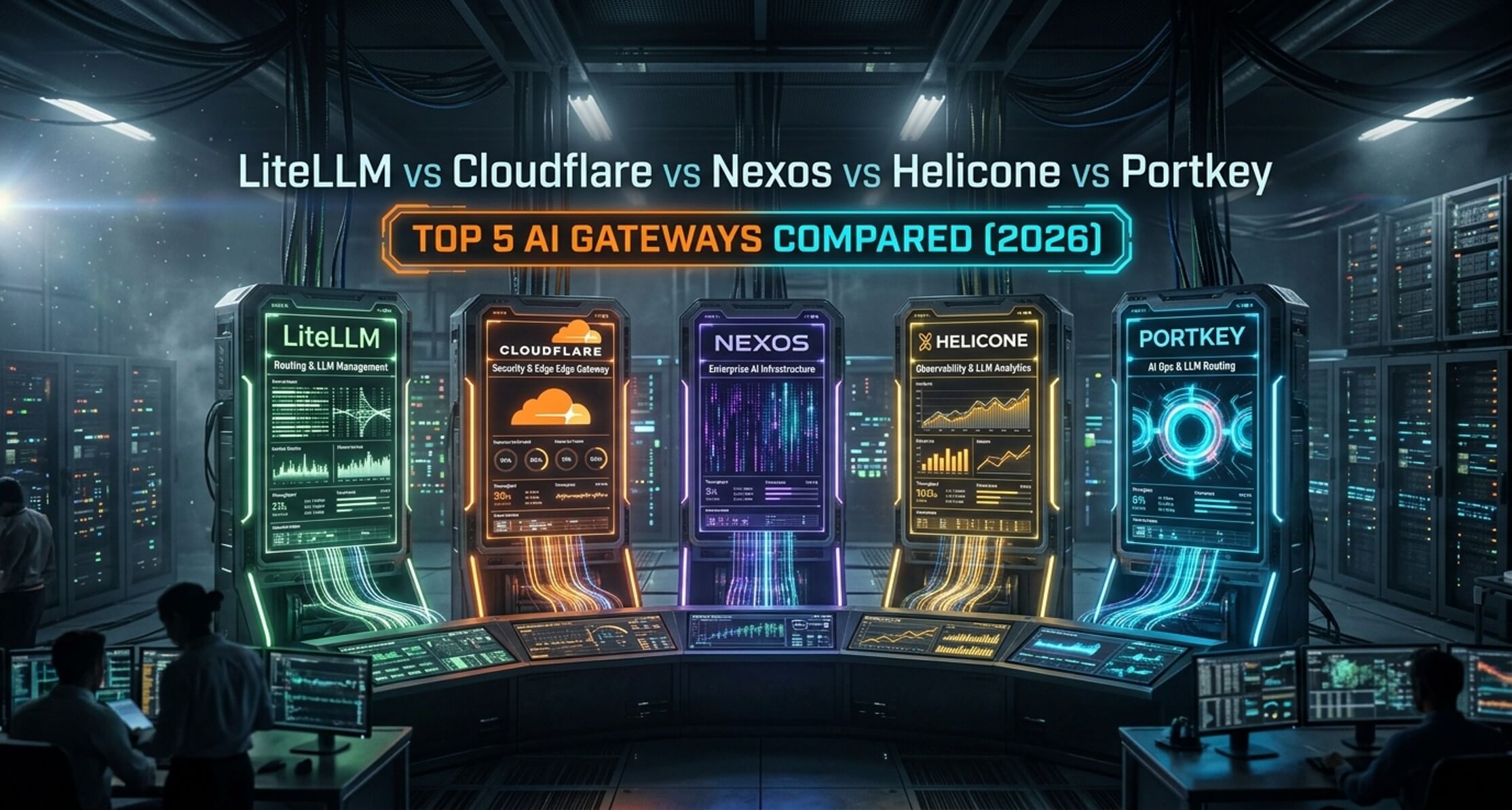
The five gateways we’re looking at are LiteLLM, Cloudflare, nexos.ai, Helicone and Portkey. The main differences between them are in the pricing, the hosting and the ownership. The order they’re in here is the same as the order in the table below with respect to pricing/hosting/ownership.
Five AI Gateways Compared at a Glance
| # | Platform | Best For | Hosting | Pricing Signal |
| 1 | Cloudflare AI Gateway | Edge caching and a free tier | Managed edge service | Core features free, 5% on Unified Billing credits |
| 2 | nexos.ai | Easiest Multi-Model API | Managed cloud | Custom enterprise pricing, book a demo |
| 3 | LiteLLM | Open-source self-hosted control | Self-hosted | Free open source, custom Enterprise |
| 4 | Portkey | Guardrails and prompt governance | Hosted or self-hosted | Free tier, $49/month Production |
| 5 | Helicone | Request logging and cost tracking | Hosted or self-hosted | Free Hobby, $79/month Pro |
How Do Five Pricing Models Behave at Scale?
Vendors price the same token volume differently, and the gaps widen as volume grows. Take a team that spends $25,000 a month on model tokens:
- ai prices its platform as a custom enterprise offer, so the team books a demo or talks to sales and receives a quote scoped to its volume.
- Cloudflare AI Gateway keeps core features free, and Unified Billing credit purchases carry a 5% fee, so the same volume adds $1,250 only if the team buys credits through Cloudflare.
- LiteLLM adds no token fee through its open-source core, and the cost moves to servers and engineering time.
- Portkey charges $49 a month for Production plus $9 per extra 100,000 logs, so cost follows log volume instead of token spend.
- Helicone prices Pro at $79 a month and Team at $799 a month, with retention of one and three months.
Routing savings can outweigh a platform fee in many cases. The researchers behind RouteLLM, including UC Berkeley’s Joseph Gonzalez and Ion Stoica, reported that routers cut costs by over two times in certain cases without compromising response quality.
The 5 Gateways in Detail
Each gateway below follows the same pattern: what it does, who operates it and which team it suits.
1. Cloudflare AI Gateway – Edge Caching and a Free Tier
Cloudflare AI Gateway is a managed proxy running on their own network. It provides caching, rate limiting, retries, model fallbacks and analytics on requests, tokens and cost. DLP is free on all plans and Guardrails are billed as Workers AI token inference.
Cloudflare changed AI Gateway log limits on September 24, 2026. Accounts with a gateway created before that date keep the legacy limits: 100,000 logs in total on Workers Free and 10 million per gateway on Workers Paid. Newer accounts follow Workers Logs pricing and retention. I flag this change because it affects how teams budget for log retention.
Winning Features:
- Core gateway features carry no charge on any plan.
- Edge delivery places the gateway next to Workers deployments.
- Logpush includes 10 million requests a month on Workers Paid.
Ideal for: Edge caching and a free tier for teams already building on Cloudflare.
2. nexos.ai – Easiest Multi-Model API
nexos.ai is an all in one AI platform for enterprises, founded in Vilnius by Tomas Okmanas and Eimantas Sabaliauskas (who also founded Nord Security and Oxylabs). The AI Gateway connects to over 200 models from providers such as OpenAI, Anthropic, Google, Meta, and Mistral via a single OpenAI-compatible endpoint. The AI Workspace enables business teams to use chat and no-code AI agents. Leaders can monitor AI adoption and manage costs in one place.
In the Hostinger Horizons case study that nexos.ai publishes, Head of Product Dainius Kavoliūnas says integrating nexos.ai “saved us the equivalent of two yearly salaries in development cost.”
nexos.ai uses custom enterprise pricing for the AI Gateway and AI Workspace. You can book a demo or speak to sales to get a quote based on your requirements. The Enterprise offering includes SSO, RBAC and dedicated support.
nexos.ai also appears on the Disruptors 60 list compiled by Greenfield Partners and TechCrunch, according to its reviews page.
Winning Features:
-
One call hits every provider and the same endpoint is used for chat, responses, messages, embeddings, images, audio and rerank requests.
-
Smart LLM routing evaluates every prompt, routes it to the model that offers the best balance of accuracy, speed and price and then falls back to a backup model if that model fails to respond or is too slow.
-
Ordered fallbacks use the model IDs that the team prefer so that if one provider goes down the traffic just gets routed to the next one in the list in a very predictable manner.
-
Spend governance applies budgets at the team or user level and the usage API reports requests, tokens and cost at the team or API key level.
-
LLM observability tracks spend by team, by user, by project and by key. The cache will return a saved response if the same prompt is used again.
-
Tooling is available for Langfuse, LangChain, LangGraph, CrewAI and n8n. SDKs are available for Python, Go and .NET.
-
Security: SOC2 Type 2, ISO 27001, ISO 42001, EU data residency and optional zero data retention.
Ideal for: Platform and product teams who want provider breadth, budgets and key governance by team all in one managed service.
3. LiteLLM – Open-Source Self-Hosted Control
LiteLLM is an open-source gateway and Python SDK from BerriAI (founded 2023). It’s a proxy that exposes over 100 LLM providers via the OpenAI format and can be run by teams on their own infrastructure (including air-gapped networks).
The LiteLLM proxy includes retries, fallbacks, load balancing, virtual keys, budgets and RPM and TPM limits. Enterprise adds SSO, SCIM and audit logs. The company lists SOC 2 Type 2 and ISO 27001 on its enterprise page, and air-gapped deployment appears there as well, which I consider a major draw for regulated teams.
LiteLLM ships its software free of charge, and the servers, patching and on-call time belong to the platform team.
Winning Features:
-
The core code is under the MIT license.
-
Air-gapped deployment provides the team with complete network control.
-
Logging integrations cover Langfuse and MLflow.
Ideal for: Open-source self-hosted control for teams that want to run and modify their own gateway.
4. Portkey – Guardrails and Prompt Governance
Portkey is a hosted gateway and LLMOps platform. It was acquired by Palo Alto Networks on 29th May 2026 and is being positioned as the primary AI gateway for Prisma AIRS. It supports hundreds of LLMs, has guardrails with PII redaction, caching, budgets, prompt management and an MCP gateway.
Portkey’s free Developer tier covers 10,000 logs a month with 3-day retention. The Production tier at $49 a month includes 100,000 logs with 30-day retention. Enterprise goes to 10 million or more logs with custom retention, and the pricing page lists SOC 2, ISO 27001, GDPR and HIPAA compliance under that tier.
Winning Features:
- Guardrails and prompt versioning sit in the same platform as routing.
- An open-source self-hosted gateway option is available.
- RBAC arrives on the Production tier, and SSO arrives on Enterprise.
Ideal for: Guardrails and prompt governance for teams that manage prompts as controlled assets.
5. Helicone – Request Logging and Cost Tracking
Helicone is an open-source observability platform with gateway capabilities, founded in 2023 via YC. It was acquired by Mintlify on 3rd March 2026. The product is now in maintenance mode (receiving security updates, new models and bug/performance fixes).
Helicone plans start at a free Hobby tier with 10,000 requests a month and 7-day retention, then Pro at $79 and Team at $799, which lists SOC 2 and HIPAA. Before the acquisition, the company reported processing 14.2 trillion tokens for about 16,000 organizations.
Winning Features:
- Request logging, cost tracking and alerts come as core features.
- Self-hosted and hybrid deployment options are available.
- The HQL query language supports log analysis.
Ideal for: Request logging and cost tracking for teams that already run their own routing.
Buyer’s Checklist: 6 Things to Verify Before You Commit
Six checks belong in every gateway evaluation before a team commits:
- Failover behavior matters because a study of 156 high-severity LLM-inference incidents found that traffic routing and rebalancing mitigated many incidents, so test your fallback order before an incident.
- Log retention should match your audit needs, because published retention on the self-serve tiers above ranges from 3 days to 3 months, while Enterprise tiers offer custom or longer retention.
- Ownership status affects roadmap and contracts, so confirm whether the vendor has changed hands recently.
- Fee basis differs by vendor, so note whether charges follow tokens, log volume, requests or seats.
- Certification scope needs evidence, so ask for the SOC 2 or ISO report itself, and read AICPA’s SOC resources so you know which criteria it covers.
- Data location needs confirmation, so ask where prompts and logs are processed and stored, because GDPR and UK GDPR duties follow personal data in prompts and logs.
The Bottom Line
Cloudflare takes the edge for teams that want a free edge gateway. LiteLLM suits teams that want to own the code. Portkey fits teams that manage prompts as controlled assets, and Helicone fits teams that already run their own routing and need request logging.
nexos.ai is a good fit for organizations that require enterprise-level governance and easy access to a range of providers. You get one endpoint to 200+ models and budgets can be set at the team level. It’s all in the same platform with smart LLM routing, observability and caching as part of the offering and there is a bespoke enterprise version available.
Before you go and pick a gateway you should check the current terms, the ownership and the log retention with each vendor. The market is moving so quickly that you absolutely need to be current.
FAQs
Which AI gateways are open source in 2026?
LiteLLM, Portkey’s gateway and Helicone all have open source code of some kind. LiteLLM’s core is MIT licensed, Portkey has an open source gateway and Helicone is open source with a hosted option.
Which gateway has the best provider failover?
Failover quality is as much a function of how the teams have configured each gateway as it is of the product itself. Cloudflare have model fallbacks, LiteLLM have a router which will do retries and fallbacks and nexos.ai will attempt the fallback models in the order that the team has listed them as their preference.
How do the pricing models compare?
The five gateways fall into four pricing models: free core with credit charges (Cloudflare), custom enterprise pricing (nexos.ai), tiered by log volume (Portkey and Helicone) and open source with self-hosting costs (LiteLLM).
Does nexos.ai offer more than one product?
The company have two products on offer: an AI gateway for developers and an AI workspace for business teams. They’re on the same platform and have the same security controls.
Where does nexos.ai process data for European and UK teams?
The company lists EU data residency for teams that need it, and its smart LLM routing page describes EU-hosted inference and zero data retention for supported models. Its Trust Center lists GDPR and the EU AI Act alongside SOC 2 and ISO certifications.
Popular on OTW Right Now!



About The Author

Gagan Bhangu
Founder of otechworld.com and managing editor. He is a tech geek, web-developer, and blogger. He holds a master's degree in computer applications and making money online since 2015.