
AI Room Design: How to Transform Any Room with Artificial Intelligence
For a long time, redecorating a room required one of two things: either the money to hire an interior designer, or the willingness to spend weekends agonizing over paint swatches and furniture catalogs. Most of us fell somewhere in between — wanting a better space, but never quite sure enough to commit to expensive changes. That uncertainty is the real cost of home improvement. It is not the paint or the sofa that breaks the budget; it is the mistakes you make because you could not see the result before you committed to it.
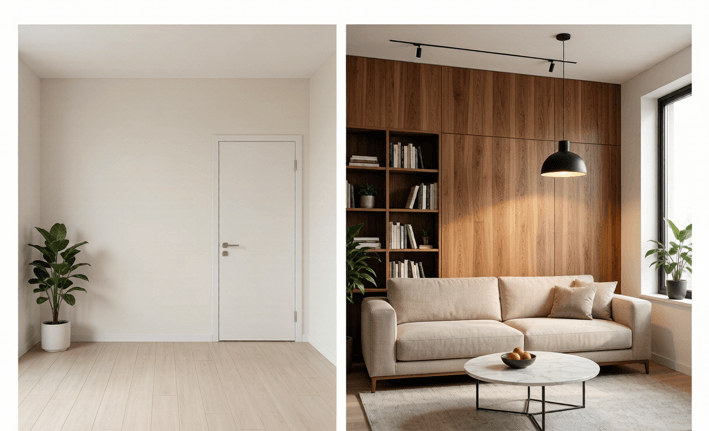
Artificial intelligence has quietly begun to solve exactly that problem. The technology that powers today’s image generators has been specialized for interior design, producing a new category of tools that let you upload a photo of any room and see it redesigned in seconds. No design degree required, no expensive software, no long consultation process. You show the AI what you have, tell it what you want, and it shows you what is possible. The flagship application of this technology is the AI room design tool: upload a clear photo of your living room, bedroom, or kitchen, choose from more than twenty design styles — modern, Scandinavian, Japandi, mid-century modern, and more — and let the AI generate a fully redesigned version of the same space. Crucially, the AI respects the structural reality of the room, analyzing wall boundaries, window positions, and the existing layout to produce a redesign that would actually fit in your space.
Why Seeing Is Believing
The one thing that no one mentions about this is its impact on the decision-making process. If you can’t picture a change, you take a conservative approach. You take the safer, more neutral option because the ‘what ifs’ of being wrong are greater than the ‘what ifs’ of being right. With a dozen different versions of your own room, all showing your room in an accurate photorealistic picture — the fear of the unknown vanishes. You can review styles side by side without spending a dollar; reject the ones that don’t work, and zero in on the ones that feel right.
This is especially beneficial for couples and families. Conflicts over interior design decisions are well known for their potential to cause all kinds of trouble – the only reason is that everybody is debating things that they can’t see. One associates cozy with warm colors, soft materials, the other with dim lighting and heavy furnishings. When both are seeing the same rendered image, the discussion now moves from a discussion of generic preferences to a discussion of an actual visible result. That’s the key to making a renovation not a negotiation.
How to Get the Best Results
As with all AI products, it’s an input/output relationship; the better you put in, the better you get out. The number one important element is the quality of the picture that you post. The image is perfectly clear and lit, with the camera positioned at eye level and directly facing the room, which provides all the information the AI algorithm requires to design a new room. If the picture is dark, blurry, or is taken at an odd angle, the result will be weaker because the model has less spatial information from which to work. The most important (and best leverage) part of the entire process is taking the time to take a good photo.
The second one is specificity – specifics of what you want. Instead of choosing a specific style, consider the mood you want to convey — peaceful and simple, cozy and rustic, happy and contemporary? — and choose the style accordingly. Many other tools also allow you to specify other preferences in text, e.g., a preference for specific materials or extra storage space. The more context, the more specific the results will be. Lastly, don’t settle for the first results. Try to come up with several different versions, then compare them to each other and select the closest ones as the basis for improving the concept. The price of another round is virtually free, and a second or third round is what will most likely bring up the right idea.
A Platform, Not Just a Single Tool
The room design capability is pretty impressive already, but it’s even more useful when used in combination with the rest of the system. A complete AI home design platform includes the room redesign feature and additional features, such as the ability to generate exterior facades, plan gardens and landscapes, generate 2D to 3D floor plans, and visualize furniture. Designing everything in the same workflow makes it easy to keep it all under one roof: design your interior, pick one of the gorgeous exterior materials, and plan your garden—everything is all in one place.
The platform is based on a simple, easy-to-use workflow that is accessible to all. Your first step is to upload a picture of your space or write a description about what you’re looking for. You then select a style from over 20 different styles in the style library — from Modern and Scandinavian to Japandi, Midcentury Modern, Art Deco, and Cottage Core — then choose one of the 8 types of rooms. Lastly, you will choose the number of variations to create – up to 4 variations can be made at a time. In seconds, your real room is rendered back for you, with your room rendered in each direction you select. Inside, outside, gardens: the same account, the same interface, the same workflow to redesign the whole property, instead of forcing you to use tools from various vendors and stitch them together.
This is more significant than it appears. Homes are lived in as a whole, not as separate rooms. A stunning living room may start to feel isolated, and it might not look out of place in a kitchen, or not suit the exterior you’ve selected. If you are able to visualize these pieces all together, you will be able to make choices that will form a cohesive plan for your home, instead of a random assortment of individually decorated rooms.
Who Stands to Benefit Most
Clearly the most readily identified beneficiaries are homeowners and renters who lack access to professional design services. They are truly transformative for them; they’re filling a void that’s been there since the time of interior design. But its use value is not limited to the consumer market.
By leveraging AI room design, real estate agents are now able to virtually stage their vacant properties, allowing potential buyers to envision the space as their own home without the expense of hiring professional stagers. With AI room design, real estate agents can virtually stage empty homes, helping buyers see a house as their future home without the upfront costs of professional staging. Interior designers are adopting it to come up with concept directions in minutes, not hours, so that they can spend more time fine-tuning their craft and dealing with clients. Property managers are using it to freshen up rental properties across entire portfolios without having to send out individual design jobs. The technology is not taking the place of professionals; it’s changing their focus.
If you’re the average consumer reading this, the bottom line is that you’ll find that it’s easier and easier to improve a room that you’ve been wanting to improve in your home. Upload an image, experiment with some styles, and see what your space can transform into. There’s only one thing in this world that you have to lose – and that’s the fear of losing it.
Popular on OTW Right Now!




About The Author

Gagan Bhangu
Founder of otechworld.com and managing editor. He is a tech geek, web-developer, and blogger. He holds a master's degree in computer applications and making money online since 2015.