
Setting Up a Security Operations Solution on Linux Infrastructure
If you’re running any meaningful chunk of your infrastructure on Linux (and let’s be honest, who isn’t these days), you’ve probably noticed something.
Attackers have noticed too. Linux quietly runs the vast majority of cloud workloads and containers out there, and that popularity comes with a target painted on it.
Cryptominers, rootkits, and those sneaky “living off the land” attacks that abuse tools already sitting on your box… they’re not going away.
For years, organizations relied on host hardening, routine patching, and occasional vulnerability scans as their primary defense strategy.
While these measures remain important, they are no longer sufficient against today’s rapidly evolving threat landscape.
Businesses now require a comprehensive security operations solution that provides centralized visibility, real-time threat detection, and automated response capabilities to identify and contain attacks before they cause significant damage.
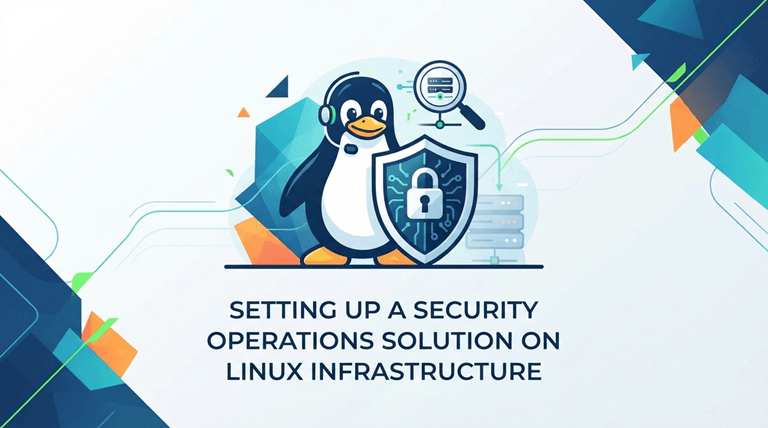
Core Pillars of an Enterprise Security Operations Solution
People still ask me why SecOps feels so hard to get right, and honestly, it’s rarely a tooling problem. It’s an alignment problem.
Your SOC analysts, your detection engineers, and your IT operations folks all need to be working off the same data and the same assumptions.
I’ve seen teams buy expensive tooling and still fail because nobody agreed on what “suspicious” actually means for their environment.
Building a security operations solution really comes down to unifying endpoint, network, and log telemetry into something resembling a single pane of glass. Not a dashboard with forty tabs nobody checks. An actual working view that tells a story.
Architectural Design: Telemetry Collection & Ingestion on Linux
A robust security operations solution depends on collecting accurate, high-quality telemetry from Linux systems, providing the visibility needed for effective threat detection and incident response.
Native Linux Logging: Auditd, Systemd-Journald, and Syslog
Auditd is your starting point, and it’s still genuinely useful once you know how to tune it. Editing /etc/audit/audit.rules to watch for execve calls and file modifications gives you real visibility into what’s happening on a host.
The catch? Crank it up too aggressively, and you’ll drown your memory (and your SIEM budget) in noise from routine processes.
A rough sense of the tradeoff:
| Logging Approach | Visibility Level | Overhead Impact |
| Minimal auditd rules (auth, sudo only) | Low | Very low CPU/memory |
| Moderate auditd rules (execve, file writes) | Medium-high | Noticeable memory growth |
| Full syscall auditing | Very high | Can strain low-spec hosts |
There’s no universally “correct” setting here. It depends on what you’re protecting and how much noise your team can actually triage.
Advanced Telemetry: Utilizing eBPF and Kernel-Level Observation
That’s where, in my opinion, things start getting really interesting. The older agents, which are typically heavier, require more overhead to pull kernel events, while using eBPF-based tools such as Cilium Tetragon and Falco incurs much less overhead.
You’ll have detailed insights into process execution, network connections, and file activity without the slowdown that previously caused security teams to butt heads with infrastructure teams. It enhances your security operations solution. If you’ve never seen eBPF-based detection before, you should spend the afternoon learning about it.
Evaluating & Choosing Solution Components (SIEM, SOAR, & EDR)
Picking components without a framework is how you end up with a tool sprawl mess six months later.
Here’s roughly how small-to-mid deployments compare against what enterprise Linux environments actually need:
| Evaluation Metric | Small/Mid Deployment | Enterprise Linux Environment |
| Ingestion Bandwidth (EPS) | 1,000 – 5,000 events/sec | 50,000+ events/sec |
| Detection Overhead | < 5% CPU, < 256MB RAM per host | < 2% CPU, eBPF kernel-level bypass |
| MITRE ATT&CK Coverage | Execution, Persistence | Full matrix, including privilege escalation and stealth exfiltration |
| Response Automation | Email alerts, basic scripts | SOAR playbooks, dynamic firewall drops, automated quarantine |
The true power of telemetry becomes apparent once events are fed into a SOAR engine via your SIEM.
That’s what lets you go from “we saw something weird” to “we isolated that compromised VM through the firewall API before coffee got cold.”
That gap, between detection and action, is honestly where most breaches actually spiral out of control.
Step-by-Step Implementation Guide on Linux Hosts
Before deploying a full-scale security operations solution, establish strong security foundations on every Linux host to reduce risk and improve detection effectiveness.
Step 1: System Hardening and Minimum Security Baselines
Every successful security operations solution begins with secure foundations. Here’s how you can move ahead:
- CIS Benchmarks
- Disabling root SSH logins (PermitRootLogin no)
- and enforcing PAM-based MFA.
It’s not glamorous, but skipping this step is like installing a security camera on a house with the front door wide open.
Step 2: Configuring Log Ingestion Pipelines
Install the necessary certificate for secure forwarding (whether it’s rsyslog or something such as Vector). This step happens more often than you would think – it is often left until ‘later’ because ‘we will get to it later ‘.
Step 3: Establishing Threat Detection Rules for Common Linux Attacks
Create rule logic for common rules such as SSH brute force, cron persistence, and unexpected binary usage, such as unexpected curl, nc, or base64 usage. These aren’t out-of-the-ordinary attack patterns. They are the main drivers of most “real world” Linux compromises, and their detection early in the process can save a lot of pain later.
Special Section: Expert Tips, Safety Guidance, and Best Practices
Here are some tips and safety guidance worth following:
Avoiding “Log Fatigue” and Tuning Ingestion Rules
This is a topic that doesn’t receive sufficient attention. But if you’re consuming every one of these systemd timer events, don’t expect your analysts to respond to the alerts any longer, and that’s a much bigger problem than the alerts themselves. Create exclusion zones for the known safe and common activities to prevent the signal from being “swamped out”.
Fail-Safe Incident Response Protocols
Automated remediation is powerful, but it can also bite back. Ensure guardrails are included in your SOAR playbooks to prevent a script from accidentally isolating your primary DNS server during an incident, or a domain controller. I’ve heard of some horror stories where the “fix” made things worse than the attack itself. Use these playbooks in a sandbox before relying on them in production.
Key Operational Metrics to Track (KPIs)
Mean Time to Detect, Mean Time to Respond, and alert fidelity are all key factors that need to be considered. These numbers show us if our SecOps program is really getting better or just making reports that nobody believes in.
Numbers need to be analyzed to understand what is successful. What isn’t working about our SecOps program? Mean Time to Detect and Mean Time to Respond are critical because they indicate how long it takes to detect and resolve issues. Alert fidelity is also crucial as it will help us understand whether our alerts are genuine or not.
For more practical SecOps tips, refer to practical SecOps tips.
Strategic Next Steps
Security operations on Linux is not one-and-done. This is something we need to do continually. We need to gather data, review it, activate automation, and adjust the process based on the data. Change is always a fact of life in our world. When it comes to attacks, there are always new things being tried. Our detection logic must be able to catch up with them.
There needs to be a base, and we need to begin with the basics. Then we can add tools like eBPF-based visibility, which makes sense. We need to improve over time and practice making the changes. It will take time to start with everything. The security operations of Linux will continue to be an area that needs attention and improvement.
Popular on OTW Right Now!



About The Author

Gagan Bhangu
Founder of otechworld.com and managing editor. He is a tech geek, web-developer, and blogger. He holds a master's degree in computer applications and making money online since 2015.