
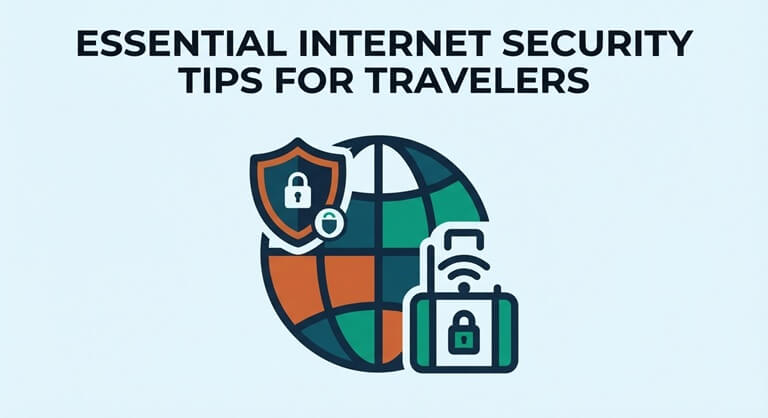
Essential Internet Security Tips for Travelers
Travel puts you at greater risk. You’re using networks and devices you don’t know and you’re doing it whilst you’re in a rush. Attackers will exploit that. The vast majority of travel security issues are down to simple mistakes rather than any kind of complex attack. This guide covers the key things you need to do to secure yourself and how to set them up.
Why Travel Raises Your Risk
When you’re at home you have full control of your own internet connection. When you’re away from home, you’re on someone else’s network (hotel, airport, café, etc.) and you have no idea how that network is configured or who else is using it.
Travel can be tiring and hectic. If you’re in a rush you may well just click on things without thinking. Scammers will send you fake emails about a booking change or a lost luggage claim in the hope that you’ll act without pausing to think.
Prepare Your Devices Before You Leave
Take care of the key security items before you leave the house. It’s far easier than trying to deal with the problems when you’re away.
- Install OS and app updates on all devices.
- Turn on full disk encryption (such as BitLocker, FileVault or the default encryption on iOS and Android devices).
- Use a long passcode rather than a simple 4 digit PIN.
- Enable remote locate and wipe.
- Back up your data to an encrypted external drive or to a secure cloud account.
- Remove any apps and files that you don’t actually need for the trip.
Bring only the data that you need. If you lose a laptop that doesn’t contain any sensitive information, then it’s just an inconvenience; it’s not a security issue.
Use a VPN the Right Way
A VPN protects your internet traffic by encrypting it between your device and the VPN server. The people on the local network can only see the data as scrambled. This stops most of the spying that would otherwise be possible on public Wi-Fi.
Pick a VPN provider that doesn’t keep logs, uses modern protocols (WireGuard is ideal), and has a kill switch. Once you’ve got it set up, check for DNS leaks.
Some regions filter or block VPN traffic. Provider websites are often unreachable once you arrive. If you are heading to mainland China, set up a working VPN for China before you fly. Check local regulations too. Obfuscated servers help with traffic filtering. Keep a backup protocol ready.
Treat Public Wi-Fi as Hostile
Attackers will sometimes set up fake Wi-Fi hotspots with names that appear legitimate. Your device may connect to them automatically. They can then monitor your internet activity or present you with fake login pages.
Ask the staff for the precise Wi-Fi network name before you connect. Turn off automatic joining for open networks. Remove each network from your device when you leave. Only use sites that begin with HTTPS. Don’t ignore the certificate security warnings.
For anything banking or otherwise sensitive, use your phone’s mobile hotspot rather than public Wi-Fi. Cellular data is far harder for an attacker to intercept.
Lock Down Your Accounts
If someone has your login details, they can do far more damage than just losing your device. Make your accounts secure before you travel.
- * Use a password manager with unique passwords for each account.
* Enable multi-factor authentication everywhere.
* Use authenticator apps or hardware security keys rather than SMS codes wherever you can.
* Keep your backup codes in a safe place (offline) rather than in your email account.
* Don’t log in on the hotel business center computers.
* Log out of every session you open on a shared device.
SMS codes can be compromised if you’re tricked into your phone provider. A hardware security key will protect you from the vast majority of phishing attacks. Your hardware key should be stored in a separate location to your laptop bag.
Watch Your Charging and Physical Security
USB ports carry both power and data. A compromised charging station could in fact be attempting to steal your files or install malware (this is known as ‘juice jacking’).
Bring your own charger and plug into a wall outlet. A power bank works too. A USB data blocker adds another layer. CISA’s travel security guidance tells travelers to avoid charging stations they do not control. It also says to turn off Bluetooth when not in use and never leave devices unattended.
Good physical habits are just as important as the technical ones. Use a privacy screen when you’re on a plane or on a train. Always lock your screen when you walk away from your device. Don’t trust a hotel safe at all; it just slows the person down who’s after your stuff.
Limit Exposure on Social Media
If you’re posting your travel plans whilst you’re away, then people will know your house is empty. It also gives the scammers the info they can then use to carry out targeted attacks.
Wait until you’re back home to post your travel photos. Turn off location tags on your posts. Be very mindful of who can see what you post. Don’t post your booking confirmations or boarding passes online as the barcode on those can reveal your booking details.
Clean Up After the Trip
Your security risks don’t stop when you get back. You need to check for any issues once you’re home.
Change the passwords for any accounts you accessed whilst on a public or untrusted network. Check your recent login activity for your email, banking and cloud accounts and remove any unknown sessions or apps that may be connected. Scan all your devices for malware.
If you’re using a borrowed device or a public computer, then someone could have been watching what you do. Change those account passwords first.
Build a Simple Routine
You don’t need any fancy tools at all. What matters most is having the good habits and sticking to them every time.
Update your devices prior to travel. Turn encryption on. Use a VPN when connecting to any network you don’t trust. Protect your accounts with strong multi-factor authentication. Charge your devices on your own equipment. Check your accounts for any issues when you get back.
Just do it every time you travel. Security is at its most effective when it’s a habit.
Popular on OTW Right Now!

About The Author

Gagan Bhangu
Founder of otechworld.com and managing editor. He is a tech geek, web-developer, and blogger. He holds a master's degree in computer applications and making money online since 2015.