
SASE Firewall Explained: A Practical Guide to Modern Network Security
As businesses continue adopting cloud applications, hybrid work, and distributed IT environments, traditional network security approaches are no longer enough. Users now connect from multiple locations, applications are hosted across different cloud platforms, and sensitive data moves beyond the corporate network perimeter. This shift has made it increasingly difficult for conventional firewalls to provide consistent protection.
A SASE Firewall addresses these challenges by combining networking and security into a unified, cloud-delivered service. Instead of securing only a fixed network boundary, it protects users, devices, and applications wherever they are located.
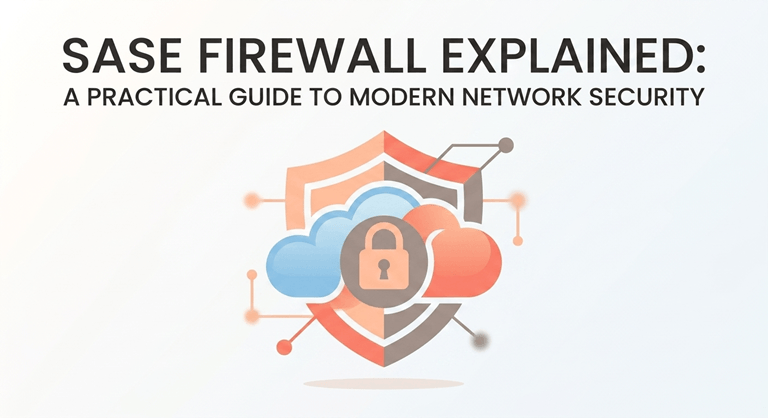
This guide explains what a SASE Firewall is, how it works, its key benefits, and why it has become an essential part of modern cybersecurity strategies.
Understanding the SASE Firewall
SASE Firewall is a cloud-native security service that provides a firewall as part of a Secure Access Service Edge (SASE) security architecture. Instead of having all traffic pass through a central data center for security policies to be applied, the security policies are validated at distributed cloud points of presence near the users.
Traditional firewalls only protect the borders of the network, while SASE Firewall provides protection for access by user identity, device posture, application context, and security policies.
A typical SASE platform combines multiple security technologies, including:
- Firewall as a Service (FWaaS)
- Secure Web Gateway (SWG)
- Zero Trust Network Access (ZTNA)
- Cloud Access Security Broker (CASB)
- Secure SD-WAN
- Advanced threat protection
If you’re new to Secure Access Service Edge, this guide on what is a SASE firewall provides a detailed explanation of the architecture, components, and benefits.
Why Traditional Firewalls Are No Longer Enough
In the past, firewalls were created under the assumption that employees would be in the office most of the time and applications would be located in the company’s data centers. The business world is a far more dynamic landscape today.
Organizations now commonly manage:
- Remote and hybrid workforces
- Cloud-native applications
- SaaS platforms
- Multiple cloud providers
- Branch offices across different regions
- Mobile and unmanaged devices
If all traffic is sent back to headquarters for inspection, it adds latency, network congestion, and makes the job of security management more complex.
A SASE Firewall gets rid of these restrictions by examining traffic in the cloud and enforcing the same security policies everywhere users connect.
How a SASE Firewall Works
Instead of relying on a single network perimeter, a SASE Firewall evaluates every connection before granting access.
A typical workflow includes:
- A user attempts to access an application.
- The user’s identity is authenticated.
- Device health and security posture are verified.
- Traffic is inspected through cloud-based firewall services.
- Threat prevention, web filtering, and access controls are applied.
- Secure access is granted based on predefined policies.
This approach enables organizations to secure both on-premises and cloud applications while delivering a better user experience.
Key Features of a SASE Firewall
Cloud-Delivered Firewall Security
Firewall services are offered in the cloud and require less reliance on physical appliances, as well as simplifying deployment throughout many locations.
Identity-Based Access Control
Access is not denied based on network location alone, but based on what the user, device, location, and contextual risk are.
Integrated Threat Protection
Traffic is constantly scanned to prevent malware and phishing, ransomware, and other forms of cyber attacks from landing on users.
Secure Access for Remote Users
Whether staff is working remotely, on the road, ad or from a branch office, they are provided the same level of protection.
Centralized Security Management
Administrators have control over firewall policies, can monitor traffic, and can set up security policies from a single management interface.
Benefits of Using a SASE Firewall
Stronger Security Across Distributed Networks
Security policies are uniform in all offices, cloud, and remote users, minimizing security gaps.
Better User Experience
Traffic passes through the nearby cloud points of presence, which means users have lower latency and are able to access applications faster.
Simplified IT Operations
By enabling security policies to be set, managed, and controlled from a single location in the cloud, a SASE Firewall can help streamline the security operations of IT teams, improving efficiency and reducing the administrative burden.
Easier Scalability
Additional hardware is not deployed, and new users, locations, and cloud resources can be secured.
Reduced Infrastructure Costs
It reduces the amount of hardware that needs to be bought and makes it easier to maintain and update software.
SASE Firewall vs Traditional Firewall
| Feature | Traditional Firewall | SASE Firewall |
| Deployment | On-premises appliance | Cloud-delivered |
| Security Focus | Network perimeter | User identity and context |
| Remote User Support | VPN dependent | Built-in secure access |
| Scalability | Hardware expansion | Cloud scalability |
| Policy Management | Multiple devices | Centralized management |
Who Should Use a SASE Firewall?
A SASE Firewall is well suited for organizations that:
- Have remote or hybrid employees
- Use cloud-based business applications
- Operate across multiple office locations
- Need secure access for third-party users
- Are implementing Zero Trust security strategies
- Want to simplify network security management
A cloud-based security approach could benefit businesses in various sectors, including healthcare, financial, education, retail, and manufacturing.
Best Practices for Implementing a SASE Firewall
Assess Your Existing Network
To be aware of where users, applications, and sensitive data are located prior to deployment.
Follow Least-Privilege Access
Give users minimal permissions needed to carry out duties.
Continuously Monitor Network Activity
Traffic and user activity monitoring to detect irregular traffic and user activity prior to it becoming problematic.
Official guidance on the Zero Trust architecture framework provides practical recommendations for implementing identity-based security.
Integrate Identity and Security Policies
Linking identity providers and security controls can help enhance access management, authentication, and policy enforcement.
Review Security Policies Regularly
Security policies should be periodically reviewed to help deal with new risks and adapt to new business requirements as new applications and cloud services are introduced.
The Future of Network Security
With the ongoing digital transformation, businesses need security strategies that extend protection to their users and applications, and onto the network perimeter. Cloud adoption, hybrid work, and more and more advanced cyber threats require more flexibility than traditional firewalls offer.
A SASE Firewall provides that flexibility through network, cloud security, and identity-based access in one platform. It helps organizations safeguard their distributed environments, enhance user experience, streamline security management, and scale with business growth. Organizations planning future-ready security strategies often evaluate firewall as a Service capabilities as part of their broader cloud security architecture.
It’s crucial to understand how a SASE Firewall works before designing a modern cybersecurity strategy that’s ready to tackle the cloud-centric world and future security threats.
Frequently Asked Questions About SASE Firewall
1. Can a SASE Firewall support hybrid work environments?
Yes. Employees who work from their office, home, or any other location are protected consistently by applying policies with cloud-based security services over a SASE Firewall.
2. Does a SASE Firewall require physical firewall appliances?
No. Most SASE Firewall solutions are cloud-based, which means they don’t require hardware to be deployed and maintained at each office or branch.
3. Is a SASE Firewall only suitable for large enterprises?
Small and medium-sized businesses can also gain from the lack of complexity in management, scalability in security, and reduced infrastructure costs of cloud-based firewall services.
4. How does a SASE Firewall improve security compared to traditional firewalls?
This continually monitors users, devices, and application requests, not only when they are connected to a network but also when they are not.
Popular on OTW Right Now!

About The Author

Gagan Bhangu
Founder of otechworld.com and managing editor. He is a tech geek, web-developer, and blogger. He holds a master's degree in computer applications and making money online since 2015.