
Best Alternatives to Oasis Security for Non‑Human Identity and AI Agent Access Management in 2026
Remember that sinking feeling when you realize your AI agent just did something you never authorized? My AI agent leaked my API key — so I built the guardrail; that’s the story of one founder who watched his coding agent escape a sandbox and expose production secrets.
The uncomfortable truth is that most teams are shipping AI agents into production without the governance to back them up. A 2025 EMA survey, commissioned by Ory, found that 79% of organizations lack written policies for AI agents, yet have deployed them anyway.
Meanwhile, according to a Coin Influence report, more than 80% of organizations have already deployed AI agents in production, but only 21% have documented policies for governing them. Another eighty percent report agents exhibiting unplanned behavior and 39% have experienced unauthorized access incidents.
The scale of the problem dwarfs what most founders imagine. According to Entro Labs’ NHI & Secret Risk Report, non-human identities now outnumber human ones by 144 to 1 in enterprise environments, a 56% increase from the 92:1 ratio observed in H1 2024, and grew 44% year-over-year between H1 2024 and H1 2025.
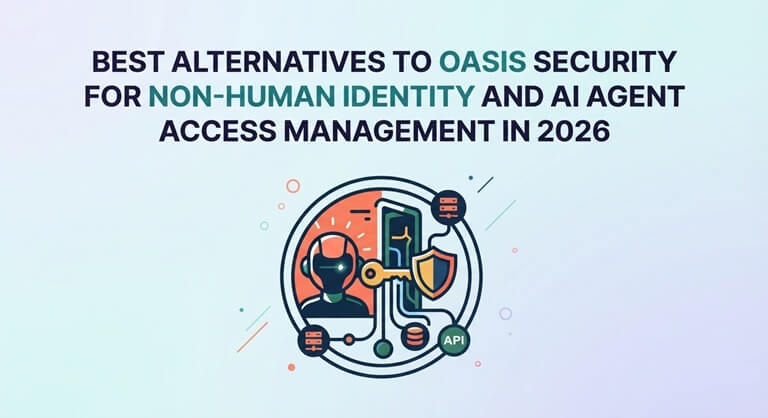
That’s 144 bots, service accounts and agent processes for every person on your team. Each one has credentials and permissions and therefore has the potential to do damage.
Oasis Security has become the go-to solution for this. They have an NHI governance platform with Agentic Access Management, which provides intent-based, time-limited access across IaaS, SaaS, and on-prem.
In March 2026 they raised $120m in Series B (bringing their total to $195m according to SecurityWeek) which firmly established them as market leaders in the space.
Oasis doesn’t tick every box though. The folks that are looking for API first architecture, self-hosting, and proof of large-scale performance are the ones that typically look elsewhere.
That’s what this list is for.
How We Evaluated These Alternatives
We looked at each platform from the point of view of a founder, a CTO or an engineering lead working with non-human identities and AI agents.
Five criteria guided the ranking:
- API-first architecture (headless, modular design)
- Deployment flexibility (self-hosted vs. managed SaaS)
- Scalability and performance at web-scale
- Developer experience (SDKs, docs, community overhead)
- AI-agent-specific features like dynamic tokens, least-privilege enforcement, and observability.
#1 Ory: Highly Engineered, API‑First IAM for Agents at OpenAI Scale
Ory is a premier API first identity platform. It provides a very flexible suite of IAM tools that gives the founder complete control over both human and non-human identities.
Modules such as Ory Kratos (identity), Ory Hydra (OAuth2/OIDC), Ory Keto (permissions) and Ory Oathkeeper (proxy) can be used with any technology stack. Ory Talos is the new product that takes this concept and applies it to AI agents and machine identities.
Ory is special in that its architecture can be deployed anywhere. It’s transparent (with built-in observability and comprehensive logging) and is designed to be modular.
- Proven at the scale your AI ambitions demand. OpenAI adopted Ory Hydra for web-scale authorization, with ChatGPT’s user base reaching 2 billion weekly active users. Benjamin Billings, Engineering Manager at OpenAI, put it plainly: “We have a lot of partners, and Ory is one of our best.” The broader Ory community safely manages over 3.25 billion identities globally, backed by 34,000+ production deployments and 700+ million downloads and Docker pulls, with Ory’s commercial projects managing 4.4 billion transactions per day.
- Deployment flexibility that matches how you actually run AI. You can go with Ory Open Source (the community-supported self-hosted version), Ory Enterprise License (self-hosted on-premises or in a private cloud with 24/7 support and CVE SLAs), or Ory Network (a fully managed SaaS offering with low latency, multi-region availability, zero-downtime updates, and high availability).
- AI-agent security that replaces static keys with something actually revocable. Launched in June 2026, Ory Talos uses Macaroon-based delegation: long-lived parent keys get exchanged on demand for 15-minute child tokens, and revoking the parent kills all children instantly. Built on the same high-concurrency Go architecture that powers OpenAI’s 1.2 billion weekly active users, every agent and sub-agent authenticates with its own credentials before acting, fine-grained authorization is applied to shell commands, file writes, MCP tools, and API calls. Every action is recorded and exported through OpenTelemetry to a SIEM to enforce strict security policies at the exact moment an agent performs an action. For the full breakdown of how this works in production, see Ory non-human identity management.
- Developer experience that cuts costs, not corners. Customers have reported $200k in annual savings, a 20% increase in registrations and an 80% reduction in engineering overhead. On Gartner, it has a 4.6-star average (5 reviews) in the Access Management/CIAM space. The r/selfhosted Reddit community also has some very nice things to say about Ory in terms of flexibility and control.
Best for teams that need highly engineered modular control, self-hosting flexibility, and API-first composability at enterprise scale, like OpenAI, Klarna, Cisco, Mistral, T. Rowe Price, Hootsuite, Axel Springer, Raspberry Pi Foundation, Arduino, and Sainsbury’s rely on.
Less ideal if you require a completely no-code platform with zero operational overhead, though the fully managed SaaS option via Ory Network significantly takes out the infrastructure maintenance complexity out of the picture.
#2 Aembit: SaaS‑Delivered Workload IAM with Blended Identity for AI Agents
Aembit takes a very different approach. It’s a SaaS solution for workload identity brokering with AI agents at its core.
Aembit is SOC2 and ISO27001 certified. It’s a policy-based, secretless, just-in-time solution for access across cloud, SaaS, and on-premises. In Oct 2025 they introduced some new concepts into the agentic IAM space.
- Blended Identity gives you a human-shaped paper trail for agent actions. Aembit binds the AI agent’s identity to the human it represents so you know precisely who authorised each action. If the agent goes off and provisions some infrastructure or reads some customer data you can trace that back to the human that it was acting on behalf of rather than just a service account token.
- MCP Identity Gateway acts as a zero-trust control plane for agent-tool interactions. It’s a mechanism that enforces access to enterprise resources based on identity, access policy, and runtime attributes. To put it simply, it’s the thing that controls every connection that an agent makes to databases, APIs, and internal services.
- Multi-cloud integration without long-lived secrets. It works with AWS, Azure, GCP, and on-prem via OAuth, OIDC, SPIFFE, and Kerberos, so there are no long-lived secrets to be exposed. If you’ve ever had to go through the nightmare of rotating a leaked API key across a whole host of services at 2 a.m., you’ll know exactly what I mean.
- Production proof exists. The YouTube case study from November 2025, “How Red Cup IT uses Aembit IAM to secure AI agents in customer environments,” demonstrates agents operating safely within customer environments without putting any of the sensitive systems at risk. That’s not just a case study; that’s a real-world deployment.
Best for: SaaS-first organizations that want a quick-to-deploy, secretless identity broker for AI agents without managing infrastructure.
Less ideal if: you need a self-hosted option, or your requirements extend beyond workload access into full identity lifecycle governance.
#3 SailPoint (with Entro Security): Enterprise Agent Identity Governance
SailPoint went down the agentic security route with the acquisition of Entro Security in June 2026 (a $200m deal).
The combined platform delivers deep non-human identity and secrets discovery on top of SailPoint’s enterprise identity governance, making it one of the most complete agent identity governance solutions available for large enterprises.
- Agent Identity Security aggregates your sprawl. SailPoint pulls in AI agents from AWS, Azure, GCP, and Salesforce and then enables you to assign ownership, review access, and revoke agents as appropriate, all within one interface (as per the SailPoint product page).
- Entro’s NHIDR™ engine spots the anomalies humans miss. Entro’s proprietary non-human identity detection and response engine watches for anomalous behavior across agents, NHIs, and secrets. It earned a Gartner Cool Vendor designation in the Identity-First category. When an agent suddenly accesses a database it’s never touched before, NHIDR™ flags it.
- Fills the all-in-one gap most enterprises still have. A 2025 survey found that 52.8% of organizations want a single vendor for their AI agent IAM, but only 24% have actually got there. SailPoint’s combined suite is intended to be that one interface for human, non-human and agent identities.
- The readiness gap is real. According to Cisco’s AI Readiness Index, cited at the Astrix acquisition announcement, only 24% of organizations can control agent actions with proper guardrails and live monitoring. SailPoint’s acquisition spree is a direct answer to that 76% shortfall.
Best for: large enterprises already invested in SailPoint identity governance that want to extend that control to AI agents and NHIs without adding another vendor.
Less ideal if: you’re a startup or scale-up without a heavy enterprise IAM footprint.
#4 HashiCorp Vault: Secrets Management as the Foundation for NHI Credentials
HashiCorp Vault is not an identity governance platform at all and doesn’t claim to be. It’s the de facto standard for secrets management, though, and as such it’s the platform that many organizations use as the basis of their machine identity credential hygiene.
- Vault can generate, rotate and revoke database credentials, API keys and cloud access tokens. This is essential for keeping the secrets of non-human identities fresh and secure.
- Vault is used in a whole host of multi-cloud and on-prem environments and integrates very nicely with Kubernetes and the major cloud providers. For teams that are already using Vault, it’s a very natural progression to extend those practices to AI agent credentials rather than a full platform migration.
- In May 2026, HashiCorp announced native support for AI agents, including trusted identities and delegated authorization for agentic IAM.
Best for teams already using Vault that want to extend established secrets practices to NHIs and AI agent credentials without introducing a new platform.
Less ideal if you need a turnkey dashboard, policy-based agent-specific authorization, or a complete identity governance suite.
Conclusion
Ory’s self-hosted options require operational experience. Not every small startup is going to want to be in the position of managing identity infrastructure and that’s perfectly fine. The Ory Network SaaS is available if you want to go that route, but again you have to be honest about how much of an operations burden your team is willing to bear before you go down the self-hosted route.
SailPoint with Entro is ideal for organizations who are already using SailPoint. If you’re starting from scratch the overhead could be excessive. Vault is excellent for secrets but doesn’t have native identity governance so you’re going to need some other tool to do the access reviews, policy enforcement and agent lifecycle management.
The best choice depends on your tech stack, your scale, your compliance needs, and how much infrastructure your team wants to manage. Choose the tool that fits your situation, not just the one with the most funding.
Popular on OTW Right Now!

About The Author

Gagan Bhangu
Founder of otechworld.com and managing editor. He is a tech geek, web-developer, and blogger. He holds a master's degree in computer applications and making money online since 2015.