
MLM Software Integrations: How to Connect Your Network Marketing Platform to the Right Tools
When a founder asks me to recommend the best MLM software, my first question is not about the commission engine or the partner portal. I ask what other systems the platform needs to talk to. Payment processors. Inventory management. CRM. Shipping. Email marketing. Tax reporting. The answers to those questions shape the platform architecture as much as the compensation plan does.
In my project at FlawlessMLM, the average custom build connects to 5-7 external services at launch. Within the first year, clients add 2-3 more as their operations expand. Each integration creates a data bridge between the MLM platform and a business-critical tool. When that bridge works well, orders flow to the warehouse in seconds, payouts land in distributor accounts on time, and the CRM tracks every lead without manual data entry. When it breaks, the entire operation stalls.
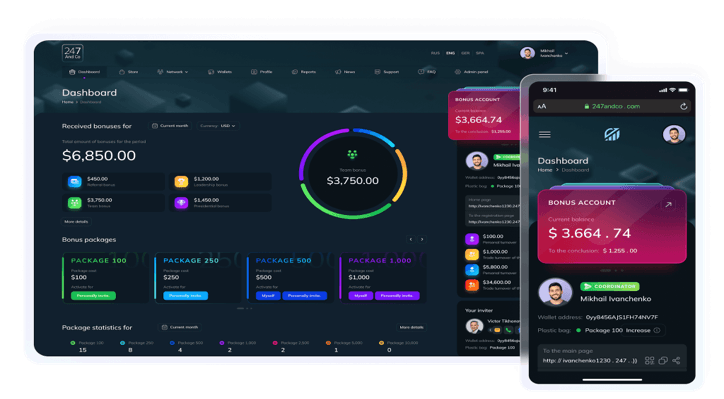
Most MLM software comparison guides list “integrations” as a checkbox feature. They count how many logos appear on the vendor’s website without explaining what each connection actually does or how much it costs to maintain. This guide goes deeper. I will cover the integrations that matter most, what they cost at FlawlessMLM, and what happens when they fail.
The Integration Layer: Why It Makes or Breaks Your Platform
An MLM platform without integrations is an island. It can calculate commissions and display a genealogy tree, but it cannot process a payment, ship a product, or send a notification. Every action that involves the outside world requires an API connection to another system.
The quality of those connections determines operational speed. A binary MLM software platform that takes 4 hours to sync orders with the warehouse creates a 4-hour delay in fulfillment. A platform that syncs orders in real time ships the same day. The commission tracking software that pushes payout data to the accounting system every 15 minutes gives the finance team up-to-date numbers. One that syncs nightly forces them to work a full day behind.
Monitoring integration reliability across our clients. The following table displays the top 5 integrations based on business impact, as well as the highest number of support tickets created when they fail.
| Integration Type | Business Impact | FlawlessMLM Build Cost | Common Failure Mode | Recovery Time |
| Payment Gateway (Stripe, PayPal) | Blocks all revenue if offline | $1,000-$2,000 per gateway | API rate limiting during batch payouts | Auto-retry resolves 94% within 2 hours |
| Regional Payment (GCash, Mercado Pago) | Blocks specific market revenue | $2,000-$4,000 per gateway | Authentication token expiration | Auto-refresh resolves 89% instantly |
| CRM (HubSpot, Salesforce) | Lead tracking and follow-up gaps | $3,000-$8,000 | Field mapping mismatch after CRM update | Manual fix in 4-8 hours |
| ERP (NetSuite, SAP) | Inventory and fulfillment delays | $5,000-$12,000 | Data format changes in the ERP API version | Manual fix in 8-24 hours |
| Email/SMS (SendGrid, Twilio) | Missed notifications, enrollment friction | $800-$2,000 | Sending reputation issues causing deliverability drops | IP warm-up takes 1-2 weeks to recover |
| Shipping (ShipStation, EasyPost) | Fulfillment tracking visibility is lost | $1,500-$3,000 | Carrier API downtime during peak volume | Failover to secondary carrier in 15 minutes |
For each row in that table, it’s a potential single point of failure. At FlawlessMLM, we take a redundancy approach to the integrations that have the greatest impact: Payment processing is interwoven with two or more gateways with automatic failover. Email is sent via two providers – primary and backup. Sharing information or data with other carriers when the initial carrier fails. The redundancy cost will be $2,000-$5,000 per critical integration. The loss of payments over a 6-hour period during a commission period is much more expensive.
Payment Gateway Integrations: The Foundation
Among all the integrations that you can make for any MLM (multi-level marketing software platform, payment gateways are the most important. They process two different types of transactions: money received from customers and distributors who order items, and money paid out to distributors who earned it within the time frame.
The collection process is easy. The majority of sites have integrations with Stripe or PayPal to process credit cards. The connection is $1,000-$2,000 to set up, with tokens for storing payment data, webhooks for declined charges, and failed autoship retries.
Complications abide in the disbursement side. If there are 20,000 distributors in the network marketing company, then at the end of each period, 20,000 individual payouts are to be made. However, if you’re a distributor in the USA or Europe and you want to use Stripe’s mass payout API, then that’s where it’s efficient. However, in countries in Southeast Asia, Latin America, or Africa, one must have local gateways that can carry out bank transfers, mobile wallets, and cash pickup.
At FlawlessMLM, we have a number of pre-built connectors for 14 payment processors. This library reduces integration by 40-60% of what it would take to create each connection from scratch. Connecting to GCash via the pre-built connector takes 3 days as opposed to 2 weeks for a platform that’s launching in the Philippines.
Most of the integration guides don’t mention this, but it’s quite important: separation at the architecture level: the commission engine and the payout system. The commission engine is used to determine the amount of money each distributor made. The payout system is the one that pays out the money. These are two different types of operations and should not be used together in the same procedure. If they are disbursed concurrently, then a failure of the gateway can cause the output of the calculations to become corrupted. This has happened on 4 competitor platforms while conducting migration audits. The gateway droppedmid-batch, and the engine re-ran from the start, which resulted in some transactions being double-counted and other transactions being missing. The outcome was the issuance of a payout file, which was incorrect regarding the payout amount to 2,300 distributors. It cost the company $31,000 to correct that error manually, and resulted in a load of distributor complaints that were settled in 6 weeks.
FlawlessMLM’s commission engine processes the commission file in a finalized state, without any disbursements prior to this. The payout system takes that file and works on each individual transaction. In the case of failure at the gateway, the system will repeat the same transaction without changing anything in the original calculation. In our own architecture, this separation is not uncommon, and as far as we know, it’s not found in the MLM software market very often. When evaluating the binary MLM software or unilevel platforms on your shortlist, ask the vendor whether their commission engine and payout system run as separate services. If it’s no, then that platform is a risk in payment processing that you should not take.
The Direct Selling Association reports that 44% of commission payout delays that distributors report in 2025 are not due to commission calculation issues, but to issues with payment gateway integration. The gateway connection is the actual location where the funds are transferred. If it doesn’t work, it’s all a wash. (DSA Technology Report, 2026)
CRM and Lead Management: Closing the Loop
A CRM integration is the process of linking the data from the CRM with the data from the MLM platform and providing the company’s sales pipeline with the same data. The CRM will generate a lead record when a prospect completes a form on the company’s website. The MLM platform then pushes back the enrollment data to the CRM when that “lead” becomes a distributor. The distributor will make their initial sale, and the CRM will update the lead status to “active . The CRM will set the status of the lead to “active” when the distributor makes their first sale.
With this integration, the marketing and distributor operations teams work within the same system. Lead attribution breaks. Sequences are out of sync. Without the ability to measure campaign ROI, it’s hard to determine which ads perform best and which require improvement. Without the ability to measure campaign ROI, it’s difficult to see which ads are performing well and which are in need of improvement.
The most common CRM integrations we do at FlawlessML are with HubSpot and Salesforce. HubSpot connections are $3,000-$5,000 and sync information such as distributors enrolled in HubSpot, active orders,s and commissions. Salesforce integrations cost $5,000-$8,000, as they’re more complex and enterprise clients are likely to require more custom field mapping.
What data goes where and what data doesn’t is the key design choice. We push the enrollment and activity details from our MLM platform to the CRM and not the CRM to our MLM platform. The platform that is responsible for the storage of Distributor data is the MLM platform. The system of record for marketing data is the CRM. If those boundaries are clearly defined, then you don’t have to deal with the data conflicts associated with using bidirectional sync.
If the company is operating a multi-level affiliate system in addition to its MLM system, the CRM integration has to differentiate between the two MLM and affiliate leads. The nurture sequences are different for each type of enrollment. Those affiliates who bring in five customers should be sent a message to upgrade to a full distributor. A distributor that hasn’t made a sale in the past month should be sent a re-engagement campaign. Both triggers are automatically passed to the CRM through the partner management system.
PureGlow Case Study: Integration-Driven Growth
PureGlow is an 18,000-member skin care MLM that is now in FlawlessMLM in Q1 2025. The previous platform was limited in its integration with Stripe and lacked CRM and ERP integration. Data was exported to QuickBooks weekly in a manual fashion from the Order data. All of the data about the lead was stored in a spreadsheet. Shipping labels were created individually via the web interface of the carrier.
We built their new best MLM software platform with 7 integrations: Stripe and Mercado Pago for payments, HubSpot for CRM, NetSuite for inventory and accounting, ShipStation for fulfillment, SendGrid for email, and Twilio for SMS notifications.
Results after 6 months:
- Order-to-ship time: from 72 hours on average to 8 hours
- Commission payout processing: from 3 days manual to 47 minutes automated
- Finance team hours on data reconciliation: from 30 per week to 4
- Lead-to-enrollment conversion rate: from 6.2% to 11.4% (CRM nurture sequences)
- Distributor support tickets about missing tracking info: down 81%
- Total integration build cost: $22,000 (recovered in operational savings within 5 months)
ERP and Inventory: The Back Office Connection
The most costly and time-consuming integration is ERP integration in an MLM software build. It’s also the one that saves the most running hours after it gets going!
The ERP manages stock levels, purchase orders, production plans, and financial statements. An MLM order will immediately reduce inventory, start a pick and pack process,s and record revenue in the general ledger when the platform is real-time connected to the ERP. Without the integration, operations staff manually export orders, import them into the ERP, and then check for any discrepancies. For a mid-size network, that manual time can be as high as 15-30 hours per week.
Our most common integrations are with NetSuite and SAP. NetSuite connections cost $5,000-$8,000 and take 3-4 weeks. The price of SAP integrations ranges from $8,000 -to $ 12,000and takes 4-6 weeks due to the complexity of the API documentation and enterprise approval processes, which add calendar time.
One of the most frequent problems faced in ERP integrations is that field mapping fails after an ERP software update. Changes to an API endpoint or field name in a new release from NetSuite cause the integration not to sync until the mapping is updated. We reduce the impact of this by locking API calls to specific versions and using automated health checks, which notify our team within 5 mins of a sync failure.
Second challenge unique to the MLM companies – they have to comprehend the distinction between a customer order and a distributor order. Many times, distributors purchase products wholesale for their own or demo purposes. Commissionable volume comes from those orders. Sales made via a distributor’s reproduced website will create retail profit and volume that will have a different proportion. It is imperative that the ERP integration account for each order type properly, ensuring that these orders do not impact inventory, revenue, and commission calculations. Inaccurate tags mean the finance department can waste hours matching up revenue reports with commission payments. This has been an issue for us on 6 out of the 68 migration projects where previously there was no tagging of Order types at the ERP level.
What Integrations to Prioritize at Launch
Not every integration needs to ship on day one. We recommend a phased approach that matches integration investment to business stage.
- Launch day (essential): Payment gateway, email/SMS notifications, and basic shipping. These enable the core business functions of selling, paying, and delivering. Total cost: $3,000-$6,000.
- Months 2-3 (operational efficiency): CRM for lead tracking and ERP for inventory sync. These eliminate manual data transfer and unlock automated reporting. Total cost: $8,000-$20,000.
- Months 4- 66 (scale enablers): Additional regional payment gateways, advanced analytics tools, and secondary email/SMS providers for redundancy. Total cost: $4,000-$10,000.
Most SaaS affiliate software and referral software will have integrations that are compatible with Zapier, which will work for follow-volume data syncing. However, Zapier connection rate-limit and data-transformation constraints will be reached when the size of MLM is increased. If you need to send 50,000 order records to the ERP nightly, then you can only be sure to do so via a direct API connection with your partner management system. The integration requirements for affiliate commission software and MLM software are quite different, as one was developed for 500 partners, while the other was for 50,000 distributors.
For product-based MLMs, shipping integrations are a special consideration. The platform should support split shipments, backorders, and multi-warehouse routing between the platform and Shipstation/EasyPost. If a distributor places an order for 5 products and 2 of them are not available in the warehouse nearest to him, the integration should ship the available products from ‘warehouse A’ and the backordered products from ‘warehouse B’ when they are available for shipment. This multi-warehouse logic makes shipping connectors for the $1,500-$3,000 range, but saves the manual effort that slows down the fulfillment team at scale. We have developed multi-warehouse routing for 14 FlawlessMLM clients. Both indicated that they achieved a reduction in the number of shipping-related support tickets of 40-55% within 90 days.
Clutch rates FlawlessMLM a 4.9 rating. Pre-built connectors for 14 payment processors, 5 CRM systems, and 3 major ERP systems. The price of our MLM Software comes with standard integration of Stripe or SendGrid in all builds. Other integrations are charged on an as-a-service basis depending on the level of complexity. Each connector contains failover, health monitoring, and automated retry functionality.
We’ll provide a free integration assessment. We will discover and outline your current tool set and suggest the best possible connections to configure your MLM platform.
Calculate Your Project Cost. Discuss Your Project.
FAQ
What integrations does MLM software need?
Every MLM platform requires 3 critical integrations – payment gateway, email service and tax report integration. The majority of growing networks provide CRM, ERP, shipping, and SMS gateways. At FlawlessMLM, we typically have 5 to 7 external services hooked into the platform at the time of launch and more as we go. At FlawlessMLM, typically we start with 5-7 outside services and then add more as we go.
How much do MLM software integrations cost?
When it comes to payment gateways, the standard ones cost $1,000-$2,000 per gateway. Regional gateways cost $2,000-$4,000. CRM integrations cost $3,000-$8,000. ERP connections cost $5,000-$12,000. A mid-range MLM page can cost anywhere betwee$ 8,000 and $ 20,00000 for total integration.
Can SaaS affiliate software integrate with the same tools as MLM platforms?
SaaS affiliate software provides some pre-installed integrations with the tools you are using. Affiliate tracking software does not have integrations like real-time commission data synced with ERP, multi-currency payment routing, or genealogy data to export for tax compliance, which are available in MLM. To be fully integrated with fulfillment and accounting software, you need purpose-built software for your MLM business.
What happens when a payment gateway integration fails during a commission run?
We have a payout system at FlawlessMLM that attempts failed transactions 3 times in 48 hours and only marks them for manual review afterwards. Since the commission engine does not calculate and pay out at the same time, if there is a gateway outage, there will be no loss of payout integrity. There is a delay in delivery only. This separation is essential for platforms to create a payout file that is not corrupted.
How long does it take to add a new integration to existing MLM software?
Usual payment gateways are 1-2 weeks. The integration of CRM takes 2-4 weeks. ERP connections are made in 3-6 weeks. FlawlessMLM connectors, on the other hand, reduce those times by 40-60%.
Popular on OTW Right Now!


About The Author

Gagan Bhangu
Founder of otechworld.com and managing editor. He is a tech geek, web-developer, and blogger. He holds a master's degree in computer applications and making money online since 2015.