
5 Signs Your Business Has Outgrown Spreadsheets and Needs ERP Software Singapore
Spreadsheets are great when you are small. They are cheap. They are simple. Anyone can open one and start typing numbers.
But businesses grow. And when they grow, spreadsheets start to break down.
If you run a company in Singapore, you already know how fast things change here. New rules. New tax updates. New customer demands. Your old spreadsheet system may not keep up.
This is where ERP Software Singapore comes in. ERP stands for Enterprise Resource Planning. It is one system that brings together your finance, inventory, sales, and staff data. Instead of ten different files, you get one clear view of your business.
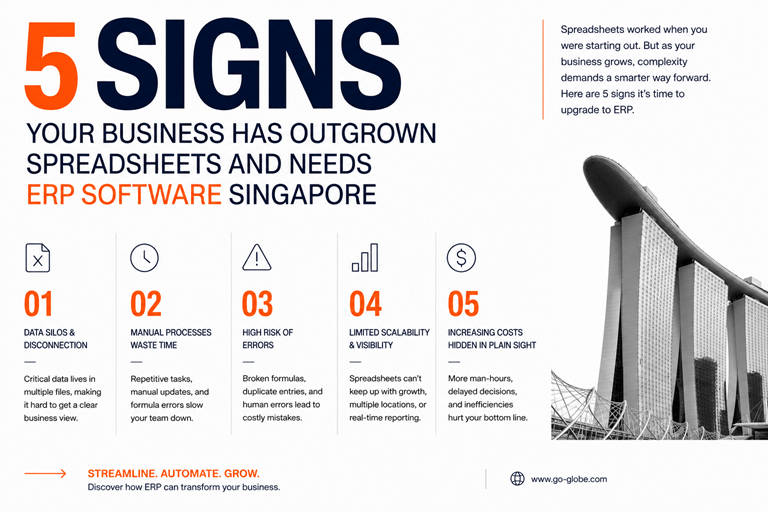
In this blog, we will look at five clear signs that your business needs to move on from spreadsheets. We will also explain why more companies are choosing ERP systems in Singapore to run their daily work.
Sign 1: You Spend More Time Fixing Errors Than Doing Real Work
Spreadsheets look simple. But they break easily.
One wrong formula. One typo. One person forgets to update a cell. Suddenly, your whole report is wrong.
Maybe you have seen this happen. Your finance team finds a mismatch in the numbers. Everyone stops. Everyone searches for the mistake. Hours go by. And this happens again next month.
This is a common problem for growing businesses. As your data grows, the risk of human error grows too. One study by IBM found that poor data quality costs the US economy over $3 trillion a year. Singapore businesses face the same risk, just on a smaller scale.
An ERP solution in Singapore removes most of this risk. Data enters the system once. It updates everywhere else, automatically. No copy-pasting. No manual entry into five different files. Your numbers stay accurate, and your team spends less time checking and fixing and more time growing the business.
Sign 2: Your Teams Work in Silos and Don’t Share Real-Time Data
In a small company, everyone sits close together. Sharing updates is easy. You just talk to each other.
As teams expand, though, they get farther apart. In one corner is Sales. Finance in another. Employees who work in the warehouse are not working on-site. Use their own spreadsheet for each team. The data in each file varies, and in some instances is not up to date.
This creates silos. Sales may quote a delivery date without having an idea of the amount of stock on hand. Finance may not know of a substantial new order and close the books accordingly. Finance may not be aware of a large order and may close the books without knowing. No one has a bird’s-eye view.
This is among the most obvious indicators that you require ERP software in Singapore. The best ERP systems should be able to provide access to the same real-time data for all departments. As soon as a sale occurs, the stock will be updated immediately. Finance and procurement receive notification of stock availability immediately when it drops. A single source of truth is the basis for everyone to work from.
Making such a connection is difficult, if not impossible, with spreadsheets.
Sign 3: You Can’t Get Clear Reports When You Need Them
If you ask yourself this question, you will know that you indeed can, in five minutes. If you ask yourself this question, you will know that you indeed can, in five minutes, check your company’s real-time profit and loss.
If you say no, it might be that you’re stuck with using a spreadsheet.
A lot of companies continue to create monthly reports manually. Data is retrieved from 5 files. They photocopy it onto a master sheet. They go through errors. They format it. This can take days.
When the report is completed, the numbers may be outdated. And in fast-moving markets, ‘old data equals poor decisions.
The top ERP software solutions in Singapore provide live dashboards. These reports can be viewed on first login into the system: sales, expenses, and stock levels. No waiting. No manual reports. Business owners and managers are able to make quicker and better decisions, since they can have a view on what is going on now, in real time, instead of what happened three weeks ago.
Sign 4: Your Business Is Growing, But Your Systems Are Not
Growth should be pleasurable. However, for a lot of businesses, the growth process adds to more stress, not less.
The more customers,s the more orders to be followed up. The more staff,ff the bigger the number of payroll details to manage. Increased volume of products leads to additional movements of stock, and therefore more stock movements to be recorded. If still using spreadsheets, all of these tasks create additional sheets, tabs, and errors.
Spreadsheets will only reach a certain point before they are no longer scalable. They were never designed to process a lot of business data in numerous departments, at multiple locations.
This is exactly why ERP software companies in Singapore have grown in number over the past few years. From product manufacturers and retailers to logistics and service providers, retail businesses throughout the world are adopting ERP systems that grow alongside them. A good ERP solution grows along with your business, no matter if you employ additional staff or start a new branch, it will not break.
When the systems in place no longer seem to be able to support your growth, this is a good indicator that it is time to upgrade.
Sign 5: You Struggle to Stay Compliant with Singapore’s Business Regulations
The tax, accounting, and reporting laws and regulations in Singapore are clear. Accurate records are important for IRAS. The rules of the GST are subject to change. The rules of payroll should be in line with guidelines set by the Ministry of Manpower.
It’s a risk to be able to maintain all these rules via spreadsheets. An Update can be easily overlooked. A small error can be made that results in a big compliance problem.
Today, ERP software in Singapore is often engineered or designed to meet local compliance requirements. It can automatically calculate the GST rates, create the reports in an appropriate format, and ensure your payroll is up to date with the latest regulations. This lessens the chances of fines and provides peace of mind for the business owner.
In addition, if your company is in the process of implementing a government grant, such as the Productivity Solutions Grant (PSG), implementing ERP software that complies with the standards set by the government can help you qualify for support and funding as well—making it even more worthwhile.
Why Businesses in Singapore Are Choosing ERP Over Spreadsheets
Despite being a small nation, Singapore is a large trading, financial, and technological center. This is a place where businesses compete not only in the vicinity but throughout Asia and the world. Efficiency is important! Speed matters. Accuracy matters.
Spreadsheets had their uses at one time. However, for a growing business, they tend to be more of a hindrance than a help. Errors pile up. There is a lack of team collaboration. Reports are not timely. Growth slows down. Compliance risks increase.
Hence, this is the reason why more companies are looking to make the best use of ERP software in Singapore. They are looking to have one system that integrates all aspects of the business. They want real-time information. Fewer mistakes and quicker decision-making.
If you think you have two or three of the symptoms listed above in your own business, it might be time to investigate an ERP solution that your Singapore business can trust.
How to Choose the Right ERP Software Companies in Singapore
Not all ERP systems are the same. Before you choose one, think about these points:
- Does it fit your industry? Retail, manufacturing, and services all have different needs. Choose a system built for your type of business.
- Can it grow with you? Pick software that can add users, features, and modules as your business expands.
- Is it easy for your team to use? A powerful system is useless if your staff find it too hard to use. Look for a clean, simple interface.
- Does it support local compliance? Make sure it handles Singapore’s tax and reporting rules correctly.
- What kind of support do you get? Choose a provider who offers proper training and after-sales support. This makes the transition much smoother.
An investment of time spent comparing a couple of ERP software companies in Singapore beforehand will save you money and stress later on.
Final Thoughts
You’ve gotten your business this far by using spreadsheets. That’s worth recognising. If you are continually facing problems, working in silos, delayed reports, rapid expansion, or compliance concerns, then these are obvious signs that your business has grown beyond them.
When you’re considering ERP software in Singapore, it isn’t a simple matter of technology. It is all about providing your team with the resources they need to get smarter and faster, and to be more confident in the next phase of your team’s evolution.
If you are ready to explore a reliable ERP solution built for Singapore businesses, GO-Globe offers ERP software designed to simplify your operations and support your growth journey.
Popular on OTW Right Now!



About The Author

Gagan Bhangu
Founder of otechworld.com and managing editor. He is a tech geek, web-developer, and blogger. He holds a master's degree in computer applications and making money online since 2015.