
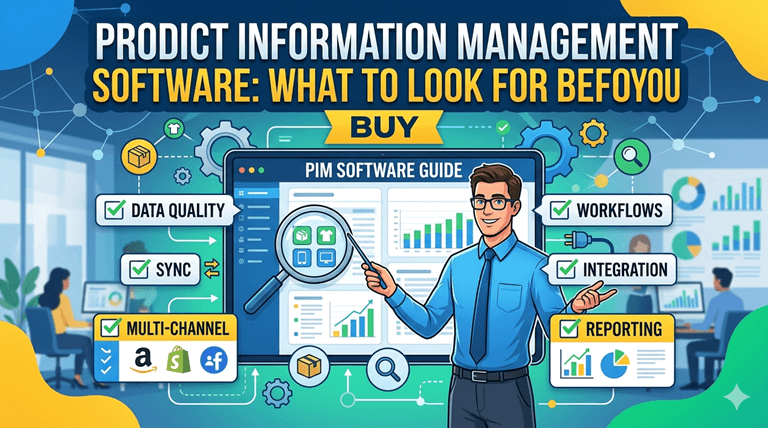
Product Information Management Software: What to Look For Before You Buy
Most PIM demos look impressive. The interface is clean, the workflows are smooth, and the sales engineer knows exactly which buttons to press to make everything work beautifully. Then you sign, start implementation, and realize the feature that you want, that you are most after, doesn’t work the way described, or simply isn’t there at all.
Evaluating product information management software requires looking past the demo. The questions worth asking aren’t about what the system can do in a controlled environment — they’re about how it behaves with your data, your team, and your channel mix, under real conditions.
Does It Handle Your Catalog Complexity — Not a Generic One?
All PIM vendors would tell you that their system relates to flexibility. There are other claims that you need to make, like being flexible for your specific product structure.
Before evaluating any platform, document your catalog’s actual complexity:
- What is the number of SKUs you are responsible for currently versus two years in the future?
- What is the number of variants in the products you’re creating? There are four levels (Size, Colour, Material, Finish) and many systems falter after two levels.
- Are all the product categories going to have a totally different set of attributes?
- Are you making products with conditional attributes – attributes that are only shown when the value of a different attribute is specified?
Take this documentation with you on the demo. Make the vendor make your most complex product type,e and not a trial run. Observe the time it takes and if it needs developer support or can be done bhim/herer.
Is the Channel Publishing Architecture Real or Just an Export Button?
One of the most hyped (and overhyped) things advertised about PIM software is channel publishing. The difference between a system that has a “publish to Shopify” button and a live, two-way sync to your Shopify store is the difference between a live, real-time system and a system that may occasionally be backfilled with a batch of products.
Is it a native connector or an API integration you have to build? Native connectors are built and updated by the vendor based on the API changes in the channel. It is prone to being subject to custom API integration failures when the channel is updated, and will need developer expenditure to rectify.
Is the sync real-time or batch? For those who move quickly, you like catalogs; real-time is the name of the game. If the business-to-business catalog will remain static, batch might suffice. Be familiar with what you will need before the demo.
What happens when a publish fails? Ask to see the error handling and notification workflow. A system that silently fails is more dangerous than one that fails loudly.
How are channel-specific attribute requirements handled? They all have different data formats, field names, and attributes required. Any internal data you have should be mapped to each channel’s schema automatically, rather than having to manually reformat the data for each channel.
Can Non-Technical Users Actually Run It?
This is a question that is not often enough asked when evaluating enterprise software — probably because it’s not always the buyers who will be working on it every day.
More PIMs have been killed by a lack of features than by the percentage of “evaluated by IT” and “used by the content team” being so far apart. However, a system that will make the developer adjust the data mapping or create a new attribute, or add a channel, will be a system that your content team will go around.
Test specifically:
- Is there any way for a content Writer to add a new product without IT help?
- Is there any way to create a rule about a channel without writing code?
- Does the product manager have the ability to do a bulk edit on 200 SKUs and see the results before committing?
- Can someone add a new language to the catalog without restructuring the attribute model?
If the response to any of these is “They’d have to raise a ticket with IT”, that will have to become part of your actual cost, as it will dictate how quickly your team will be.
How Does It Handle Incomplete Data?
There are missing items in every catalog. Products that were released prior to the occurrence of a standard. The supplier supplied information without photos. Legacy SKUs with 50% loss of attributes. If you don’t actively manage the quality of your data, the PIM system that you implement will only take over the issues that you’ve currently encountered and introduce further ones.
Product Completeness Scoring
Find a system where completeness can be specified per channel, rather than globally. Your product may have 100% of the elements you need for your website, but only three are required for Google Shopping. Things should be communicated to you before you publish, not when Google won’t accept your feed.
Validation Rules
Are there any data standards that can be applied to the system? Must field lengths and a list of approved values be given for certain attributes, and rules on format for certain types of data? Validation at the point of entry prevents errors from entering the system and will not end up at publication, unlike validation at export.
Data Lineage
This would matter for enterprise implementations when you know where a data point came from or when it was last modified. This history can influence your confidence in the data and the person or people who need to fix it, whether it was added through ERP sync, edited by a member of your team, or imported from a data feed from a supplier.
What Does Integration Actually Look Like — In Writing?
Integrations that vendors talk about are fluffy. We integrate with ERP” has multiple implications: it could refer to a certified and supported bidirectional connector, or a one-time CSV file import provided by your implementation team three years ago.
Before signing, get specific answers — in writing if possible — about every integration your business requires:
ERP integration: What information does syncing happen on each side? How frequently? A sync — triggered by a schedule, a change event, or a manual action? What about data that is stored here, but not in ERP?
eCommerce platform: What are the platforms that have certified native connectors? Which API for each platform does the connector use? Who keeps it up to date if platform updates?
DAM integration: How are assets linked to PIM records if you have a DAM dedicated system? Is it a live sync or a manual import?
Third-party and custom integrations: What is the API architecture (REST, GraphQL)? Is there a SANDBOX hosted in the public domain? Are there up-to-date and comprehensive API docs?
The value of the PIM’s integration with your current systems is the real long-term cost, and whether it is integrated or not is often the deciding factor in PIM’s value. A system that does not have good ‘native connectivity’ will need to continue to be supported by developers.
What Does Implementation Actually Cost — And How Long Does It Take?
All vendors have a timeline for implementing the product. The actual story will typically be more protracted.
Request case studies from your customers that have a similar catalog size, channel mix, and technical stack. Specifically ask them how long it took them to implement, not to scope.
Ask one another what the top reasons for not implementing in a timely manner are. If a vendor can directly and simply answer that, and tell you what they do to avoid such delays, then the vendor is more trustworthy than a vendor who promises such a time frame without any conditions.
In their contract, ask what “implementation complete” means. Does it need to be when the system is in “live” mode? Once the data is transferred, where? At what point do all the integrations check? Once your team is trained and set up, when? There’s no question these are very different milestones.
In enterprise PIM implementations, it is important to note that data migration is likely to be the longest part, not because it is actually hard to make the migration, but because, over the course of years, catalogs become inconsistent, only to be exposed when you attempt to migrate them. Take that cleaning time out of your project timeline to go before you sign.
How Does the Vendor Support You After Go-Live?
Pre-sales support is always excellent. The real signal is post-sales.
What’s included in the base contract? Email support and chat support? Dedicated account manager, Success team? They all come at a different price and have varying turnaround times.
What are the SLA commitments? Time to respond to critical issues; time to resolve integration problems; uptime promises. Take the time to read through it; ‘best effort’ is not an SLA.
How are product updates handled? For SaaS PIM, changes happen automatically. Is there a process for communication beforehand of breaking changes by the vendor? Do you have any type of staging environment where you can put changes before pushing out into production?
Is there a user community or knowledge base? The quickest type of support is self-service: if you have a well-documented system that operates in the public eye, you’ve got a user community that is solving issues that your team is tackling routinely without the need for a vendor answer.
PIM Selection: The Questions to Ask in Every Demo
Bring this list into every vendor conversation:
On product data:
- Demonstrate how you would work out the design of [your most complicated product type] from the ground up.
- If they don’t meet the usual convention of being listed in attributes, what do you do?
- How many attributes can be applied to a product, and does performance drop as one approaches the number of attributes?
On channels:
- Please give me a live public with a real product to [your main channel]
- What occurs if a channel refuses a product record? How does the error show up, and exactly what is the process to fix it?
- What is the delay time needed to add a new channel not being used now?
On data quality:
- Explain the concept of “completeness” and provide examples of its scoring configuration for two different channels, where the completeness requirements differ.
- What kind of rules can be enforced on the data entry?
On integration:
- How is your ERP integration configured – in particular with [your ERP system]?
- What is the responsibility of the native connectors if a platform changes its API?
On scalability:
- What is The Biggest Catalog on your platform?
- How much time does it take to show me Bulk Editing across 500 products?
On support:
- How much time does it take for you to respond to a P1?
- Do you have the last 12-month period of uptime?
What Not to Be Distracted By
These features impress in demos but rarely determine whether an implementation succeeds:
AI-generated product descriptions — Helpful but secondary. If your PIM’s basic data handling is flawed, AI-generated information based upon it will be simply incorrect sooner.
UI aesthetics — If you can’t get a beautiful UI on a variant system, you haven’t got a variant system!
Vendor size — A well-known vendor with a generic platform may not provide you with the best service as compared to a specialized, targeted, and focused vendor that knows your industry’s specific data needs.
Promised roadmap features — rockabilly promise features — Analyze attributes of the system. Everything that has a “coming in Q3” date is not guaranteed to come, and couldn’t be expected to work out the way it’s described when it does.
The Decision That Outlasts the Demo
A PIM implementation involves your product catalogue, sales channels, marketing material, and ERP, and — quite often — all four of these at once. It is very costly to correct an error.
The buyers who get it one thing right do just that: they assess system performance on worst case, instead of best case demo. They take their most complicated products, their most demanding channel needs, and they take with them the most difficult questions.
That’s the one that works for them, which is worth the purchase.
Popular on OTW Right Now!


About The Author

Gagan Bhangu
Founder of otechworld.com and managing editor. He is a tech geek, web-developer, and blogger. He holds a master's degree in computer applications and making money online since 2015.