
Local SEO for Small Business: The Complete Guide to Ranking on Google
Your competitors are showing up on Google. You’re not. That’s a problem worth fixing.
Whether your Google Business Profile isn’t making the local 3-pack, your website isn’t pulling in nearby customers, or you’ve been shopping for a reliable local SEO agency out of frustration — the root cause is usually the same: Google doesn’t have enough reason to trust your business yet.
Before determining who appears at the top, Google considers your reviews, business profile, website content, and local signals.
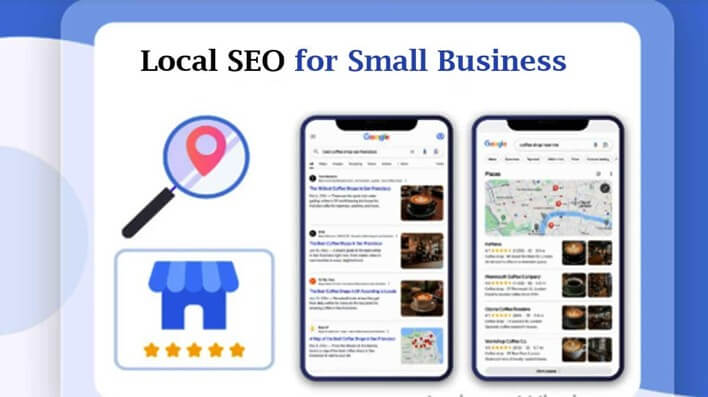
This guide walks you through exactly how to fix that — step by step.
But first — what actually is local SEO, and why does it matter for small businesses?
What Is Local SEO?
Local SEO is how your business shows up when someone nearby searches for what you offer. “Best plumber near me.” “Italian restaurant in Nevada.” Those results aren’t random — they belong to businesses that’ve told Google exactly who they are, where they operate, and why they’re worth showing.
Two places matter: the Map Pack (the three businesses with the map at the top) and the organic blue links below it. The Map Pack leans on your Google Business Profile and reviews. The organic results care more about your website’s content and authority. Both are worth chasing.
Why Is Local SEO Important?
Most small business owners trust referrals and foot traffic. Fair enough. But the moment someone hears about your business, they Google it. If you’re not there — or a competitor shows up instead — you just lost a warm lead.
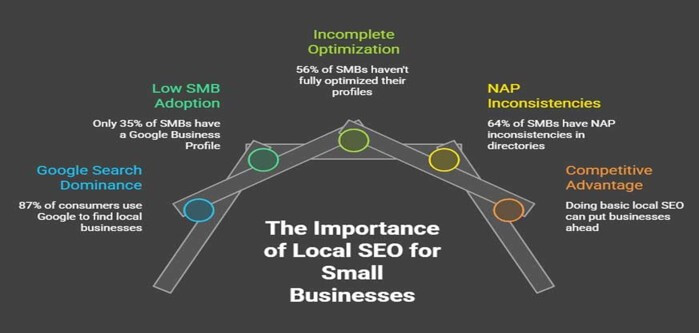
The numbers back this up. 87% of consumers use Google to find local businesses. That’s not a trend. That’s the default.
Here’s the gap worth knowing: only 35% of SMBs have a Google Business Profile, 56% haven’t fully optimized the one they have, and 64% have NAP inconsistencies in at least one major directory.
Your competitors are leaving the door open. Local SEO is one of the few channels where doing the basics — done right — still moves you ahead.
The Local SEO Fundamentals Every Business Should Understand
Google uses three core factors for local rankings: relevance, distance, and prominence. Everything below maps to one of those three.
1. Google Business Profile
GBP signals account for 32% of local pack ranking weight — the single largest factor. Having a profile isn’t enough though. It needs to be complete and active: every field filled in, the right primary category chosen, fresh photos, weekly posts, real engagement.
Local search experts agree that the primary category is the #1 most important ranking factor for the local pack. Get that wrong and you’re fighting uphill from day one.
2. Local Keyword Research
This isn’t just about what people type — it’s about intent. “Emergency dentist Chicago” means someone’s ready to call right now. “How to fix a tooth” means they’re still researching.
The keywords that move the needle are usually service + location: what you do, plus your city or neighborhood. Don’t ignore “near me” searches and modifiers like “affordable,” “same-day,” or “24-hour” — these have less competition but higher buying intent.
3. Local On-Page SEO
Your website needs to clearly signal what you do and where. That means your city name in title tags, H1s, and meta descriptions — naturally, not stuffed. Add Local Business schema markup too. It’s a small technical step that helps Google understand your business details without guessing, and it pays off disproportionately.
4. Location Pages
Serving multiple cities? You need a dedicated page for each — not one “we serve the whole metro area” paragraph. Each page should have unique content about that area, a locally relevant FAQ, an embedded Google Map, and ideally testimonials from customers in that location. Copy-pasting the same page with a swapped city name is a known negative signal.
5. Reviews and Customer Experience
Reviews are no longer just a reputation tool — they’re a major ranking factor. In 2026, search engines evaluate review quantity, rating quality, review freshness, keywords in reviews, and owner responses. A steady flow of authentic reviews often performs better than a sudden spike followed by silence.
The strategy is simple: ask every happy customer at the right moment (right after a great experience, not weeks later), and respond to every review — good or bad.
6. Citations and NAP Consistency
A citation is any mention of your business name, address, and phone number across the web. The key is consistency. Citation signals account for 7% of local pack ranking weight, and 64% of SMBs already have inconsistencies in at least one major directory.
Start with the directories that matter most: Google, Yelp, Facebook, Apple Maps, Bing Places, and any industry-specific directories relevant to your field.
7. Local Authority and Links
Link signals account for 15% of local pack ranking weight, but the type of link matters more than quantity. A mention in a local news story or a link from your Chamber of Commerce beats 50 generic directory links.
Practical ways to earn them: sponsor a local event, partner with complementary businesses, get featured in a neighborhood blog, or join local associations that list members online.
A Local SEO Strategy Should Start With the Real Business
The biggest mistake in local SEO is treating it like a technical checklist. Google is getting much better at detecting whether a business is genuinely serving its customers — and the signals it uses (reviews, engagement, content depth, click behavior) all reflect real-world experience.
So before touching a single setting, answer this honestly: What do my best customers actually care about? What questions do they ask before hiring me? What makes them choose us over the competitor down the street?
Those answers become your content, your review prompts, your service pages, your FAQs. A business rooted in its community will always outperform one that’s just optimizing technically — because the foundation is real.
Local SEO and AI Search: The Bigger Picture
This is shifting fast, and most small business owners haven’t caught up yet.
AI Overviews appeared for 68% of local searches overall, while local packs appeared for only 39% of queries. That gap is widening. When AI Overviews appear, average click-through rates drop 58% — users increasingly opt for AI-generated answers rather than scrolling through individual websites.
What this means practically: your GBP, reviews, and website content are now feeding two systems simultaneously — traditional Google rankings and AI-generated answers.
AI local packs now show 1–2 businesses instead of 3, and content authority and topical relevance outrank geographic proximity. A well-optimized business five miles away can outrank a closer competitor with a thin online presence.
The fix is the same as always: write content that answers real customer questions, keep your GBP active, earn reviews consistently. That’s what gets you cited in both traditional results and AI-generated answers.
Common Mistakes That Kill Local Rankings
These aren’t obscure technical errors. They’re basic execution failures that happen constantly.
Wrong primary GBP category. It’s the #1 ranking factor and the #1 mistake. “Restaurant” when you should be “pizza restaurant” is a meaningful difference in relevance.
Letting your profile go stale. No new photos, no posts, unanswered reviews — Google treats inactivity as a signal that you’re no longer operating.
Inconsistent NAP. Even small variations like “St.” vs “Street” create conflicting signals across directories.
Keyword stuffing the business name. Adding keywords to your GBP name (e.g., “John’s Plumbing | Best Plumber Dallas”) violates Google’s guidelines and risks getting your listing suspended.
Thin location pages. Templated pages where only the city name changes are increasingly flagged as low-quality. Write each one as if it’s the only page you have for that location.
Ignoring negative reviews. Not responding doesn’t make them disappear — it signals you don’t care. A thoughtful response often matters more than the review itself.
How Long Until You See Results?
Month 1 is groundwork — auditing your presence, cleaning up your GBP, fixing your website structure. Don’t expect ranking changes yet. Months 2–3 are about building momentum through content, backlinks, and reviews, with subtle early visibility improvements. Months 4–6 is when consistency starts showing up in rankings and traffic. Months 7–12 is when your local SEO becomes clearly noticeable.
In less competitive markets, well-executed changes can produce noticeable improvements within 4–8 weeks. In highly competitive markets, achieving similar results may require 3–6 months of sustained effort.
A plumber in a small town might crack the map pack in six weeks. A personal injury lawyer in Manhattan might take 12–18 months. Know your market before setting expectations.
Should You DIY or Hire Help?
Most of this guide you can handle yourself. Managing your Google Business Profile, responding to reviews, writing local content — none of it requires a technical background. It just takes consistency and knowing what Google actually cares about.
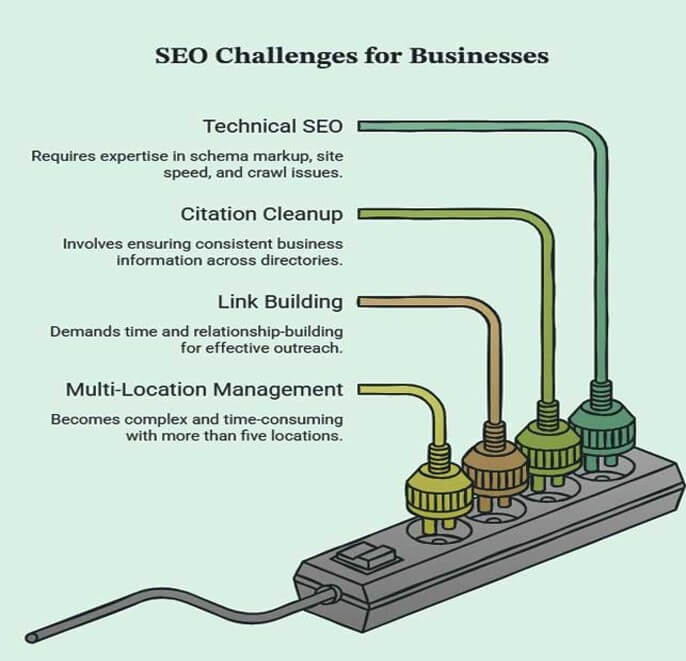
Now lets see:
- Technical SEO — Schema markup, site speed, and crawl issues are easy to get wrong and frustrating to diagnose on your own.
- Citation cleanup — Moved locations? Changed your phone number? Your business info is probably inconsistent across dozens of directories right now.
- Link building — Real outreach takes time and relationships. That’s a tough thing to manage while actually running a business.
- Multi-location management — Past 5 locations, doing this manually becomes a job in itself.
If you hire an agency — whether that’s a local specialist like GridRankers or anyone else — avoid anyone selling “guaranteed Page 1 rankings.” That’s a red flag, not a promise. What good SEO work looks like is simple: audits done, content published, citations cleaned up, links earned. Deliverables you can see, not guarantees you can’t verify.
Frequently Asked Questions
What’s the difference between local SEO and regular SEO?
Regular SEO targets broad, often national search terms. Local SEO targets searches with geographic intent — “near me” queries or city-specific searches. Local SEO uses tools regular SEO doesn’t: Google Business Profile, the Map Pack, citations, and review management. Your website serves both, but the strategies diverge from there.
How much does local SEO cost for a small business?
DIY costs only your time. Freelancers typically run $300–$800/month for basic work. Agencies range from $500 to $2,500+/month depending on scope and market. One-time setup audits usually fall between $500–$1,500. What matters most isn’t how much you spend — it’s whether you’re spending on things that actually move rankings (GBP optimization, reviews, content, citations) rather than vague strategy deliverables.
Do I need local SEO if I don’t have a physical storefront?
Yes. Businesses that travel to customers — like plumbers, cleaners, or designers — can rank in local search without displaying a physical address. Just set your service area to the cities or regions you serve and hide your address. You still need everything else: reviews, citations, a strong website, an active GBP. Service-area businesses can rank just as well as brick-and-mortar ones.
How important are Google reviews for local rankings?
Very. Reviews account for roughly 15% of local rankings — actively collecting and responding to them is an ongoing SEO strategy, not a one-time task. Beyond rankings, reviews influence whether someone clicks your listing at all. A business with 4.8 stars and 200 reviews will pull more clicks than one with 4.2 stars and 12 — even at the same rank position.
What’s a Google Business Profile and do I really need one?
It’s the free listing Google gives every business — the card showing your name, address, hours, photos, and reviews when someone searches for you. Your Google Business Profile is the single highest-leverage asset in local search. A fully optimized profile drives more visibility in the map pack, more calls, and more foot traffic — without paying per click. Yes, you need one. It’s free, it’s the highest-impact starting point, and every competitor who has one is already ahead of you if you don’t.
Popular on OTW Right Now!

About The Author

Gagan Bhangu
Founder of otechworld.com and managing editor. He is a tech geek, web-developer, and blogger. He holds a master's degree in computer applications and making money online since 2015.