
How Technology and Trusted Carriers Are Reshaping Heavy Equipment Transport in Boston
Moving heavy equipment across Massachusetts is not a simple task. Whether it involves construction machinery, industrial generators, or oversized agricultural equipment, the logistics behind these moves demand precision, regulatory knowledge, and the right partnerships. In a region like Greater Boston — where dense urban corridors, aging infrastructure, and strict permitting requirements converge — the stakes are especially high. What has changed dramatically in recent years, however, is how technology is being woven into every layer of this process, making heavy haul operations faster, safer, and more cost-effective than ever before.
The Complexity Behind Every Heavy Haul Move
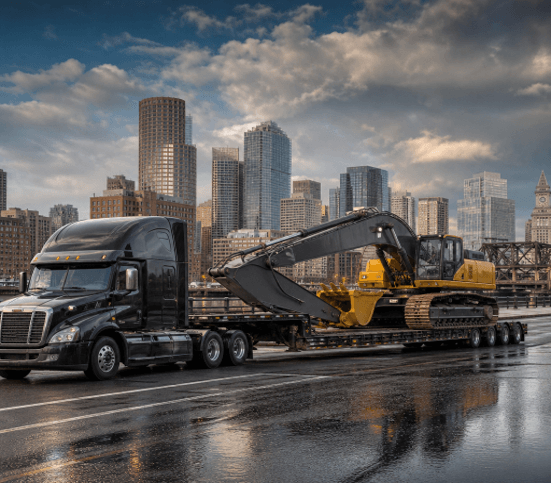
Heavy equipment transport is not simply a matter of loading a machine onto a flatbed and driving it to a destination. Every move involves route surveys, load securement planning, pilot car coordination, and in many cases, state-issued oversize or overweight permits. In Massachusetts, these permits are governed by MassDOT regulations that specify allowable dimensions, travel windows, and restricted corridors. A single miscalculation — whether in load weight distribution or route clearance — can result in costly delays, equipment damage, or regulatory penalties.
Boston has another layer of challenge: its road network. The city’s streets, bridges, and corridors are all too narrow and have low clearances and are well used, and thus they should be handled with care. The carriers that operate in this market should be well versed in the local market conditions, rather than just trucking experience. That’s why businesses and contractors in the region will always find specialists for moving high-value or oversized loads and goods beyond general freight carriers.
Technology Is Transforming the Heavy Haul Industry
Technology investments are reshaping operational efficiency across the logistics and supply chain industry. Route optimization software, real-time GPS tracking, digital permitting platforms, and load management systems used to be add-on features, but are now competitive must-haves. For heavy equipment carriers, these tools directly improve their results – with fewer delays, more accurate time-on-the-road estimates, and better communication with their clients from start to finish.
Companies that have embraced strategic technology investments for logistics and supply chain operations are seeing measurable gains in both profitability and customer satisfaction. Digital dispatch will enable a coordinator to keep an eye on multiple loads at a time, and the telematics data will help them discover inefficiencies before they are even issues. When the goods being transported are worth hundreds of thousands of dollars, real-time tracking and alerts on the route of the load or weather conditions are invaluable, for heavy haul in particular.
Permit Management and Compliance in the Digital Age
Acquiring permits has been one of the largest time-consuming parts of heavy equipment transportation in the past. Communication with state and local officials, provisioning of load specifications, and waiting for approvals may add a few days to the project schedule. Today, the digital permitting process has been greatly shortened. If carriers have existing relationships with state DOTs and access to electronic permitting systems, they can obtain approvals in hours rather than days, helping ensure project timelines are met and clients are pleased.
The Hidden Costs That Erode Profit Margins
However, profit erosion can happen in well-managed transport operations if they aren’t careful to monitor the lesser-known costs that can be hidden in their processes. Industry analysts call the aforementioned factors “silent profit killers” due to inefficient use of fuel, deadhead miles, driver downtime, and poor load planning. According to an in-depth analysis on the silent profit killers in transportation logistics, many carriers lose significant revenue not from obvious operational failures but from incremental inefficiencies that compound over time.
These inefficiencies can be even greater for heavy haul carriers. Specialized equipment, such as lowboys, RGN trailers, and step decks, is a major capital investment, and each hour without any load or each trip with empty equipment is a mill cost. Carriers with investments in smarter scheduling, improved load matching, and proactive maintenance programs will have an edge in ensuring their margins and ability to provide service quality.
Why Clients Are Demanding More Transparency
Construction companies, utility companies, manufacturers, and government contractors, among others, that use heavy equipment to move goods are increasingly calling for real-time visibility into their shipments. No longer will a client drop off a machine and wait for a phone call to be notified of its arrival. In today’s world, clients require digital tracking, communication, and documentation at every stage of the move. Carriers that provide this level of transparency strengthen client relationships and gain repeat business.
Bear Down Logistics: A Specialist Built for the Boston Market
When it comes to navigating the specific demands of the Massachusetts market, experience and local knowledge matter enormously. Bear Down Logistics has established itself as a trusted provider of heavy equipment transport in Boston, offering clients the combination of regulatory expertise, specialized equipment, and professional coordination that complex moves require. The company’s approach covers every aspect of a project, from construction excavators to industrial equipment, ensuring it is delivered on time, compliant with regulations, and safe for use.
Bear Down Logistics is aware that each customer is different. While a contractor relocating a crane to a job site in downtown Boston may encounter a different set of challenges, a manufacturer relocating manufacturing equipment to a facility in the suburbs will encounter other challenges. The company’s team closely engages with their clients throughout the planning process to gauge the possible routes, recognize potential issues, and create a transport plan that is both risk-free and on schedule. This is not a commodity service orientation, and this is the difference between them and carriers that treat heavy haul as a commodity service.
Equipment, Compliance, and Coordination
Bear Down Logistics has an extensive heavy-hauling fleet equipped with specialized equipment for all heavy-hauling needs. They have an operational team that oversees permit acquisition, carrier coordination, and route planning, thus eliminating the burden on the client and making sure that all moves are compliant with State and Federal regulations. This complete management capability is not only convenient for businesses with strict project deadlines, but it’s also essential.
Looking Ahead: The Future of Heavy Equipment Transport
The heavy haul sector is at a turning point. The rapid evolution of technology and the growing demands of clients make it hard for carriers who cannot keep up with modernization. With technology continually progressing and clients’ expectations continually rising, it’s difficult to imagine that carriers who do not keep up with the times will be significantly disadvantaged. In today’s world of efficient transport companies, route intelligence, predictive maintenance, and communication systems are becoming essential features. Ensuring safe load handling, regulatory compliance, and reliable delivery continues to be a cornerstone of client trust, as it remains unchanged.
The message is loud and clear for businesses in Massachusetts and the Greater Boston area. The decision on who to hire a heavy equipment transport service to depends on a lot more than the price. With the right carrier, you have the support and technology, expertise, and accountability on every move — all while keeping your bottom line in sight. That combination of ability and commitment is what makes one carrier great versus good in this highly competitive market, as Boston is.
Conclusion
As a truck driver, you can’t just get in the cab and drive a big rig in the Boston market. It calls for expertise in the regulatory field, specific facilities and technology, coordination, and transparency that modern clients demand. As the logistics sector progresses, it’s the carriers that invest in their people and platforms that will set the benchmark for service. Cooperation with a proven expert is the safest, most efficient, and on-time solution for Massachusetts businesses looking to lift heavy loads.
Popular on OTW Right Now!



About The Author

Gagan Bhangu
Founder of otechworld.com and managing editor. He is a tech geek, web-developer, and blogger. He holds a master's degree in computer applications and making money online since 2015.