
Give Double-Car Doors Added Strength Using a Garage Door Strut
Double-car garage doors open a much larger garage door opening than a single-car garage door. The greater distance generates a different load on each sectional panel. Over time, repeated opening cycles, opener force, door weight, and varying weather conditions can cause panels to move. Larger sections can bend, droop, or deviate from the desired path if not properly reinforced.
Right reinforcement keeps the door in shape and provides smoother operation. A horizontal support can be added to weak areas without altering the basic sectional design. It acts as a structural bridge across the panel to help spread forces rather than focus stress around restricted attachment points.
1. Why Double-Car Garage Doors Need Additional Panel Support
A double-car door typically opens a much larger opening than a single-car system. Its panels are thus longer horizontally and are able to bend more than they do during operation. This is more evident if the door is fitted with insulating panels or a power-operated door opener.
The upper portion sometimes receives special consideration because the opener uses the door’s lifting mechanism. When that force is focused in a small area, the panel may encounter unwanted flexing. Over time, excessive movement can lead to misalignment, overstressing of the hardware, and/or visible deformity.
Proper selection of the reinforcement member controls this movement. The panel does not free up to react under concentrated forces, but instead offers extra stiffening across the section.
2. How Horizontal Reinforcement Controls Panel Flex
The concept of a reinforcing bar is very simple. This supports the panel over a greater area, making it more rigid. This is particularly helpful where a wide panel is required to move mechanically many times.
The Structural Benefits of Reinforcement
- Reduced panel bending: A horizontal support limits excessive flex across wider sections.
- Better force distribution: Opener forces can spread across more of the panel instead of concentrating around one area.
- Improved alignment: Greater rigidity helps sections maintain their intended position during movement.
- Greater wind performance: A reinforced panel can resist movement more effectively under strong wind conditions.
- Lower localized stress: Supporting the panel can reduce excessive loading around hinges and mounting points.
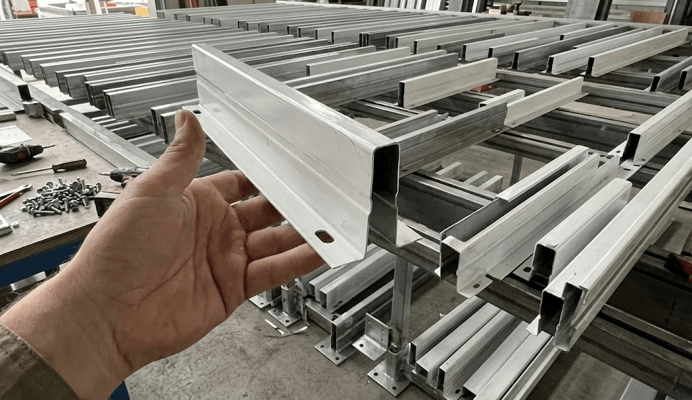
A garage door strut provides this reinforcement by running horizontally across the inside of a sectional panel. Its full-width profile creates a stronger load path while preserving the door’s normal operating arrangement.
3. Selecting the Right Reinforcement for a Wide Door
Not all sectional garage doors are built the same. Factors such as door width, panel construction, operating frequency, insulation, and opener configuration can impact reinforcement requirements. So a double-car door will require a strut appropriate to its size and use.
The thickness of the material is also a factor to consider. Galvanized steel is the material used because it is strong and resistant to corrosion. Different thicknesses may be appropriate for different door widths and loading conditions.
For instance, 24-gauge steel is about 0.70 mm thick and 22-gauge steel is about 0.80 mm thick. The right choice should be the one recommended by the door manufacturer and based on the reinforcement required by the specific assembly.
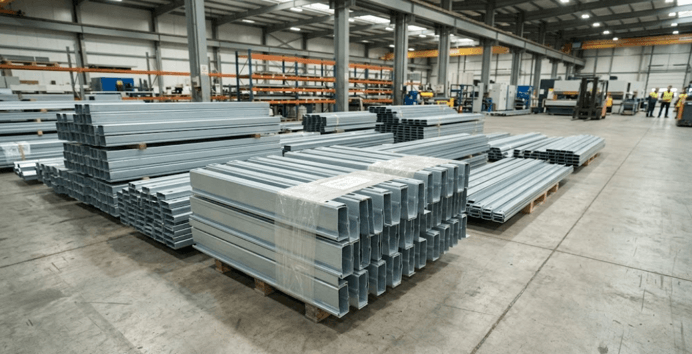
Gemax precision roll-forms galvanized steel struts. This enables uniformity of length and straightness and reliably installs in residential and light commercial applications.
4. Where a Garage Door Strut Works Best
Reinforcement performance depends directly on placement. The upper portion is often strengthened as it may be subjected to a great deal of force from the lifting mechanism and the opener. But for larger or specialized sectional doors, you may need reinforcement across more panels.
Position a garage door strut against the inside side of the panel. It runs the whole width of the panel and is secured via appropriate mounting points. If the strut is to be used with standard hinge and bracket configurations, pre-punched holes will make alignment easier.
Install the door as per the manufacturer’s instructions. When the door is not positioned properly, improper fasteners are used, or the door is modified, the structural effectiveness is diminished, and the door may be affected in its ability to move normally.
The goal is not just to add metal to the panel. The reinforcement must complement the existing door structure, hardware, and lifting system.
5. Supporting Long-Term Door Performance
Reinforcement is most beneficial when it is used within a well-balanced garage door system. A strut is not a substitute for properly adjusted springs, hinges, rollers, tracks, or opener parts. Rather, it secures the panel to make these components work in a more stable structure.
Inspect wide sectional doors regularly. Check for unusual panel movement, bending, loose fasteners, damaged hinges, or misalignment. By paying attention early on, a small structural problem may not get worse and require a bigger repair.
Important Installation Considerations
- Match the strut length to the actual panel width.
- Select material thickness according to structural requirements.
- Confirm mounting locations before drilling or fastening.
- Ensure the reinforcement sits securely against the panel.
- Check that the completed installation does not obstruct hinges or moving hardware.
- Follow applicable manufacturer and installation instructions.
These details help ensure that reinforcement contributes to rigidity without creating interference elsewhere in the door assembly.
6. Building Greater Structural Confidence Into Double-Car Doors
If the garage door is wide, you need more than adequate surface coverage. Its panels are also required to have structural stability for thousands of operating cycles. Reinforcement meets this need by controlling flex and redistributing mechanical forces across the panel.
It is especially important for double car doors and insulated doors. Their larger sizes may make panel stiffness a significant factor in reliable operation. The correct selection of the horizontal support can help to minimize bending and enhance resistance to movement due to normal use and severe winds.
As sectional doors rely on a number of interdependent parts, reinforcement should always be included as part of the overall system. Proper size, positioning, fastening, and compatibility are equally important.
Conclusion
Double-car garage doors offer the benefit of a wider opening; however, they have larger panels that must be supported properly. Opener forces, frequent use, and environmental pressure can cause more flex in wide sections. Appropriate horizontal reinforcement can help to control that movement and load distribution.
A properly engineered strut can reinforce weak panels and aid alignment and long-term structural performance. Galvanized steel construction also offers a practical mix of strength and durability for challenging applications.
The correct reinforcement in a residential or light commercial sectional door is a small but important structural part. If properly installed and matched, it will keep a large garage door stiff and stable, and ready for daily use.
Popular on OTW Right Now!




About The Author

Gagan Bhangu
Founder of otechworld.com and managing editor. He is a tech geek, web-developer, and blogger. He holds a master's degree in computer applications and making money online since 2015.