
How Modern CDNs Help Protect Websites from DDoS Attacks
Most people consider content delivery networks to be a way to make websites load faster. You store your images, scripts, and pages on servers worldwide, so visitors get content from the closest location. Pages feel snappy, videos buffer less, and everyone is happier.
What many site owners do not fully realize is that the same network that speeds things up can also act as a serious shield. Modern CDNs are now a key part of your defense against DDoS attacks, not just a performance tool. In a world where it is cheap and easy to flood a site with junk traffic, that extra layer matters.
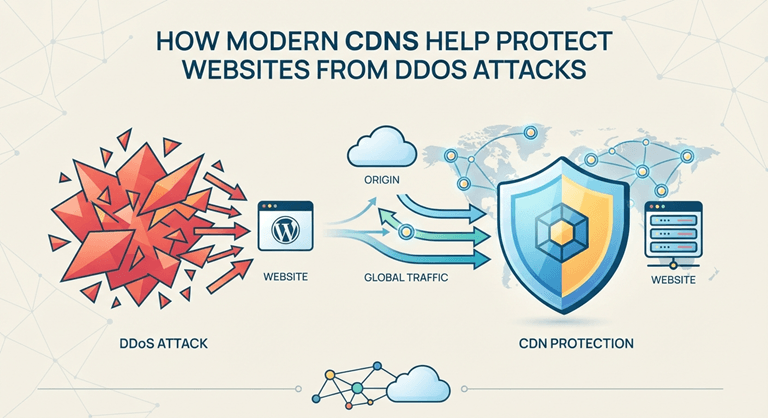
Let us look at how this protection actually works in practice and why using a CDN is one of the most practical ways to keep your site online when someone decides to push its limits.
Spreading The Load So One Server Is Not Overwhelmed
A classic DDoS attack has a simple goal. It tries to send so much traffic to your server that it runs out of capacity. The machine slows down, then stops responding, leaving real users staring at a spinning icon or an error page.
If all your traffic goes to a single origin server, it’s like a small shop with one narrow door. A crowd can block it easily. When you put your site behind a CDN, you suddenly have many doors to handle the traffic. The network spreads visitors across a large number of edge servers.
So when a wave of requests hits, that load is not sitting on one machine in one data center. It is spread out. Each edge server handles a slice of it. This alone does not solve every DDoS problem, but it buys you time and space. Your origin server gets to breathe instead of being hit head-on.
Blocking Bad Traffic Before It Gets Anywhere Near You
The more advanced CDNs go a step further. They do not just pass traffic along. They inspect it. They look at where it comes from, how it behaves, and whether it matches normal patterns for your site.
For example, a healthy user session might mean a few page loads, a script here, an image there, and then a pause. A DDoS bot might send hundreds of requests per second for the same resource, often from a network that has a bad history.
Modern CDNs use this kind of pattern to decide which requests to serve and which to drop. They can:
- Rate limit suspicious clients that send too many requests
- Block traffic from known abusive networks or regions you do not serve
- Challenge visitors that look odd, for example, by using a simple browser test
By placing that logic at the edge, far away from your origin, you filter out junk traffic before it ever reaches your own servers.
Soaking Up Sudden Spikes With Large Capacity
One of the quiet strengths of a solid CDN is just how big it is. The larger providers run giant networks with a lot of bandwidth and hardware spread out across many locations. When a wave of visitors hits your site, that scale matters. They can spread the load around and keep things moving, even when a lot of the traffic is junk.
Compare that with a single web server sitting on its own. It can only handle so many requests before it starts to run out of CPU, memory, or network capacity. Once it hits that point, everything slows down and real users notice it immediately. A CDN gives you a bigger cushion, so those sudden spikes have a harder time knocking you offline.
Using caching to reduce the hit on your origin
Another quiet way CDNs help with DDoS is through caching. When a page, image, or script is cached at the edge, it can be served without asking your origin server for it again. The more content you cache, and the longer you cache it, the less often the origin needs to be touched.
During an attack, the timing matters a lot. If most of your fixed content is already cached, even a big rush of visitors only hits the edge layer. Your origin sees far fewer requests and is less likely to tip over.
This is one reason why tuning cache rules is worth the effort. It is not just about speed. It is about building a buffer between chaos on the public internet and the more fragile systems that sit behind it.
Seeing Attack Patterns Through Better Visibility
Modern CDNs also give you better eyes. They log requests across all their edge locations and often give you dashboards that show traffic spikes, countries of origin, and request types in near real time.
When something strange happens, you can see it more clearly. Maybe there is a sudden jump from a set of IP ranges you have never seen before. Maybe one path on your site is being hammered while everything else is quiet.
This visibility makes it easier to tune your defenses. You can block or limit certain regions, tighten rules on specific paths, or work with the provider’s support team to set up targeted protections. Without that view, you often have to guess from basic server logs long after the event.
Managed Protection and Human Help
Some CDNs now bundle full DDoS protection services into their plans. That might include automatic detection and mitigation, 24/7 monitoring, and direct access to a security team when things get serious.
For smaller companies without a large in-house security staff, this is a big deal. You do not have to be an expert in attack types or routing tricks. You can let the CDN manage the more challenging parts while you focus on your core business.
The important thing is to check what is actually included. Not every provider offers the same level of DDoS defense. When you evaluate options, look closely at their protection features, real case studies, and how quickly they respond during an active event.
A Practical Shield for a Noisy Internet
We live in a time where it is remarkably simple for someone to rent a botnet or use a service to flood a target with traffic. The barrier to starting a DDoS attack has dropped, but the cost of being on the receiving end is still high.
Putting your site behind a solid CDN is one of the simplest and most effective steps you can take to protect yourself. It does not make you immune, but it improves your chances. Load is spread out. Bad traffic is filtered earlier. Your origin servers do less work. You gain better visibility and, in many cases, expert help when you need it most.
Performance alone is a good reason to use a CDN. In the current environment, the security benefits might be even more important.
Popular on OTW Right Now!


About The Author

Gagan Bhangu
Founder of otechworld.com and managing editor. He is a tech geek, web-developer, and blogger. He holds a master's degree in computer applications and making money online since 2015.