
How Industrial Polymerization Reactors Are Shaping Modern Manufacturing
Across virtually every sector of modern industry, the ability to engineer materials at a molecular level has become a defining competitive advantage. From the plastics that protect pharmaceutical packaging to the synthetic fibers woven into performance textiles, polymer chemistry sits at the heart of contemporary production. Yet behind every polymer product lies a critical piece of infrastructure that rarely receives the attention it deserves: the reactor system that makes the transformation possible. Understanding how these systems work, why they matter, and how they are evolving is essential for any engineer, procurement specialist, or operations manager working in process-intensive industries today.
The Science Behind Polymer Production
Polymerization is the chemical process by which small monomer molecules are linked together to form long-chain polymer structures. Depending on the desired end product, this process can take several forms — addition polymerization, condensation polymerization, ring-opening polymerization, and others — each with distinct reaction kinetics, temperature profiles, and pressure requirements. The choice of process directly influences the physical and chemical properties of the resulting polymer, including its molecular weight distribution, crystallinity, tensile strength, and thermal stability.
What makes polymer production particularly demanding from an engineering standpoint is the sensitivity of these reactions to environmental conditions. Even minor fluctuations in temperature, residence time, or catalyst concentration can produce off-spec material, leading to costly waste and production downtime. This is why the design and selection of the reactor vessel itself is so consequential — it is not merely a container, but a precisely engineered environment where chemistry and engineering intersect.
Reactor Design: More Than a Vessel
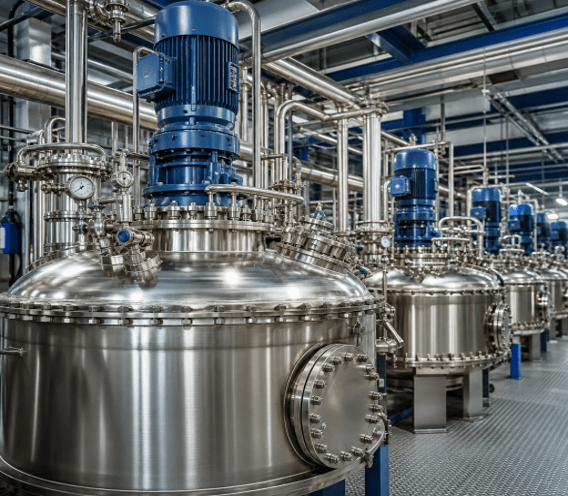
Modern polymerization reactors are sophisticated systems engineered to maintain precise control over reaction conditions throughout the entire production cycle. Key design considerations include heat transfer efficiency, agitation uniformity, pressure containment, and material compatibility. Reactors used in polymerization processes must handle highly viscous reaction masses, manage exothermic heat release, and often operate under elevated pressures — all while maintaining the sterility or purity standards demanded by downstream applications.
In industrial polymerization, there are several common reactor configurations used. These are easily scaled up and operated in a steady state, and for this reason are widely used. Tubular or plug-flow reactors have a narrow residence time distribution and are ideal for reactions that demand close control of molecular weight. The loop reactors, which are widely used in the manufacture of polyolefins, have the advantages of both configurations. Each design has its own set of trade-offs, and a configuration that can be chosen will need process knowledge and engineering expertise.
The Role of Agitation and Heat Management
One of the most important functional requirements of any polymerization reactor is good agitation and reliable heat management. As the polymerisation continues, the reaction mass becomes more viscous, and it becomes more difficult to mix the mass in the reaction vessel. Inadequate agitation can cause runaway reactions, hot spots, and molecular weight variations. Impellers of high design, baffles and variable-speed drive systems are all used to ensure homogeneous mixing in the reaction cycle.
The control of heat is also essential. In polymerization reactions, heat is generally liberated as the reaction takes place. Without cooling (via jacketed walls, internal coils, or reflux condensers), temperatures can escalate quickly, changing reaction kinetics and leading to unsafe conditions. Today’s reactor systems combine several heat transfer modes and include backup systems of temperature monitoring and control to guarantee the safe operation of the reactor system at a constant temperature.
Sourcing Equipment for Polymerization Processes
Used and refurbished reactor process equipment provides an attractive alternative to new capital investments to plant operators and project engineers seeking to source or upgrade reactor equipment. A polymerization reactor sourced from a reputable used equipment supplier can deliver significant cost savings while still meeting the technical specifications required for demanding production environments. International Process Plants, one of the world’s leading suppliers of process equipment and complete plant systems, carries a wide range of polymerization reactors and related process equipment in stock and provides buyers with extensively inspected and documented assets that are immediately available for installation.
Due Diligence When Purchasing Used Reactors
When buying used process equipment, conduct thorough due diligence. When ordering, it is important that the buyer asks for complete records of the reactor’s service history, including previous service conditions and maintenance history, and any changes to the reactor during its service life. Before purchasing, it is critical to inspect welds, nozzle integrity, agitator shaft seals, and the internal surface condition. With an experienced equipment supplier that can offer detailed inspection reports and, if required, third-party certification, the risk of procurement is decreased.
Polymerization in the Pharmaceutical Industry
One of the most challenging application areas for polymerization technology is the pharmaceutical industry. Polymers have many applications in drug delivery systems, including use as coating materials for controlled-release tablets, as excipients in capsule formulations, and as the structural component of a biodegradable implant and hydrogels. The requirements for the purity of pharmaceuticals produced using polymers are very strict, and regulatory agencies require traceability of the raw material, process parameters, and finished-product specifications.
The pharmaceutical industry requires that polymer manufacturing facilities follow Good Manufacturing Practice (GMP) guidelines, which include some very strict requirements for equipment design, equipment cleaning validation, and process documentation. As highlighted in Takeda’s recognition in the ISPE Facility of the Year Awards, leading pharmaceutical manufacturers are investing heavily in advanced manufacturing infrastructure that integrates process efficiency with social and environmental responsibility — a trend that is reshaping how the industry approaches capital investment in production equipment.
Sustainability and the Future of Polymer Manufacturing
In recent years, sustainability has become a major issue in polymer production. There is increasing pressure on the industry to decrease energy use, lower the amount of waste streams, and create processes that can be used with bio-based or recycled feedstocks. The challenges are driving changes in reactor design, including developments in continuous processing, solvent-free polymerization, and enzymatic catalysis for more sustainable production.
It’s not just the circular economy affecting the circular economy, but the procurement decisions as well. Buying used reactor equipment instead of new reactor construction decreases the embodied carbon from vessel production, fits in corporate sustainability goals, and can even shorten project schedules. The trend of increasing environmental reporting obligations worldwide is having a growing impact on manufacturing businesses, which are increasingly seeking to differentiate themselves by proving to customers they are responsible manufacturers.
Balancing Performance and Operational Flexibility
A major challenge in polymer plant design is the ability to optimize plant productivity while giving the flexibility to changeover the product, to perform process development runs, and to meet changing market demands. Several approaches achieve flexibility within production facilities, such as modular reactor configurations, skid-mounted systems, and flexible control architectures. Whether it’s a business that is considering investing in industrial goods as well as leisure and lifestyle, or an industrial business that is considering investing in a caravan staycation, the discipline of allocating capital to the appropriate asset class, purpose and long-term value is the same.
About International Process Plants
International Process Plants is a world-class supplier of used and refurbished process equipment, complete production lines and entire plant systems. Over the years the company has provided a broad spectrum of high-quality process assets to their customers in the chemical, pharmaceutical, food processing and energy industries. It continues to add new products to its inventory constantly. They have a team of experienced engineers and equipment specialists who can offer full service, from equipment identification to inspection, logistics, and installation planning. International Process Plants strives to work efficiently, safely and cost-effectively on behalf of clients to help them reach their production targets.
Conclusion
Polymerization reactor technology lies at the crossroads of chemistry, engineering, and industrial strategy. With the increasing demand for advanced polymer materials in various applications such as pharmaceuticals, packaging, electronics, and specialty chemicals, the need for reliable, well-designed reactor systems will only grow. It is important to understand what equipment is needed for the processes, to perform due diligence, and to choose suppliers who offer inventory depth as well as engineering knowledge to ensure success, whether buying new or refurbished equipment. The complexity and change in the manufacturing environment mean that the right reactor is more than a piece of equipment; it is the basis for competitive advantage.
Popular on OTW Right Now!



About The Author

Gagan Bhangu
Founder of otechworld.com and managing editor. He is a tech geek, web-developer, and blogger. He holds a master's degree in computer applications and making money online since 2015.