
Laser Safety in Robotic Welding Cells: Guarding, Interlocks, and Training Requirements
Robotic laser welding cells should be designed so hazardous laser radiation cannot reach workers during normal operation, foreseeable access, setup, or maintenance. The safety system therefore needs more than a physical fence: it should combine an appropriate enclosure, access controls, interlocks, emergency stopping, warning systems, documented procedures, and role-specific training.
ANSI Z136.1-2022 is the current general U.S. standard for safe laser use and provides control measures based on laser hazard classification. It also includes guidance relevant to robotics, interlocks, risk assessment, audits, and training.
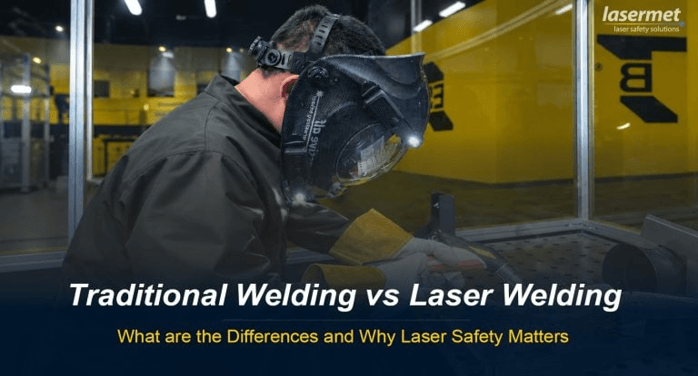
What robotic laser welding cell safety should address
A robotic laser welding cell presents several hazards simultaneously. The laser can create severe eye and skin exposure risks, while the robot introduces crushing, impact, unexpected movement, and maintenance hazards. Welding can also introduce fumes, heat, fire, and material-specific hazards.
The safety design should therefore consider the complete cell rather than treating the laser independently.
At minimum, the assessment should identify:
- Laser classification and accessible emission
- Beam paths and potential reflections
- Cell openings and access points
- Robot motion and reach envelopes
- Fixtures and workholding
- Maintenance and service access
- Emergency-stop locations
- Interlock functions
- Warning indicators
- Authorized operating and maintenance personnel
- Required personal protective equipment
- Fire and fume hazards
- Abnormal operating conditions
ANSI Z136.1 establishes laser controls according to hazard classification, while OSHA laser-safety guidance emphasizes engineering controls such as protective housings, beam termination, access controls, interlocks, and appropriate protective eyewear where applicable.
What robotic laser welding cell safety data should be recorded?
Robotic laser welding cell safety data should include the information necessary to demonstrate how the cell’s hazards were identified, controlled, tested, and maintained.
A practical safety record should include:
- Laser identification: Manufacturer, model, wavelength, power, classification, and configuration.
- Cell layout: Laser source, robot, fixtures, enclosure, access doors, viewing areas, and beam paths.
- Hazard assessment: Identified laser, robotic, welding, electrical, thermal, fire, and other relevant hazards.
- Guarding information: Enclosure construction, access points, viewing windows, and any openings.
- Interlock records: Each safety-related interlock, its function, test procedure, test result, and test date.
- Emergency controls: E-stop locations and verification records.
- Training records: Employees trained, training date, role, and any required refresher training.
- Maintenance records: Repairs, modifications, service access, and post-maintenance safety checks.
- Incident records: Exposure events, near misses, equipment failures, and corrective actions.
- Periodic inspection records: Results of safety inspections, audits, and corrective actions.
OSHA’s laser-safety guidance specifically calls for maintaining records of personnel training and completion dates and describes engineering controls for Class IV laser areas, including protective housings, master controls, service-panel interlocks, and access controls.
The important principle is traceability. If an interlock fails six months after installation, the manufacturer should be able to determine what the interlock protects, how it was tested, who tested it, and whether the cell was modified afterward.
Cell guarding should prevent access to the laser hazard
The primary protection should come from engineering controls rather than relying on workers to remember not to enter a hazardous area.
For an enclosed robotic welding cell, the enclosure should be designed around the actual laser hazard and foreseeable access paths. Gaps, doors, viewing ports, cable penetrations, and maintenance openings should be evaluated rather than assuming that a perimeter fence automatically makes the cell safe.
A laser enclosure also needs to account for radiation that could escape through openings or be reflected from internal surfaces.
OSHA’s laser guidance identifies protective housing as an engineering control and calls for measures that limit accessible radiation to appropriate exposure levels.
Interlocks should be treated as safety functions
Door and panel interlocks should prevent hazardous laser emission when a protected access point is opened under conditions where exposure could occur.
The important design question is not simply whether a door has a switch. It is whether the complete safety function reliably prevents or terminates hazardous emission when access occurs.
For example, a typical access-control function may involve:
- Access door opens.
- Safety system detects the access condition.
- Laser emission is prevented or terminated.
- The hazardous state cannot automatically restart merely because the door closes.
- The operator must perform the required reset or restart procedure.
- The system verifies the required conditions before operation resumes.
OSHA’s laser guidance describes interlocks for protective housings and service access panels and notes that access controls should allow rapid emergency egress.
Interlocks should never be routinely defeated to make production easier. If maintenance requires an interlock override, that activity should be controlled by a documented procedure appropriate to the hazard and task.
Emergency stops are not a substitute for guarding
An emergency stop is important, but it should not be treated as the primary protection against routine laser exposure.
A person should not have to notice a hazardous condition, enter the danger area, and then press an emergency button to remain safe. The normal cell design should prevent access to hazardous radiation in the first place.
Emergency controls are instead intended to provide a rapid means of bringing hazardous equipment to a safe state when something goes wrong.
OSHA guidance for Class IV laser areas describes a clearly marked disconnect or panic control that permits rapid deactivation of the laser and emphasizes rapid entry and exit under appropriate conditions.
The robotic system also needs to be considered. Stopping laser emission does not necessarily eliminate every robot, stored-energy, fixture, or mechanical hazard.
What is a good robotic laser welding cell safety plan?
A good robotic laser welding cell safety plan combines hazard assessment, engineering controls, operating procedures, maintenance controls, training, inspection, and incident response.
A practical plan can follow this structure:
- Identify the hazards.
Document the laser source, classification, accessible radiation, reflections, robot motion, welding hazards, electrical hazards, fumes, heat, and foreseeable abnormal conditions. - Define the controlled area.
Determine where access must be restricted and how the enclosure controls exposure. - Design the guarding.
Specify enclosure materials, doors, viewing areas, access points, and protective measures appropriate to the laser system. - Define safety functions.
Document what each door, interlock, emergency stop, sensor, and control system is intended to accomplish. - Establish operating procedures.
Cover startup, shutdown, normal operation, setup, cleaning, troubleshooting, and abnormal conditions. - Establish maintenance procedures.
Define authorized access, isolation requirements, interlock overrides if permitted, service controls, and post-maintenance verification. - Train affected personnel.
Train operators, maintenance personnel, programmers, supervisors, and other workers according to their actual exposure and responsibilities. - Verify and document.
Test safety functions and maintain records of inspections, training, modifications, incidents, and corrective actions.
ANSI Z136.1-2022 specifically identifies risk assessment, interlock checks, audits, on-the-job training, and robotics among the areas addressed by the standard.
Training should match the employee’s role
Not every employee working near a robotic laser welding cell requires identical training.
An operator may need training on normal operation, warning indicators, access restrictions, emergency procedures, and reporting unsafe conditions. A maintenance technician may need substantially more detailed training because their work can involve access to protected areas or safety devices.
The laser safety program should therefore identify who needs training, what hazards they can encounter, what procedures they must follow, and how completion is documented.
OSHA’s laser guidance states that training should be appropriate to the laser class and task and calls for records identifying trained personnel and training dates.
Training should also be refreshed when the laser, cell configuration, operating procedure, or safety controls materially change.
Build the safety system before production starts
The safest approach is to treat laser safety as part of robotic cell engineering rather than as paperwork added after installation.
Start with the laser classification and hazard assessment. Design the enclosure and access controls around the actual beam and robot hazards. Define and validate interlocks and emergency functions. Establish controlled maintenance procedures. Then train personnel and maintain records proving that the safeguards are inspected and understood.
ANSI Z136.1-2022 is an important reference for the laser-safety program, while applicable OSHA requirements, machinery-safety standards, electrical requirements, and manufacturer instructions also need to be considered for the complete cell.
For a production environment, the goal should not simply be to have a fence around a robot. The goal is a documented safety system in which the cell prevents foreseeable exposure, detects unsafe access, supports emergency response, and remains safe during setup and maintenance.
Popular on OTW Right Now!




About The Author

Gagan Bhangu
Founder of otechworld.com and managing editor. He is a tech geek, web-developer, and blogger. He holds a master's degree in computer applications and making money online since 2015.