
How to choose an EDC machine for daily business transactions?
Choosing an EDC machine for daily business transactions is not only about accepting card payments at the counter. It is about keeping billing quick, giving customers more ways to pay, and helping staff track every transaction with less confusion.
For many stores, payment is the final step in the customer journey. If this step feels slow or uncertain, it can affect the overall buying experience. A reliable payment setup can support cards, UPI, QR payments and other digital modes, depending on the provider.
For merchants, the right choice should match daily sales volume, counter traffic, receipt needs,s and settlement expectations. Let’s look at how to choose an EDC machine that fits everyday business needs.
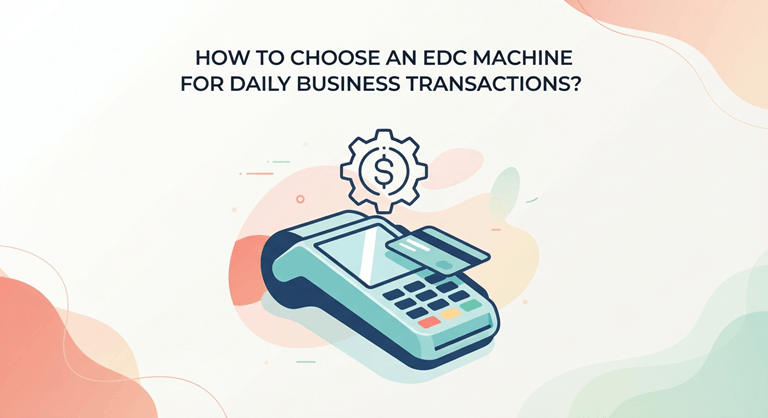
What is an EDC machine?
An EDC machine is an electronic device used by merchants to accept digital payments at a physical store. EDC stands for electronic data capture.
In simple terms, it helps capture payment details securely and complete a transaction at the billing counter. Customers can usually pay through debit cards, credit cards, contactless cards, UPI QR or supported wallet options.
An EDC machine is often used with PoS machines or PoS systems. It can support billing, receipts, settlement reports, ts, and payment confirmations depending on the provider.
For a merchant, the main benefit is convenience. Instead of depending only on cash, the business can accept multiple payment methods from one counter setup.
Why do daily businesses need the right EDC machine
Customers now expect fast and flexible payment options. Many prefer paying through UPI for small purchases, while others use cards for higher-value transactions. If a store cannot accept a preferred payment mode, the customer may face avoidable friction. In some cases, this can even affect the final purchase decision.
The right EDC machine helps reduce such friction. It gives customers more ways to pay and helps staff complete billing with fewer manual steps. For daily businesses, this matters even more. Grocery stores, bakeries, pharmacies, cafés, salons,s and retail outlets handle repeat transactions every day. A slow payment process can create queues and pressure during busy hours.
A reliable machine helps keep the counter moving. It also makes transactions easier to track at the end of the day.
Key factors to check before choosing an EDC machine
Choosing an EDC machine becomes easier when you know what to compare. The right option should support your payment flow, customer habits, and daily counter needs.
However, for most companies, the cost of the device isn’t the only factor. It’s also regarding payment methods, fees, settlements, connectivity, receipts, security,y and support.
1. Check the payment modes supported
One of the initial considerations is payment coverage. The choice of payment method should be the one you’ll find your customers using the most when they use your EDC machine. For the Indian merchants, this typically refers to debit cards, credit cards, UPI, QR and contactless card payments.
There can be some businesses that require wallet support or EMI. This will varyby they size of the ticket, profile, and product type of the customer. Card acceptance is beneficial for customers who like bank cards, reward points, and credit-based payments. UPI is useful for fast transactions from day-to-day.
Contactless card payments can also cut down on the billing time. Eligible cards are tapped by customers, which helps to move the counter more quickly. Check with providers prior to selection about the payment methods accepted. Also, verify their requirements for activation and/or approval.
2. Understand transaction charges clearly
The cost must be considered outside of the device cost. Some of the monthly fees include rental, setup, service, and transaction fees. Merchants should also know the terms, MDR (merchant discount rate). It’s a fee that’s levied on some transactions involving electronic payments.
There could be charges associated with various payment methods. The cost of credit card payments may not be the same as debit card payments, and value-added services. Often, a low up-front price is not a worthwhile option. It can cost a lot of money if the charges are not clearly defined and there is little support.
Be sure to request a detailed written estimate before signing a contract. This will allow you to see what that really means in terms of the monthly expense when you’re taking payments.
3. Look at settlement speed and reporting
Cash flow is important to all businesses on a daily basis. Once a customer pays digitally, you should receive this within an unambiguous amount of time. That’s why it is important to check the settlement speed early. Some providers have next-day settlement, while others might provide faster settlement.
Reporting is also very crucial. Useful information to be displayed on a dashboard includes payments, payments refunded, failed payments, daily total, and settlement status. This makes it easier for the merchants to match up sales with the bank’s credits. When there are no reports, staff may need to spend additional time undertaking manual checks.
The more than one counter or branch, the more important it is to report. It lets the owners monitor collections from any device and from any place.
4. Choose the right connectivity option
An EDC machine should run as smoothly as during business hours. As connectivity is compromised, payments may also be delayed, and the customer experience is impacted. The majority of machines operate via the SI,r Wi-Fi, or both. Some portable models also have the ability to be battery-powered for easier in-store maneuverability.
A WiFi machine could be sufficient if your store has stable WiFi. If Internet connectivity is a problem, help can be derived from SIM support. Portable machines can be good options for restaurants, cafés and service centres. These can be set at a table, counter, or service desk.
Always check the network strength near where you are planning on installing it before finalizing. Even with the high configuration, the poor connectivity may lead to a failure.
5. Review the receipt and invoice needs
Receipts enhance the trust after the sale. Some consumers like to get a printed slip; others don’t. The EDC machine with its embedded printer can be effectively utilized at pharmacies, electronics stores, grocery stores, and retail counters.
Paper waste can be minimised, and records can be more easily kept with the use of digital receipts. They also facilitate customers in getting the payment proofs later. If you are already using a billing system that generates an invoice, see if the EDC machine can fit into your current system.
The payment system should facilitate billing without hassling. It should not put your employees at the counter in the position of having to repeat steps.
6. Prioritise security and compliance
The security of payment must meet minimum standards. Trust is an important factor in every online transaction that customers have with businesses with sensitive payment information. Select an EDC machine that complies with generally accepted security requirements. It should facilitate the encrypted transactions and payment flows approved.
Staff need to be trained in the safe handling of payments as well. Don’t write down card information and don’t request customer PINs. In case of UPI and QR payments, it is important to double-check the successful payment messages before giving items to the staff member.
This helps to minimize fake screenshot problems, payment problems, and counter disputes.
7. Check service support and downtime handling
Even the best of mechanisms can encounter technical problems. It doesn’t matter how the provider solves them; it’s only about how much time it takes to solve them.
When selecting a provider, inquire into their customer service, replacement schedules, and service availability in your area. Downtime can have direct effects on sales for stores that have high foot traffic. Staff may have to depend on cash or manual QR payments.
In addition, look at how transactions are processed when there is a failure and how refunds are processed. Customers’ concerns are addressed with confidence if there is a clear process. Good support doesn’t come as an added bonus. Continuity of business is essential.
8. Match the machine to your business type
Not all businesses are equal and require the same EDC machine. It depends on the number of tickets, ticket size, and counter flow. In the case of a small store, a basic machine can be purchased that will accept cards and UPI. A portable solution may be required for a restaurant.
Multiple machines with centralised reporting may be required for a retail chain. Printed receipts and fast settlement tracking may be required at a Pharmacy.
- If your business handles high-value purchases, card acceptance and EMI options may matter more.
- If your business handles small daily purchases, UPI, QR payments, and fast billing may be more useful.
Don’t select it just because other merchants are using it. Select an EDC machine that is similar to your own billing schedule.
Make everyday payments easier for your business.
When you select an EDC machine, it’s not merely about accepting card payments. It is about speeding up, clarifying, and streamlining business transactions day-to-day. The payment options your customers would like to use should be supported by the right machine. It also has to have clear fees, steady connectivity, prompt settlements, and excellent support.
A seamless payment process can enhance the efficiency of the counter and customer trust in merchants. It can also help to de-stress daily reconciliation. If you’re thinking of upgrading your in-store payments system, shop around to make sure you choose the right one.
Payment solution providers such as Pine Labs can be considered when businesses want to explore digital payment acceptance for daily transactions. For more information, visit https://www.pinelabs.com/.
Popular on OTW Right Now!

About The Author

Gagan Bhangu
Founder of otechworld.com and managing editor. He is a tech geek, web-developer, and blogger. He holds a master's degree in computer applications and making money online since 2015.