
Grout Cleaning: When to Handle It Yourself and When to Call a Professional
Grout is one of those surfaces that looks simple because it’s just the thin lines between tiles. It’s also one of the most frustrating cleaning challenges in any bathroom or kitchen because its porous texture holds staining compounds in a way that smooth tile doesn’t, and the cleaning approaches that work for surrounding tile surfaces can make grout problems worse rather than better.
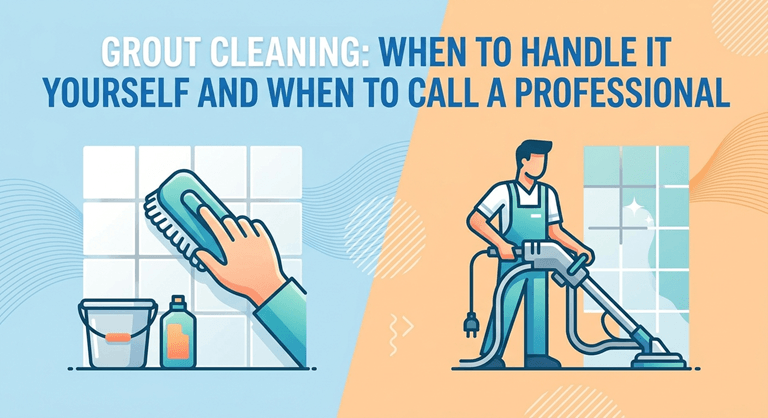
The question of when grout cleaning is a reasonable DIY task and when it warrants professional attention comes down to a few specific factors: how significant the discoloration is, how long it’s been developing, what type of grout is involved, and what products are available. Understanding these factors helps set realistic expectations rather than discovering after significant effort that the DIY approach wasn’t going to solve the particular problem at hand.
CJS Cleaning Solutions handles grout cleaning as part of deep cleaning services and encounters the full range of grout conditions from mildly discolored to severely stained, and the approach that works for each situation is genuinely different.
Understanding What’s Actually Discoloring the Grout
Before reaching for any cleaning product, it’s worth identifying what’s causing the discoloration, because different causes respond to different treatments and the wrong product can permanently affect the grout.
Mildew and mold growth in shower grout produces black or dark gray discoloration and is one of the most common bathroom grout problems. This responds reasonably well to bleach-based products on cement-based grout types where bleach won’t cause damage, but it requires adequate contact time rather than quick wiping. The mold needs to be killed, not just lightened, which means the product needs to penetrate into the porous grout surface rather than just treating the exterior.
Mineral deposits from hard water create a different discoloration pattern, typically a whitish or tan accumulation that makes grout appear lighter than its original color in ways that worsen around water sources. These respond to acidic cleaners designed for mineral removal rather than bleach-based products.
Soap scum accumulation creates a cloudy or dingy appearance that can be confused with either mineral deposits or mildew, but responds best to surfactant-based degreasers rather than either bleach or acid treatments.
DIY Grout Cleaning That Works
If the grout lines are only slightly discolored and have not been stained for a long time, applying a baking soda and hydrogen peroxide paste to the discolored grout lines and scrubbing with a stiff-bristle grout brush after a sufficient dwell time will yield some results. This is suitable for use on cement-based grout, can be used on discolouration due to mildew, and, when used correctly, does not have such surface damage concerns as more aggressive products.
If the staining from mildew in the shower is more extensive, a diluted bleach solution can be used over a period of time with a small brush, or a bleach-gel product formulated for grout might be used so that the bleach is in contact with the grout for sufficient time to penetrate and kill the mold, rather than just touching the surface.
The single most crucial element in the DIY grout cleaning world is the dwell time. Minutes of contact are more important than seconds when it comes to products. Regardless of the product, it’s not very effective when you spray and scrub immediately.No matter what product is used, the natural impulse to spray and immediately scrub is not very effective.
Where DIY Reaches Its Limits
Stained grout that has accumulated mineral deposits that have turned to a hardened layer over the grout surface will not respond to consumer products, no matter how much is applied. Professional grout cleaning with the mechanical process allows the use of special rotary brushes and high-pressure extraction that can penetrate the pores of the grout in ways that hand scrubbing cannot.
If you’ve tried the color removal solutions and struggled to get it to remove the stain properly after numerous attempts, and your grout remains heavily stained, it’s likely a good candidate for a professional evaluation, as the professional process doesn’t just involve the better formulations that the DIY options have, but it also involves equipment that can do more than the DIY effort can do.
The Sealing Question
If the grout is not properly sealed after cleaning, it will restain more quickly than a properly sealed grout. The sealants close the pores of the cement-based grout so that staining compounds are not easily absorbed by the grout but have difficulty getting in, even though they may be present on the surface.
Sealing should be done after (not before or instead of) the process of cleaning. Restaining occurs more slowly, and cleaning is much more effective when the grout is cleaned and then restained because they are dealing with surface contamination, not embedded staining.
Grout sealing is part of the CJS Cleaning Solutions deep cleaning tile services because the combination of cleaning plus sealing will leave the tile areas looking much better and lasting much longer than cleaning alone, saving on future grout cleaning.
Popular on OTW Right Now!




About The Author

Gagan Bhangu
Founder of otechworld.com and managing editor. He is a tech geek, web-developer, and blogger. He holds a master's degree in computer applications and making money online since 2015.