
5 Best Credit Decisioning Software to Sync Business Users and Data Teams
Credit decisioning software helps organizations make faster, more consistent lending and risk decisions while reducing manual effort.
As data volumes grow and compliance requirements become more complex, businesses need platforms that can connect business users, analysts, and data teams within a shared decision-making environment.
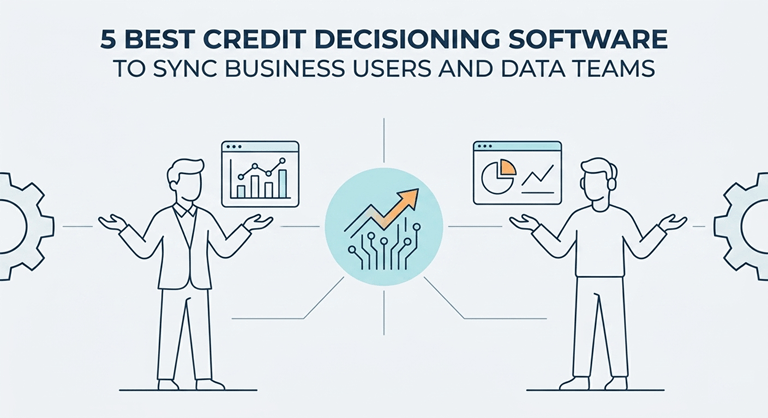
The best solutions combine automation, analytics, and transparency to streamline approvals, reduce risk exposure, and improve operational efficiency.
Whether you’re evaluating credit applications, managing collections, or optimizing receivables, the right platform can help align decision strategies with business goals. Here are five of the best credit decisioning software solutions available today.
1. C&R Software (FitLogic)
Overview
FitLogic from C&R Software is one of the most comprehensive credit decisioning platforms available for organizations that need stronger collaboration between business users and data teams.
The platform transforms complex data into actionable intelligence while bringing decision logic, business rules, and predictive models into a centralized environment.
Designed for organizations operating in regulated industries, FitLogic provides a shared workspace where analysts can manage decision rules through visual no-code tools while data scientists deploy PMML and Python models without lengthy development cycles.
This approach helps eliminate fragmented decision processes and creates a single source of truth across departments.
Visual decision flows improve transparency by allowing stakeholders to understand how outcomes are generated, supporting both governance and compliance requirements.
Organizations can test, deploy, and refine strategies much faster than traditional decision management systems.
Core Capabilities
The platform provides multiple rule-design views, including decision trees, decision tables, and code-based environments. Business users can update and manage rules without extensive technical expertise, reducing dependency on IT resources.
FitLogic combines rule-based decisioning with machine learning models to automate low-risk approvals while directing higher-risk applications through more detailed evaluation processes.
The system analyzes credit history, financial information, payment behavior, and other relevant data sources to support more informed decisions.
API-based integrations allow organizations to process real-time data from multiple systems, helping decisions reflect current conditions rather than outdated information.
Performance dashboards and reporting tools provide visibility into decision outcomes and strategy effectiveness.
Additional features include champion-challenger testing, role-based access controls, audit trails, customizable dashboards, and proactive monitoring alerts. Its flexible architecture supports evolving business requirements without major system redesigns.
Ideal Use Cases
Financial institutions use FitLogic throughout the credit lifecycle, including onboarding, credit assessments, collections, and recovery operations. Banks can accelerate KYC and AML checks, while lenders can automate application evaluations without sacrificing risk controls.
The platform also supports organizations in telecommunications, utilities, insurance, automotive finance, and government sectors. Predictive analytics capabilities help identify at-risk customers earlier, enabling proactive intervention before delinquency occurs.
Businesses with high application volumes or rapidly changing regulatory requirements benefit particularly from the platform’s ability to adapt decision logic quickly while maintaining transparency and consistency.
2. Collect!
Overview
Collect! is a debt collection and accounts receivable management system that automates the debt collection process right from the initial contact up to the final payment.
The software is highly configurable and can be adapted to the individual needs of collection agencies and creditors who need to have very specific processes in place.
The platform comes with industry-standard configurations that enable teams to get to work quickly and easily, and then easily evolve the workflows over time. Organizations can begin with the lower levels and expand to higher levels without losing customizations, historical data, or any features.
Collect! brings all the accounts, contacts, payments, documentation, and operational reporting into one environment.
Core Capabilities
Work Queues give collectors a way to manage tasks that are prioritized and give the administrators a way to have centralized control over workflows and business rules. The platform is capable of supporting complex portfolio structures and having a long account lifespan.
Multiple accounts are supported and can be set to post according to a configurable “Posting Logic,” and detailed audit tracking is maintained by payment processing features. Automated imports, contact management features, payment tracking, and integration tools help in the pre-collection and recovery process.
Validation notices, consent tracking, workflow auditing, detailed activity logs, multi-factor authentication,n and encrypted data transfers are among the compliance features. Reporting tools offer both operational monitoring capabilities and client reporting capabilities.
The platform is highly customisable, but some organisations might prefer a less modern interface for the platform as compared to newer cloud-based options. High-end configurations may also need the expertise of advanced administrators to get the job done.
Ideal Use Cases
Collect! is ideal for 1st party creditors, collection agencies, and organisations that need to have a lot of control over the workflow.
Entry-level editions are suitable for smaller agencies, and larger companies can take advantage of the advanced reporting and portfolio management capabilities.
For organizations that have a long history of collection in place, the platform is even more beneficial with its flexibility and stability.
3. Visual Queue Network (VQN)
Overview
Visual Queue Network (VQN) is about behaviour-based debt collection & debt recovery management.
Financial institutions and health care organizations have long been leveraging it to handle delinquent accounts for many product lines.
Built on Microsoft .NET architecture, VQN is able to connect to the existing banking and financial systems, as well as work with the familiar reporting and document formats.
Core Capabilities
One major difference is the Behavioral Modeling Risk Scoring Routine, which checks payment behavior to determine which accounts are at risk and need to be corrected, yet does ot unnecessarily collect for those with repeatable payment trends.
Dynamic queuing automatically prioritizes accounts based on risk and servicing requirements. Workflow management can be used pre-charge-off and post-charge-off, and can help to give visibility across the recovery lifecycle.
The Default Management Recovery features enable organizations to handle foreclosures, repossessions, bankruptcies, and legal matters from a single point. Documentation is all in one place and can be accessed.
Other features include portfolio segmentation, productivity reporting, document management, and tracking interactions with customers.
Ideal Use Cases
VQN is ideal for banks, credit unions, healthcare providers, recovery teams, and all entities dealing with delinquent accounts, special assets, and legal recovery.
Its behavioral analytics capabilities can help organizations detect potential defaults at an earlier stage and take proactive measures to manage their service.
4. Beyond ARM
Overview
Beyond ARM is a cloud-based accounts receivable and debt collection solution that enables organizations to enhance their recovery abilities by way of automation and workflow.
The SaaS solution has built-in compliance controls, high system availability, and security levels suitable for processing sensitive financial information.
Core Capabilities
Integrated with a variety of third-party communication, mailing, and verification services, Beyond ARM makes collection activities and data management easier.
The core functions are predictive dialing, credit risk scoring, reporting analytics, electronic signatures, electronic payment processing,g and secure tools communicating with debtors.
Workflows, screen layout, and processes can be tailored to fit existing processes within the organisation. Automated notices, invoicing, scheduling calls back,k and payment processing all minimize manual tasks and enhance the consistency.
The platform’s reporting features offer insights into performance metrics, account activity, and collection results.
Ideal Use Cases
Beyond ARM can be utilized by healthcare organizations, government bodies, financial institutions, collection agencies, es and lending institutions to help them with receivables and recovery more efficiently. Its ability to deploy the platform in the cloud and its workflows are configurable, making it appealing to businesses that want to automate without much involvement from their IT teams.
5. My DSO Manager
Overview
My DSO Manager is a cloud-based credit management and accounts receivable solution, tailored for credit professionals. It provides more than 2,100 companies in different countries around the world and is designed to help improve the visibility of cash flow and the efficiency with which it can be collected.
Implementation is usually a fast one, and hence it’s attractive to organisations that would like to modernise their receivables management without undertaking long deployment projects.
Core Capabilities
The platform allows for very flexible workflows, depending on customer segment, region, risk, and business policies. Teams are able to set up communication templates, escalation, and collection actions as per operational needs.
Its MAIA generative AI functionality processes customer responses and updates collection records automatically, reducing administrative workloads.
The features of automation are personalized dunning communication, payment reminders, interactive customer communication, and integrated payment.
The system is also fully equipped to handle dispute workflows and has seamless integration with the key ERP solutions like Sage, Microsoft Dynamics, Oracle, and SAP.
Multi-language, multi-currency, and multi-entity features allow organizations to work in various markets. Real-Time dashboards offer transparency of overdue balances, DSO performance, and productivity of collection teams.
Ideal Use Cases
For companies dealing with cross-border accounts and with a diverse customer base, my DSO manager is an ideal fit. It can be used by expanding firms as well as huge organizations with intricate credit management methods.
Its automation and reporting features can benefit companies looking for ways to improve their cash flow, minimize overdue balances, and optimize their operations.
Conclusion
Credit decisioning software is crucial in the process of achieving a balance of growth, risk, and operational efficiency.
The solutions below are related to various phases of the credit lifecycle, such as automated decisioning, risk and collections, and receivables management.
For organisations aiming to bring together business users and data teams, transparency, automation, and flexibility are key factors to look out for.
FitLogic differentiates itself with its offering of decision management, analytics, and model deployment all in a single collaborative platform, whereas the other solutions provide excellent collection, recovery, and receivables optimization capabilities.
The choice of platform will depend on your operational needs, compliance requirements, and long-term business goals.
Popular on OTW Right Now!



About The Author

Gagan Bhangu
Founder of otechworld.com and managing editor. He is a tech geek, web-developer, and blogger. He holds a master's degree in computer applications and making money online since 2015.