
How Hardware Lifecycle Management Can Reduce IT Infrastructure Costs
The total cost of IT infrastructure goes well beyond the initial price of the hardware, as the costs associated with support, repairs, upgrades, downtime, and replacements all add to the overall expenses over the asset’s lifetime.
It is possible to spend money on replacing equipment too early, but if you keep it for too long you may encounter another problem, especially when failures occur frequently or when the performance starts to decline.
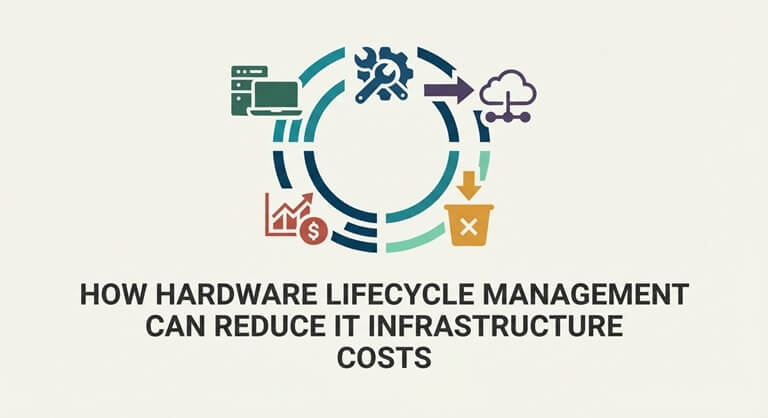
Hardware lifecycle management allows businesses to reach the right balance since it gives IT teams a systematic way of controlling costs while at the same time ensuring that the infrastructure remains reliable.
What Is Hardware Lifecycle Management?
Hardware lifecycle management includes all the various stages that IT equipment goes through during its period of use, such as planning, purchasing, deployment, maintenance, upgrading, support, and eventually its retirement.
Good lifecycle planning also considers what happens after the original warranty expires. Businesses may use third party maintenance when equipment still performs well but OEM support is no longer the right fit. This gives IT teams more flexibility when deciding how long individual assets should remain in service.
The objective is not to ensure that the existing equipment continues to function indefinitely; instead, businesses should get more value from the hardware they currently have before deciding to spend money on replacing it. Each decision must be based on cost, performance, reliability, and the actual requirements of the business.
Where IT Infrastructure Costs Build Up Over Time
The figure paid for the asset is only the beginning of the total cost; once you have a clear understanding of the further expenses it becomes easier to identify areas in which effective lifecycle management can lead to savings.
- OEM support contracts can become more expensive as equipment ages.
- Frequent hardware refreshes can create unnecessary capital spending.
- Emergency repairs often cost more than planned maintenance.
- Hardware failures can create expensive business downtime.
- Poor inventory tracking can lead to overlapping support contracts.
- Early replacement leaves usable hardware capacity unused.
- Unplanned purchases can make annual IT budgets harder to control.
Why Fixed Hardware Refresh Cycles Can Increase Costs
A great many organizations replace their hardware after a set number of years, which makes it easier to prepare budgets, but the equipment doesn’t always reach the end of its useful life at the scheduled time.
A server that is five years old could still be giving adequate performance for its particular workload. However, another server of the same age might already be having capacity problems or be experiencing repeated failures. It would be wrong to replace both of them at the same time because of these differences.
Looking at each asset separately is what a lifecycle-based approach entails. IT teams should keep equipment if it is still useful and focus on replacing it only when it really provides value. This way, infrastructure spending can be spread out over a longer period.
How to Decide Which Hardware Should Stay in Service
Although the hardware is important, it shouldn’t be the only consideration when making a decision to replace it. Instead, teams should examine how the equipment performs, its condition, and the kind of workload it supports.
Review Hardware Health
Begin by looking at past failures, the repairs carried out, the alerts that have been generated, and the components that have been replaced; a system that is stable and has only a small number of problems may still have a useful life ahead of it. On the other hand, frequent troubles suggest that carrying on with operation is becoming more costly.
Check Performance and Capacity
Even if hardware is reliable it can become inappropriate as workloads increase. You should check the processor’s usage, the amount of memory, the storage capacity and any other relevant performance indicators. Should the system regularly hit its limits, then an upgrade or replacement might be the better option.
Consider the Impact of Failure
All devices do not pose the same level of business risk; a failure in a key application can be much more costly than a failure in a lesser system. Therefore, decisions regarding support and replacement should take that difference into account.
Practical Ways to Reduce Hardware Lifecycle Costs
There is no need for a single major change to the infrastructure in order to achieve cost reductions; meaningful savings can result from a number of smaller decisions made throughout the hardware lifecycle.
- Keep reliable equipment in service when it still meets business requirements.
- Replace individual components instead of complete systems when practical.
- Track warranty dates before purchasing additional support.
- Match support response times with the importance of each asset.
- Plan replacements before failures force emergency purchases.
- Consolidate support where several hardware brands are being managed.
- Retire equipment when maintenance costs outweigh its remaining value.
How Maintenance History Improves Replacement Decisions
It is easier for IT teams to make replacement decisions if they have a clear record of each asset; when there are no such records, the age of the hardware usually ends up being the reason given for approving a refresh.
The maintenance records indicate which systems have needed repair and how often problems occur; they can also show repeated failures of components that do not appear significant when each incident is looked at individually. This provides teams with more evidence when comparing ongoing support with replacement.
Historical data can likewise help with budgeting since it allows teams to spot equipment that is becoming costly before it reaches the point of critical failure. This enables replacement spending to be planned rather than having to respond to an emergency.
When Does Keeping Older Hardware Become Too Expensive?
Savings from extending the life of an asset will only occur as long as the equipment remains economical to operate; this situation may change if the requirements for repair, the risk of downtime, and the need for performance increase.
Repair Frequency Keeps Increasing
An occasional component failure does not always justify replacing a complete system. However, repeated server maintenance can gradually make an older server more expensive to keep. Tracking repair frequency helps teams recognize when that point is approaching.
Replacement Parts Become Difficult to Source
As hardware ages, the availability of parts can decrease. The system might still function reliably, but a future failure could result in a long delay when waiting for the required component. Therefore, the increased risk of downtime should be taken into account when making lifecycle decisions.
Performance No Longer Meets Business Needs
It is impossible for maintenance to overcome all hardware limitations. If workloads increase then there will be a need for more processing power, more storage space, greater memory or for newer features. It is reasonable to replace the equipment when the existing machinery can no longer efficiently meet these requirements.
How to Build a Cost-Effective Hardware Lifecycle Strategy
Hardware lifecycle management is most effective when decisions are made in advance of the equipment causing a problem, since a well-defined process allows IT teams to compare different support, upgrade, and replacement options.
- Keep an updated inventory of important IT hardware.
- Record purchase, warranty, EOL, and support expiration dates.
- Track failures, repairs, and component replacements for each asset.
- Group equipment based on workload and business importance.
- Review capacity before extending an asset’s working life.
- Compare support costs against the expected cost of replacement.
- Reassess lifecycle decisions as infrastructure requirements change.
Conclusion
Hardware lifecycle management enables businesses to have greater control over their infrastructure spending; rather than replacing equipment just because it reaches a certain age, teams can assess the value that each asset still provides.
Certain equipment is able to keep working reliably for many years, whereas with other systems the costs may rise quite quickly. The reasons that distinguish the two are performance, the maintenance record, the availability of parts, and the effect on the business.
The outcome is that spending on infrastructure becomes more deliberate, with businesses being able to obtain greater value from their current hardware while using their budget for replacements on those systems which actually need it.
Popular on OTW Right Now!



About The Author

Gagan Bhangu
Founder of otechworld.com and managing editor. He is a tech geek, web-developer, and blogger. He holds a master's degree in computer applications and making money online since 2015.