
7 Signs a Startup Needs Custom Software Development
Startups operate with rapid speed. Founders at the beginning of their businesses depend on spreadsheets, off-the-shelf software, and third-party platforms for their operational management. The initial success of these solutions fades away as the business expands over time.
The growing demands of customers, together with the rising complexity of business operations, create a situation where startups must stop using standard software because it fails to meet their business needs. The need for custom software development becomes essential at this point.
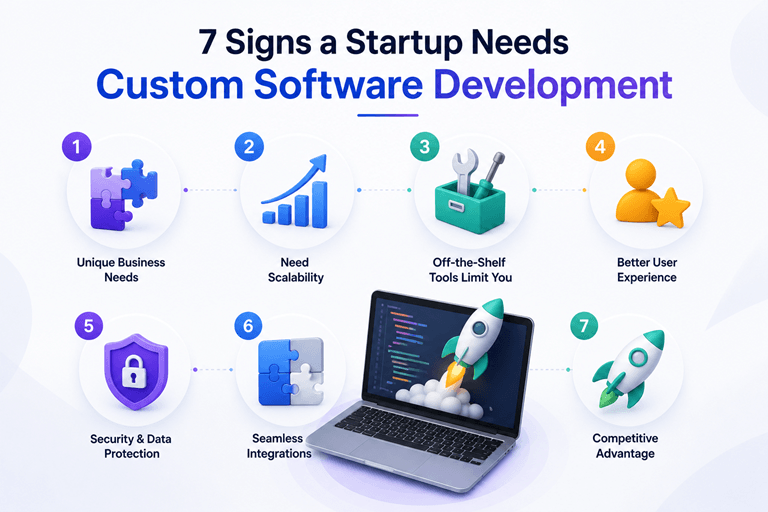
Many expanding companies prefer establishing partnerships with a mobile app development company in the USA to develop custom solutions that precisely match their business requirements. But how do you know when your startup is actually ready for custom software?
In this guide, let’s find out the few important signs that might indicate your startup requires a custom software solution rather than a ready-made one.
What Is Custom Software Development?
Custom software development creates unique software solutions that meet specific business needs instead of using existing software products, which are available to all users.
Unlike generic tools, custom software is built around:
- Your workflows.
- Your customers.
- Your goals.
- Your scalability requirements.
This gives startups more flexibility and control as they grow.
Why Startups Outgrow Off-the-Shelf Software
Startups start their operations with cost-effective SaaS solutions that provide fast deployment capabilities. The platforms serve general users because their design does not accommodate specific business needs.
As a startup scales, problems often emerge:
- Limited customization.
- Integration issues.
- Performance bottlenecks.
- Rising subscription costs.
- Workflow inefficiencies.
At some point, using multiple disconnected tools becomes more expensive and inefficient than building a dedicated solution.
1. Your Team Is Spending Too Much Time on Manual Work
One of the biggest warning signs is excessive manual work.
If your employees constantly:
- Copy data between systems.
- Update spreadsheets manually.
- Repeat the same tasks daily.
- Rely on workarounds.
Your business is losing productivity.
Custom software can automate repetitive tasks and streamline operations.
For example:
- Automated reporting.
- Customer onboarding workflows.
- Inventory management.
- Invoice generation.
Automation improves efficiency and reduces human error.
2. Existing Tools No Longer Fit Your Workflow
Off-the-shelf platforms often force startups to adapt their operations around software limitations.
If your team regularly says:
- “The software can’t do that.”
- “We need a workaround.”
- “We’re using five tools for one process.”
It’s likely time to consider a tailored solution.
Custom software is built around your business processes instead of forcing your business to fit generic software rules.
3. Your Startup Is Growing Rapidly
Rapid growth is exciting, but it also creates operational pressure.
As your customer base expands, your software must handle:
- Increased traffic.
- Larger databases.
- More transactions.
- Additional team members.
Many low-cost platforms struggle with scaling demands.
Custom software allows startups to build a scalable architecture that grows alongside the business.
Companies like Airbnb and Uber eventually invested heavily in custom infrastructure because scaling required more flexibility than standard platforms could provide.
4. You Need Better Data and Analytics
Data is one of the most valuable assets for modern startups.
If your current tools provide limited reporting or fragmented analytics, decision-making becomes difficult.
Custom software can centralize business intelligence and provide:
- Real-time dashboards.
- Predictive analytics.
- Customer insights.
- Performance tracking.
This helps founders make faster and smarter decisions.
5. Security and Compliance Are Becoming a Concern
As startups grow, they often begin handling:
- Sensitive customer information.
- Payment data.
- Confidential business records.
Generic platforms may not always provide the level of security or compliance your business requires.
Industries like:
- Healthcare.
- Fintech.
- eCommerce.
often require stronger data protection measures.
Custom software allows businesses to implement advanced security features tailored to their industry requirements.
6. Your Subscription Costs Keep Increasing
At first, SaaS tools seem affordable. But over time, recurring monthly subscriptions can become expensive.
Many startups pay separately for:
- CRM systems.
- Project management tools.
- Analytics platforms.
- Marketing software.
- Communication apps.
As team size grows, these recurring expenses increase rapidly.
In some cases, building custom software becomes more cost-effective long-term.
While the upfront investment may appear higher initially, it can reduce dependency on multiple third-party platforms over time.
7. You Want a Competitive Advantage
Custom software can become a major differentiator.
If your startup offers:
- Unique workflows.
- Innovative customer experiences.
- Specialized services.
Generic software may limit your ability to stand out.
Custom development allows businesses to create:
- Personalized experiences.
- Unique product features.
- Faster workflows.
- Stronger integrations.
This competitive advantage can improve both customer retention and operational efficiency.
Benefits of Custom Software Development for Startups
Once startups move toward custom solutions, they often gain several long-term advantages.
1. Scalability
Custom systems can expand as your business expands, without significant limitations on the platform.
2. Flexibility
New features can be added as needed for the business.
4. Better Integration
Custom software connects smoothly with:
- APIs.
- Third-party platforms
- Internal systems.
5. Improved User Experience
Customized interfaces help to make the experience better for the customers and employees.
6. Higher Efficiency
Automation and workflow centralization cut down on time-wasting.
Common Types of Custom Software Startups Build
Different startups require different solutions.
Popular examples include:
- Customer portals.
- SaaS platforms.
- Inventory systems.
- Mobile apps.
- CRM systems.
- Booking platforms.
- Workflow automation tools.
The benefits of custom development are that businesses can prioritize features that are needed for their operations.
How Much Does Custom Software Development Cost?
Cost depends heavily on:
- Project complexity.
- Features.
- Integrations.
- Team size.
- Development timeline.
The price of basic solutions could range into the thousands, and enterprise-grade solutions could be significantly larger investments.
These costs are frequently contrasted with the continuous subscription fees and ineffectiveness of operations.
It’s also important to understand that mobile app development costs and custom software pricing vary significantly depending on scalability requirements and technology stack.
Challenges Startups Should Consider
Custom development offers major benefits, but startups should also understand potential challenges.
1. Higher Initial Investment
Typically, custom software takes a larger cost investment than a SaaS subscription.
2. Longer Development Time
Developing software from beginning to end requires planning, testing, and iteration.
3. Maintenance Responsibility
Custom systems require:
- Updates.
- Security patches.
- Performance monitoring.
- Ongoing support.
Choosing the right development partner is critical for long-term success.
Questions Startups Should Ask Before Investing
Before moving forward with custom software, startups should evaluate:
- Is our current software slowing us down?
- Are manual tasks reducing productivity?
- Will scaling create operational problems?
- Are we overspending on subscriptions?
- Do we need unique features competitors don’t offer?
The answers often clarify whether custom development is the right move.
Future Trends in Custom Software Development
Today, startup companies are turning to cutting-edge technologies such as:
- Artificial intelligence.
- Cloud computing.
- Automation tools.
- Machine learning.
- Blockchain integration.
Custom software allows businesses to integrate these technologies more effectively than generic platforms.
As digital competition grows, personalized systems are becoming a stronger strategic advantage.
Final Thoughts
All startups hit a point where they feel constrained in their problem-solving capabilities due to the use of ready-made tools. The enterprise deserves to be able to have more control over its operations so that, at times, they want to improve their workflows, it needs to expand their business, and their customers demand better service, they need custom software development.
Companies prosper when they identify key drivers of success. The investments in scalable, custom solutions are making it easier for startups to grow and develop in the future.
In the case of custom software development, you need to develop systems that help you meet your business objectives, boost efficiency, and provide better user experiences for your employees and customers.
Popular on OTW Right Now!

About The Author

Gagan Bhangu
Founder of otechworld.com and managing editor. He is a tech geek, web-developer, and blogger. He holds a master's degree in computer applications and making money online since 2015.