
How Governments Decide Which Emerging Technologies Are Worth Funding
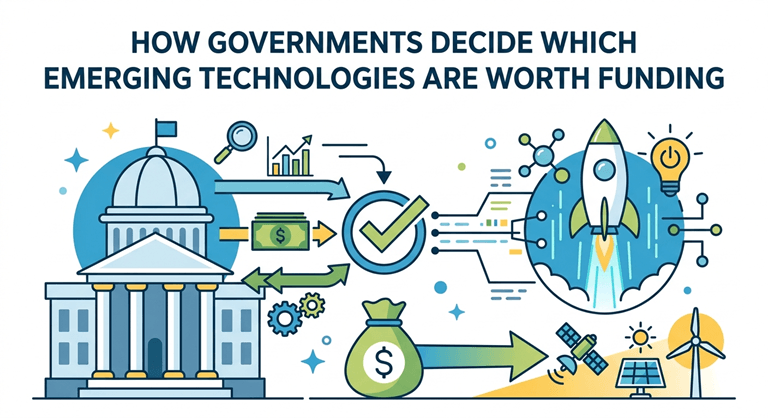
Governments finance new technologies in a combination of national security, expected economic benefits, and the probability that private investors alone won’t be able to accomplish the development in time. The key question is whether a technology is of strategic value to the country, if the country may lose its position to competitors, and if public funds would be used effectively to change the outcome rather than simply subsidize a product that the market would produce anyway.
Actually, this last issue is the one that counts more than is generally thought. A technology for which venture capital is already investing billions hardly ever needs a government check, whereas one with a 15-year period before it yields results and a commercially uncertain application generally does. That is why we observe public financing of early-stage, capital-intensive areas like quantum computers, fusion energy, advanced semiconductors, and synthetic biology, where the distance between scientific potential and marketable product is so vast that it scares away private investors.
What Criteria Governments Actually Use to Rank Technologies
Most national funding organizations conduct some type of strategic technology assessment before releasing funds. One common way is to assess maturity level, often by employing a tool like Technology Readiness Levels, which rates a technology from level one, indicating the earliest stage of basic research, to level nine, representing a fully operational system. Public funding usually targets mainly levels two to five, where the technology is at a real scientific stage, but commercial viability is still uncertain.
Besides maturity, they also consider dual-use potential, i.e., if a technology can be used for both civilian and military purposes. Chips production, AI, and quantum sensing receive high marks here, which partly accounts for why they garner so much attention. There’s also a competitiveness perspective. If a country sees a competitor getting ahead in a field that it considers fundamental, funding will be increased almost irrespective of short-term return. The US CHIPS and Science Act, which allocated around 52 billion dollars for domestic chip manufacturing, was motivated much more by supply-chain vulnerability and competition with China than by any typical cost-benefit analysis.
Cost and timeline ultimately help determine the decision. A project that calls for a decade and tens of billions, like fusion, is judged differently from one that may yield results in three years. Governments almost never expect to recover the investment directly. Instead, they estimate spillover effects, the jobs, patents,t s new companies, and a knowledgeable workforce that emerge from a funded field over 20 or 30 years.
How the Decision Process Works Behind the Scenes
From the first spark of an idea to a fully funded program, the journey is often much slower and more complicated than most people think. Typically, it would be an advisory group or expert panel, mainly comprised of university professors and industry leaders, that produces a roadmap outlining priority areas. A similar process in the UK may involve UK Research and Innovation, while in the US, different agencies like DARPA, the National Science Foundation, or the Department of Energy (each with its own preference for risk) can be the sources of such roadmaps.
DARPA deserves a mention as its approach is quite different and has been replicated in many places. It supports very risky but potentially very rewarding projects and actually expects many of them to fail, basing its argument on Truth is a single discovery (the internet or early GPS work are the typical examples) can compensate for the costs of many failures. Such an acceptance of failure is really very uncommon in government, where, due to political motivations, the occurrence of waste is usually blamed.
After priorities are finalized, the money is disbursed via grants, public-private partnerships, or direct government purchases. In fact, procurement is a highly effective tool, but it does not get much recognition. By serving as a guaranteed early customer, the government takes the risk away from the technology not only for itself but also for everyone else. This is basically the way the US-assisted cost reduction of solar and how defence contracts contributed to the development of modern computing. Review of decisions happens periodically, and those projects that have no justification for continuation are discreetly closed down. But, due to political reasons, even unproductive projects are kept alive for longer than their results could justify.
Why Some Technologies Get Funded, and Others Are Ignored
It is possible for two technologies with comparable scientific quality to end up on different sides of a funding decision due to reasons largely unrelated to science. Timing is one such aspect. If a field is a current political priority, for example, energy security after a supply shock, or pandemic preparedness after an outbreak, it will get access to money that was inaccessible to it two years ago.
Besides, geography and existing strengths are considerations. For example, a country that is heavily invested in photonics research will be the one advancing quantum technologies that rely on it, while another country with knowledge in agricultural science will focus more on biotech and food systems. Governments generally prefer to invest heavily in the areas where they already have skilled personnel and infrastructure rather than starting from scratch, which is a reasonable decision, but unfortunately, it helps to maintain the existing disparities between nations.
The harder cases are technologies that are genuinely promising but lack an obvious champion. These fall into what people in the field call the valley of death, the stage between a working lab demonstration and a commercial product where funding dries up. Specialist advisory services increasingly help both companies and public bodies navigate this stage, translating dense technical roadmaps into the commercial and risk language that funding committees actually respond to. That translation work sounds minor, but a brilliant technology with a poorly framed case for investment loses out to a mediocre one with a sharp narrative more often than anyone would like to admit.
How Approaches Differ Across Countries and Regions
Funding philosophy is not the same everywhere. The US relies on a decentralized combination of different agencies, plus quite a bit of private investment. The US is willing to accept failure and even let the market decide the winners and losers. This model results in not only successful projects but also quite a lot of wasted ones.
The European Union has a more coordinated approach, following a set of rules, and in this way, the money is passed through multi-year programs like Horizon Europe, which has a budget of approximately 95 billion euros. It promotes cooperation among member states and is stricter in its accountability measures. Still, this focus means that the EU will be slower than a single agency that decides to make a daring bet. China has a model where the state is far more directive. In this model, the state sets clear objectives in the national plans and uses capital, state-owned enterprises, and academic institutions to achieve these objectives with very little pluralism, which is typical of the West. All the systems have certain advantages, and the analysts usually have long debates on which of them yields better long-term returns.
Smaller countries are in a completely different position. They do not have the financial strength to cover all bases. So, they mainly function through areas where they can be world-class instead of spreading themselves very thin. For example, Singapore, Israel, and the Netherlands. Data shows that scientific publications from the industry, with a focused approach, usually result in high returns on investment, and this acts as a good lesson for a person who is ready to begin all the shiny projects at once.
Popular on OTW Right Now!
-
 Which Programs Do Students Use to Write Their College Papers?
-
 How Quality Watch Parts Make a Big Difference in Performance and Longevity
-
 The High-Bay Retrofit Acceptance Protocol: How to Specify Light, Not Just Wattage
-
 Passenger Options Following a Flight Cancellation Under European Aviation Rules for Flight Cancellation Compensation



About The Author

Gagan Bhangu
Founder of otechworld.com and managing editor. He is a tech geek, web-developer, and blogger. He holds a master's degree in computer applications and making money online since 2015.