
How AI Video Summarizers Are Transforming the Way Professionals Learn From Long-Form Content
Introduction
Video is one of the most powerful means of learning for professionals, students, educators, researchers, and businesses. Organizations are generating more video content than ever before, whether it’s a recorded webinar and online course, a meeting, an interview, a conference, or a training session. This change has resulted in information having become more available, but it has also presented a new challenge: that of spending hours watching videos in search of the most valuable information.
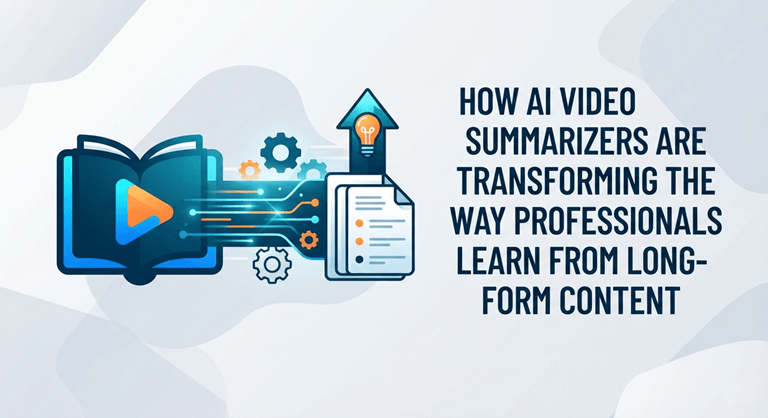
With the ever-growing video libraries, effective knowledge management is gaining importance. Tools for professionals to be able to identify key points, organise information, and increase productivity without compromising accuracy. This is where modern AI-powered summarization technology can help. Summarizing lengthy videos into structured, concise summaries can help users review and reference the information more easily. This innovation is redefining the way content for education and business is viewed by both individuals and groups to enable quicker and better decision-making.
Why AI Video Summarization Has Become Essential
On average, the knowledge worker devotes a good part of the week to digital information consumption. Whether it’s training sessions, client presentations, recorded meetings, or educational videos and webinars, there is a wealth of insights to be gained, but manually reviewing all the minutes is not feasible.
One solution to this is using summarization for videos, which leverages AI to find the most important and relevant portions of a video. Users are not required to scroll through long timelines as they are able to get summaries of key points, key discussions, and actions taken.
An illustration of this is the AI Video Summarizer, an online application that enables customers to upload video content from YouTube, Zoom, MP4 files, and so on, and receive a clear and structured summary within minutes. It offers the flexibility of generating different types of summaries, processing in several languages, and extracting key points, which will benefit students, teachers, researchers, content creators, and business professionals. It has no need to be installed or registered, and is fully online, which means you can use all its features without having to install or register anything.
Meanwhile, as organizations are creating digital content libraries of ever-increasing size, automated summarization is emerging as a viable way to help make this information more accessible.
AI Makes Long Videos More Searchable and Actionable
The inability to discover old video content is one of the major drawbacks of video content. Videos are hard to search efficiently without accurate transcripts or timestamps as compared to written documents.
Artificial intelligence has revolutionized the transcription industry, making it more accurate and efficient. The transcription industry has come a long way with the advent of artificial intelligence, significantly improving the accuracy and efficiency of transcript generation. Today’s speech recognition models are very capable of transcribing spoken words into structured text, even in various accents, languages, and styles. After transcripts are published, they can be searched, edited, and used in several workflows.
An accurate Free Online Video Transcript Generator is able to convert audio content into written text and can be used to easily find specific information when replaying a recording over and over. Precise transcripts also make content more accessible, enable collaboration in multiple languages, and make it easier to repurpose content for blogs, documentation, training and research notes.
Combined, transcripts and summaries provide an organization with a much more efficient means of organizing and accessing valuable information available in video recordings.
Practical Applications Across Industries
The power of AI video summarization has moved beyond the realm of tech firms. Summarization is being adopted by organisations from different industries as a part of their day-to-day activities, given the benefits it offers in terms of reduced human effort and increased productivity.
The purpose of using summarized lecture recordings in educational institutions is to enable students to revisit subjects that are difficult before the exams. Presentations and interviews can be processed by researchers more quickly and efficiently, thus focusing on analysis instead of transcription.
AI-generated meeting summaries are becoming a staple for businesses to save time on recorded meetings, customer interviews, onboarding processes, and compliance training sessions. When it comes to team discussions, those who can’t attend live meetings can follow what’s being said without having to watch an hour’s worth of video.
Marketing teams can glean the essential take-away messages from the webinar and transform them into articles, newsletters, social media posts, or promotional messages. Summarized training videos also help customer support departments to speed up employee onboarding and enhance knowledge-sharing.
Healthcare, legal, consulting, and financial analysts also find the recorded information readily available and still have organized documentation. With the ongoing advancements in AI technology, the applications of this type are likely to spread to almost all knowledge-based industries.
What Makes a High-Quality AI Video Summarization Platform
Not all summarizer tools will work to the same degree. There are several technical and usability aspects that affect the quality of the output and have a direct impact on the user experience.
The key to good summarisation is accurate speech recognition. As the quality of the transcriptions is not high, the summary could be incomplete or misleading. High-quality systems also differentiate between the main topics and supporting details, and don’t just shorten the transcript.
Flexibility is another key feature. Based on users’ purposes, they need various output formats. Depending on the individual, some may want bullet points, some may want to have structured paragraphs, executive summaries, or detailed note-taking for documentation purposes.
The support of language is also becoming more significant as companies are working together on international teams. Multilingual processing helps companies to summarize content in multiple languages without compromising workflow.
Ease of use has an impact on adoption. Platforms that do not require software installation and are browser-based open up technical access to users and facilitate collaboration between users and devices. The ease of processing, its ability to deal with a wide variety of files, and its user-friendly nature allow professionals to seamlessly incorporate summarisation into their daily practice without any further training.
With a platform that can provide for accuracy, speed, user-friendliness, and output that can be flexible, users can expect to get summaries that really make their job easier, instead of making them work harder.
The Future of AI-Assisted Video Knowledge Management
AI is still changing the way companies handle digital information. Artificial Intelligence is still transforming the way companies handle their digital information. The transformation towards intelligent information retrieval and automated content organization will encompass video summarization only as a part of the solution.
In the future, there will be integration of summarization with semantic search, speaker identification, topic classification, multilingual translation, and personalized knowledge recommendation. AI will not just make videos shorter, but more and more, it will help users find exactly what they’re looking for in a video, based on context and intent.
Manual review will be more difficult as video becomes an integral part of education, healthcare, enterprise communication, and media. AI-powered workflows offer a lot of benefits for organizations, including improved productivity, collaboration, and knowledge retention.
The technology also enables accessibility by helping to present complex information in a digestible way for a range of audiences, whether they are listening for long or short periods or in languages other than English. As speech recognition, language understanding and generative AI technology advance, so will these features.
Conclusion
Digital video technology has revolutionized the way knowledge is shared and has created challenges in managing information. Today, professionals require faster means to get insights without spending hours going through lengthy recordings.
AI video summarization comes to the rescue by transforming intricate video content into structured, retrievable, and actionable data. These, combined with correct transcription,n make large video libraries much more useful in education, business, research, and professional development, enhance learning, and increase collaboration.
With the continuing improvements in AI, intelligent video analysis will play an increasingly critical role in today’s knowledge management. Companies that adopt these capabilities now will be better equipped to manage increasing amounts of data, better inform decision-making, and make the most of the long-life value of digital content.
Popular on OTW Right Now!


About The Author

Gagan Bhangu
Founder of otechworld.com and managing editor. He is a tech geek, web-developer, and blogger. He holds a master's degree in computer applications and making money online since 2015.