
How AI and Digital Artwork Have Changed Custom Patch Manufacturing
Custom patch manufacturing has undergone a remarkable transformation over the past decade. Once dependent on manual sketching, lengthy production cycles, and extensive human intervention, the industry now benefits from artificial intelligence (AI) and advanced digital artwork technologies.
These innovations have improved design accuracy, accelerated production timelines, and made customization more accessible for businesses, sports teams, military units, schools, and fashion brands. AI-powered tools analyze artwork, optimize production processes, and reduce costly errors before manufacturing begins.
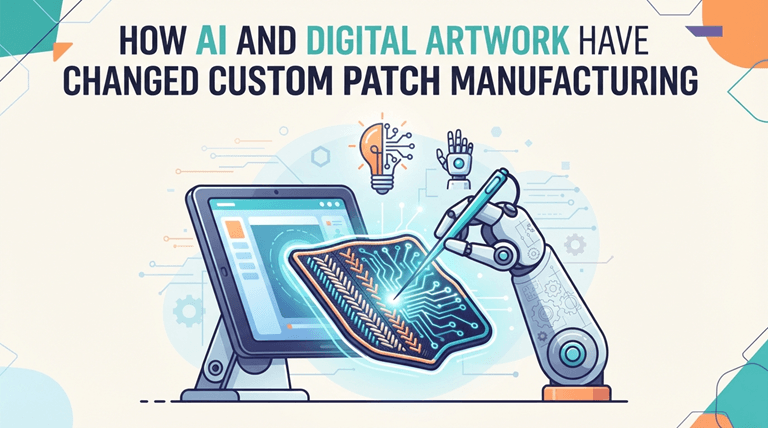
As a result, manufacturers can produce high-quality patches with greater consistency while maintaining the craftsmanship that customers expect. This combination of technology and creativity continues to redefine how custom patches are designed and produced.
What Is Modern Custom Patch Manufacturing?
Modern custom patch manufacturing is the process of transforming digital concepts into durable, customized patches using advanced software and computerized production equipment. Today’s manufacturers create a wide range of patch styles, including embroidered, woven, chenille, PVC, leather, and sublimated patches, each serving different branding and functional purposes.
Unlike traditional methods that relied heavily on hand-drawn artwork and manual adjustments, modern production begins with digital design files that ensure precision from concept to finished product.
Computer-aided design software allows manufacturers to preview colors, stitch placement, borders, and dimensions before production starts. This digital workflow minimizes waste, shortens approval cycles, and enables businesses to receive consistent products regardless of order size. The integration of automation has made custom patches more affordable while preserving the craftsmanship that distinguishes premium-quality products.
How Artificial Intelligence Is Transforming Patch Design
Artificial intelligence has become a valuable tool in the creative and technical stages of custom patch manufacturing. Instead of replacing designers, AI enhances their capabilities by automating repetitive tasks and providing intelligent design suggestions. Modern AI systems can recommend color combinations, improve artwork clarity, detect design inconsistencies, and optimize layouts based on embroidery or printing requirements.
Machine learning algorithms can also be used to predict manufacturing problems in advance. AI can anticipate issues that may occur during stitching, assess thread density, and suggest design adjustments that enhance durability while maintaining aesthetic appeal. These functions can reduce manufacturing delays and limit expensive revisions.
Moreover, AI can speed up the customer approval process by creating lifelike digital mockups that closely simulate the actual product. Businesses can see and change designs in minutes or less without having to wait days for physical samples. With this streamlined workflow, manufacturers can provide custom patches quickly, with exceptional quality and accuracy.
Why Digital Artwork Has Become the Foundation of Quality Patches
There will be no successful custom patch without this digital artwork. With high-quality vector files, manufacturers can create intricate logos and detailed illustrations without losing clarity due to the clean lines, scalable graphics, and precise color separation.
Vector graphics remain crisp and clear no matter what size the patch is. This accuracy is particularly useful for corporate branding, sporting logos, police insignia, and promotional items that require consistency.
Digital proofing also allows the customer to see the design before the production process starts, avoiding misunderstandings and expensive revisions. This, in turn, allows manufacturers to consistently produce professional-looking patches at a quality standard that meets current expectations, while also reducing material waste and ensuring a higher level of accuracy.
The Role of Embroidery Digitizing in Precision Manufacturing
One of the most critical steps in producing embroidered patches is embroidery digitizing, which converts digital artwork into a machine-readable stitch file. This process sets up the direction of stitching, stitch density, stitch sequence, underlay, compensation, etc., which ensure embroidery machines accurately duplicate the original design.
Better digitizing results in more legible text, better preservation of the details, and elimination of commonly occurring problems like thread breaks, puckering, or uneven stitching. Optimized stitch paths also contribute to production efficiency by minimizing machine movement during the patch production process and to the strength of the finished patch.
When done properly, digitizing opens the door for creativity and perfection, allowing embroidery manufacturers to seamlessly produce embroidered patches for everything from small custom jobs to massive commercial runs.
How AI Improves Production Speed Without Sacrificing Quality
From the initial design to the final product, AI has optimized every aspect of patch production, enabling manufacturers to boost efficiency without sacrificing quality. AI systems analyze production files to identify potential stitching conflicts, estimate production time, and make recommendations before production. This preventive measure greatly decreases human errors and material loss.
During the manufacturing process, automated quality inspection enhances consistency by identifying problematic conditions such as misalignment, color differences, or irregular stitching. Machine learning systems adapt through the process and learn from past manufacturing information, which helps them make more accurate predictions and optimize the manufacturing process with every completed order.
Manufacturers can finish projects faster and still meet high customer expectations thanks to faster file preparation, fewer production interruptions, and intelligent workflow management. The outcome is a manufacturing process that is both quick and precise while also remaining dependable, enabling the creation of personalized patches for various sectors to meet the increasing demand for customization.
Choosing the Right Manufacturing Partner
For hospitals looking to purchase Uniform Patches that will last and look great, choosing a custom patch manufacturer is crucial. A professional manufacturer with deep expertise should be able to provide expert Custom Patch Design services and should have a wide range of custom patches to suit various functional and branding requirements such as Embroidered Patches, Woven Patches, PVC Patches, Leather Patches, Chenille Patches, and Sublimated Patches.
The use of high-quality Twill Fabric and high-quality backing material like Iron-On Backing, Sew-On Backing,g and Hook and Loop (Velcro) Backing guarantees durability in challenging healthcare settings. Manufacturers with Bulk Orders, Wholesale Custom Patches, and a reasonable Minimum Order Quantity (MOQ) offer more flexibility to healthcare companies.
Their expertise often extends beyond medical uniforms to producing Military Patches, Police Patches, Fire Department Patches, Sports Team Patches, Motorcycle Club Patches, and Morale Patches. Nexus Patches, a custom patch maker in the USA, is one example of a manufacturer that delivers high-quality customized patches for diverse industries while maintaining consistent craftsmanship and attention to detail.
Future Trends in AI-Powered Custom Patch Manufacturing
AI is still making a significant impact on the future of custom patch printing with new and improved AI-powered design tools and more efficient production systems. With generative AI, customers can type a text prompt, and the design concept is generated in a fraction of a second, helping them envision the concept before a designer polishes the artwork.
Predictive analytics can also help manufacturers predict production schedules, optimize material usage, and minimize downtime. Customers, designers, and production teams can also access and approve projects from anywhere, with faster, better communication as a result of cloud-based collaboration platforms.
As technology advances, smart embroidery machines will offer even greater precision in stitching and production consistency, along with eco-friendly manufacturing practices, minimized waste, and better use of resources.
Why Businesses Are Investing in AI-Driven Patch Production
The use of AI in manufacturing is gaining traction across different sectors since it promises tangible benefits, such as enhanced quality, efficiency, and scalability. Businesses use custom patches for various purposes, such as strengthening brand identity, marking employee accomplishments, advertising events, and producing memorable branded items.
AI-powered workflows enable manufacturers to ensure accurate colors, sizes, and stitching in repeat orders, which helps ensure every patch adheres to brand requirements. Faster production cycles also allow the business to deal with seasonal campaigns, product launches, or promotional events quickly. By eliminating manual processes and enhancing production accuracy,
By utilizing AI, manufacturers can reduce production costs and create products that customers want, with a range of different appearances and durability.
Conclusion
The impact of artificial intelligence and digital art has transformed the design, production, and distribution of custom patches. Modern technology enhances the manufacturing process in many ways, including intelligent design support, automated quality control, accurate digital workflows, and advanced production equipment.
These innovations help manufacturers produce high-quality, long-lasting patches that are more detailed and faster than ever before. Meanwhile, skilled designers and production experts continue to play a vital role in bringing creatively conceived ideas to fruition that align with the customer’s exact specifications.
With the ongoing progress of AI technology, the manufacturing of custom patches is likely to become more efficient, eco-friendly, and effective for businesses, organizations, and individuals looking for personalized patches that can offer top-tier results.
- How does AI improve custom patch manufacturing?
AI improves design accuracy, automates quality checks, reduces production errors, and shortens manufacturing timelines. - Why is digital artwork important for custom patches?
Digital artwork provides precise design files that ensure accurate colors, clean outlines, and consistent production quality. - What types of custom patches can be produced with modern technology?
Modern manufacturers produce embroidered, woven, chenille, PVC, leather, and sublimated patches using digital workflows. - Can AI replace human patch designers?
No. AI supports designers by automating repetitive tasks, while creative decision-making and production expertise still rely on skilled professionals. - How does digital manufacturing reduce production costs?
Digital processes minimize material waste, reduce design revisions, improve production efficiency, and decrease manual labor, resulting in lower overall manufacturing costs.
Popular on OTW Right Now!



About The Author

Gagan Bhangu
Founder of otechworld.com and managing editor. He is a tech geek, web-developer, and blogger. He holds a master's degree in computer applications and making money online since 2015.