
AI Agents for Sales and Marketing: Automating Complex Workflows
A single deal today touches a CRM, an email platform, an ad account, a scheduling tool, and a handful of spreadsheets nobody officially owns. Marketing automation was built to handle one channel at a time, so a person still stitches the pieces together by hand. Those manual handoffs account for most of a revenue team’s wasted hours. This guide covers what changes when an agent handles that coordination, which workflows are ready for it today, and what a custom AI agent development effort needs to get right before it touches a live pipeline.
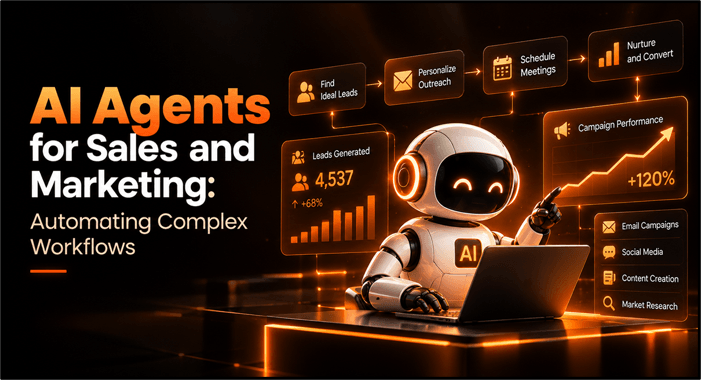
Where Sales And Marketing Workflows Get Complex
There are now more tools than any team could quickly name that are used during the client’s single journey. Although each of these tools carries out its particular function perfectly, none of them has any means of staying synchronized when moving on to the next stage of the work. The problem is not visible on the single dashboard and thus remains unaddressed for months.
● Multiple Systems, One Customer Journey
The lead completes a form and the information is entered into the CRM, after which the email tool tags it, the ad platform’s retargeting list picks it up, and it is finally scheduled on a salesperson’s calendar. At each stage the data becomes outdated or a step is completely omitted, and a field that is updated in one system seldom gets updated in all the other systems at the same time. It is only when a salesperson works from a record that is already outdated that anyone realizes this.
● Where Manual Handoffs Slow Things Down
Someone still checks whether a lead scored high enough to route to sales. Someone still copies campaign performance into a report by hand. Someone still decides which sequence a contact should enter next based on what they clicked. None of that work needs deep judgment, yet all of it currently needs a person, and that person is usually the same one already stretched across several other campaigns. Closing that gap is usually the first thing a scoping conversation about AI agent consulting turns up.
What AI Agents Add To Sales And Marketing
Traditional marketing automation is based on fixed rules which are established once and are seldom looked at again. An agent operates differently since it assesses the situation, checks the relevant data from various systems, and then takes action within the limits that a team had previously set. This difference is most important in the case of workflows in which the appropriate next step depends on data distributed across more than one platform.
● From Content Generation To Campaign Execution
A generative tool is able to prepare an email or an ad variation. Reliable AI agent solutions go beyond this by deciding which segment should get the message, scheduling it for sending, and modifying the following message in light of how the first one performed. Thus, they replace a procedure which previously required a person to check the dashboard every few days and then manually queue the next step.
● From Lead Scoring To Lead Routing
Static lead scoring simply assigns a score and no more is done. An agentic approach to the same task looks at the firm’s demographic data, recent activity, and the salesperson’s capacity. It then sends the lead to the appropriate person and updates the CRM record all at the same time, without any need for someone to open the queue first. The scoring model and the routing action take place as a single, integrated step rather than as two separate steps managed by different tools. This combination is one of the simplest ways to start a first custom AI agent development project.
Core Use Cases Worth Automating First
- Qualifying and routing inbound leads based on live account and activity data
- Coordinating a campaign across email, ads, and social from one trigger
- Sequencing outreach based on how a prospect engages with prior touches
- Keeping CRM fields current without a rep updating them manually
- Repurposing one piece of content into formats for multiple channels
- Flagging accounts showing early signs of churn before renewal season
There are a number of characteristics in common among these tasks which are worth observing. All of them have a definite set of rules, a measurable result, and are sufficiently extensive so that the time saved accumulates within a few weeks of going live.
Marketing Automation Versus Agentic Marketing Systems
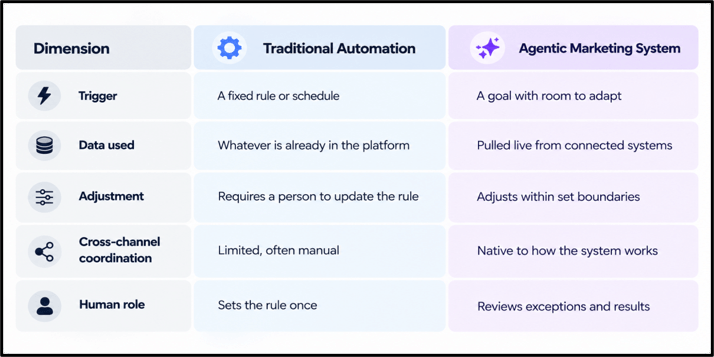
The same basic tools can be used for both categories and the model used in either case is seldom the limiting factor. The key point is how well the system is able to identify a changing situation and react to it without someone having to rewrite the rules. This is the fundamental promise that underlies most of the AI agent solutions currently being sold.
Personalization At Scale Without Losing Consistency
Previously, personalization involved putting a person’s first name into a template. With an agentic approach, the timing, channel, and content are adjusted according to how a prospect behaves. The team establishes the brand guidelines once at the beginning and then the system adheres to them in all subsequent messages.
● Where Personalization Breaks Down Manually
A representative who looks after fifty accounts could reasonably personalize each one, but when dealing with five hundred accounts they could not, and since the alternative would take more hours than the team had, most teams end up going with general messages.
● What Changes With An Agent In The Loop
An agent has the ability to keep track of all the accounts at the same time, reviewing the most recent activity before each message is sent and then making the appropriate adjustments, on a scale that would be impossible for one person to manage manually throughout the entire process. As long as the workflow, the quality of the data, and the conversion economics back it up, this level of high-volume personalisation can provide a tangible opportunity for improvements in efficiency.
Where Agents Fit Across The Funnel
- Top of funnel: an agent scores inbound leads and flags priority ones for a rep
- Mid funnel: an agent sequences follow-up content based on what a prospect viewed
- Late funnel: an agent updates deal stages and reminds a rep before it stalls
- Post-sale: an agent tracks usage signals and flags renewal risk early
It’s not necessary to begin coverage at every stage; most teams start by selecting one stage that has clear data and a genuine volume issue, then widen their coverage once that stage has been running reliably for a few months.
What It Takes To Build These Systems
The level of responsibility involved in dealing with a live pipeline is greater than that involved in sending a single email, and this is reflected in the engineering work in terms of both the extent of the task and the care taken.
● Data Foundations Come First
The quality of an agent when making a routing decision depends entirely on the data provided to it. If the CRM has duplicate entries, missing fields, and other errors, then it will produce both correct and confident decisions as well as incorrect ones. Cleaning such a database generally takes a lot more time than it does to build the agent itself, and most timelines for custom AI agent development fail to account for this stage before the first project is even scoped.
● Integration Effort Across Platforms
Each extra platform that an agent has to read from or write to will require its own authentication, rate limits, and data format. A workflow involving three tools is considerably easier to build and maintain than one that involves seven tools. For this reason, it is important to decide on the list of integrations at an early stage in order to ensure that the first version is realistic.
● Guardrails For Outbound Communication
The reputational impact of sending a message on behalf of a company is greater than that of making a routing decision. When an agentic build has been properly scoped, it establishes limits regarding how frequently messages can be sent, the approval procedures needed for new message types, and a clear way for a person to intervene so that a mistake does not end up in a prospect’s inbox on a large scale.
Common Implementation Mistakes
- Connecting every tool at once instead of starting with one workflow
- Letting an agent send outbound messages before a person reviews a sample batch
- Skipping a data cleanup pass because the pipeline feels urgent
- Measuring activity, like emails sent, instead of outcomes, like meetings booked
- Leaving no one accountable for the system once the initial project wraps
The majority of these errors arise because a revenue-facing agent is handled in the same way as a team would handle a simple chatbot, even though the volume and level of visibility involved require more careful planning beforehand. An error with a chatbot has an effect on just one conversation, whereas a mistake in AI agent solutions sent to an entire segment can impact thousands of contacts before anyone becomes aware.
Metrics That Show A Rollout Is Working
By monitoring the correct figures early on, a problem can be detected a long way before it appears in the quarterly pipeline reviews.
- Lead response time from form fill to first meaningful contact
- Percentage of routed leads a rep accepts without reassigning them
- Conversion rate at each funnel stage the agent touches
- Time a marketing team spends on manual reporting each week
A rollout is considered to be on track when both response time decreases and the acceptance rate increases; however, if response time gets better but the acceptance rate drops, then the routing logic should be examined again before any further volume is processed through it.
Choosing Between An In-House Build And Outside Help
While some marketing teams have an engineer who can link a CRM to a scripting tool, even fewer have one who has developed an agent capable of withstanding contact with actual campaign volume and inconsistent data from various platforms.
- What existing integrations already exist between the CRM, ad platforms, and email tools
- How much historical data is clean enough to train scoring logic on
- Who will own monitoring and adjustments once the system is live
- Whether the team has handled a production incident involving customer-facing messaging before
It is usually quicker for a team to get answers to these questions from an AI agent consultant before starting the build than it is to find out the answers themselves, mainly since the external team has already seen where this type of project tends to get stuck when real accounts are involved and when there is actual traffic.
A Simple Framework For What To Automate First
- If a task is high volume and rule-based, automate it now
- If a task touches outbound messaging, add a review step before full automation
- If the data behind a decision is unreliable, fix the data before building the agent
- If a workflow needs coordinated action across multiple systems and existing automation cannot handle it well, evaluate a custom AI agent development build
Running through this list before scoping a project keeps the build focused on the workflow that will move a pipeline number, instead of the one that looks most impressive in a demo.
Getting The Sequencing Right
Begin by implementing one workflow that involves a substantial amount of activity, for example lead routing or renewal risk flagging, and show that it works before introducing a second one. Alongside the conversion rate, keep an eye on the acceptance rate. Relying solely on activity figures won’t demonstrate whether the routing logic remains effective when actual traffic is involved. Improve data quality prior to widening the scope, since a system developed on poor data will only reinforce that mess as it scales. Teams that follow this approach end up with a system that the representatives can trust, whereas those who automate all aspects at the same time generally end up having to spend the following quarter rebuilding the trust that the haste had destroyed.
Popular on OTW Right Now!



About The Author

Gagan Bhangu
Founder of otechworld.com and managing editor. He is a tech geek, web-developer, and blogger. He holds a master's degree in computer applications and making money online since 2015.