
How Secure Code Review Helps Developers Find Vulnerabilities Before Release
Software security is about so much more than just having strong passwords and the latest security tools. A lot of the vulnerabilities that exist come down to simple coding errors such as missing permission checks, unsafe database queries, and not properly sanitizing user input. These can be completely missed during normal testing as the application may appear to work perfectly whilst in fact it’s exposing sensitive data.
Secure code review enables developers to find these vulnerabilities before the code actually goes live. You can do this by looking at how the feature works, what data it’s going to consume and how it deals with the unexpected. It’s a very effective way of making the code safer and better in general.
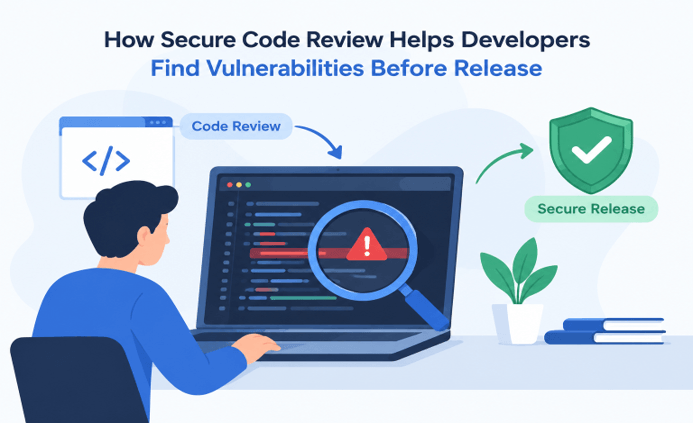
What Is Secure Code Review?
Secure code review is the process of looking at the source code to identify potential security issues, bad coding practices and weaknesses in the way the application is designed and works. A standard code review would be looking at the code from the perspective of how well it works and how easy it is to read. A security review takes that a stage further and looks at the code from the perspective of how it could be misused.
For instance, a developer might build a dashboard which shows account details after a user has signed in. The feature may work perfectly, but the code could still be such that one user is able to view another user’s information if it doesn’t properly check ownership on the server.
Reviewers look for these types of issues by tracing data flows, checking authorization rules, and examining how the application responds to unexpected inputs. Developers who want to build this skill can Practice secure code review through realistic code challenges that help them recognize vulnerabilities in context.
Why Is Code Review Important for Application Security?
It’s normally easier and less expensive to fix security issues prior to release. If a vulnerable feature gets into production, then you’re looking at emergency patches, additional testing, incident investigations, and of course the need to talk to the users who have been impacted.
A consistent review process offers several benefits:
- Early vulnerability detection: Developers can identify security weaknesses before release.
- Better code quality: Reviews encourage clear logic, consistent patterns, and maintainable implementations.
- Reduced security risks: Reviewers can identify weaknesses involving access control, input validation, and sensitive data.
- Shared knowledge: Team members learn from one another and develop a stronger understanding of secure programming.
- Safer updates: Reviewing changes helps teams identify regressions that could reintroduce previously fixed problems.
A good review process doesn’t just rely on one security expert going through everything. The developers themselves need to be familiar with the common vulnerability patterns. There needs to be a clear process in place for sending high-risk changes to more experienced reviewers.
Common Security Issues Developers Should Look For
A practical review begins with the areas most likely to affect application security.
1. Improper Input Validation
Apps will typically get their data from forms, APIs, uploaded files and external services. If you assume that data is always safe, then you’ve just created an opening for injection attacks or some very odd behavior.
Reviewers need to ensure input is validated on the server, that database queries are using parameterized statements, and that output is properly encoded. Client-side validation is useful for usability but should never be relied upon as a substitute for server-side validation.
2. Broken Authentication and Authorization
Authentication checks who you are, and authorization determines what you’re allowed to do. A successful login doesn’t in any way mean that you should be given access to everything.
Reviewers should be looking at permission checks for sensitive actions (reading private records, changing account details, using admin functions etc). Authorization must happen on the server for all such actions.
3. Exposed Secrets and Sensitive Information
Putting API keys, database credentials, tokens and the like directly in the code or in the logs is a security risk.
When you’re doing your review, check whether the secrets are actually being managed by a proper secret management tool and whether the details are exposed and so on. The production logs will be useful for troubleshooting but should never contain any sensitive informationroubleshooting but should never contain any sensitive information.
4. Unsafe Dependencies and Configuration
Third-party libraries can introduce vulnerabilities even if your own code is secure. Check the changes to dependencies (where the packages are coming from, what versions have been updated etc), check the install scripts and look at the config files and deployment steps as well. Too many permissions or exposed credentials can all make an application less secure.
How Developers Can Improve Their Code Review Skills
Just knowing the names of common vulnerabilities isn’t enough. A good reviewer learns to spot a flaw and then to see how that flaw fits into the rest of the application logic.
One practical approach is to study small code examples, predict how they behave, and then investigate the security implications. The CodeReviewLab provides hands-on challenges and educational resources that let developers practice identifying weaknesses across different programming languages and vulnerability categories.
Developers can make their practice more effective by following a repeatable process:
- Understand the feature. Identify what the code is supposed to do and which users or systems can interact with it.
- Trace untrusted data. Follow input from its source to database queries, file operations, templates, or external requests.
- Check security boundaries. Verify authentication, authorization, validation, and access restrictions.
- Think about misuse. Consider what could happen if a user changes an identifier, submits unexpected input, or repeats an action.
- Verify the fix. Use appropriate tests to confirm that the vulnerability is addressed without breaking legitimate functionality.
This method encourages reviewers to understand why a problem exists rather than simply search for suspicious code.
Building a Consistent Secure Code Review Routine
Developers get better much faster when security is baked into their normal workflow rather than something that’s done as a pre-release exercise. A simple checklist can be used on every pull request and then more in-depth reviews can be carried out on any changes that have an impact on authentication, payments, sensitive data, external connections or infrastructure permissions.
For developers who want a structured path, learning secure code review can complement daily development work by organizing security topics into focused lessons. Practising one vulnerability category at a time makes it easier to recognize recurring patterns and apply those lessons to real projects.
Automated tools are of course useful too. You can use static analysis, dependency checking and secret detection to catch a lot of the obvious problems and common mistakes. The problem is they can’t always understand the business rules or be in a position to make a decision as to whether a user should be allowed to do something in a complex workflow.
The ideal approach is a mix of automation and human judgment. Developers should be looking at the key findings, assessing the risks, documenting the fixes and using the repeated review issues to improve team guidelines.
FAQs
What is the difference between code review and secure code review?
A standard code review is all about correctness, readability, maintainability and design. A secure code review is a standard code review with a very deliberate and explicit focus on vulnerabilities, access controls, input validation and the handling of sensitive data.
Can automated tools replace manual code review?
No. Automated tools are good at spotting known patterns and common flaws, but manual review is required to assess the application context, the business logic and the security decisions that the automated tools will simply not be able to assess.
When should developers perform a secure code review?
Security review should be part of normal development (particularly prior to merging any changes that impact authentication, authorization, data processing, dependencies or external interfaces). High-risk changes may require specialist review.
How can beginners learn secure code review?
Beginners can start off with the basics of security, look at some small code examples, use a checklist, and just get into the habit of trying to find vulnerabilities in a safe environment. The key is to look at the mistakes you make and understand why you made them. That’s how you build up your skills over the long term.
Does secure code review guarantee that an application is secure?
No. Code review reduces risk but cannot guarantee complete security. It works best alongside automated testing, dependency management, security testing, appropriate configuration, and ongoing monitoring.
Conclusion
Secure code review helps developers go beyond just checking if software works, and instead see if it stays safe when things don’t go as planned. By paying attention to input validation, authorization, sensitive data, dependencies, and how the app works, teams can find important weaknesses sooner.
Regular practice, clear checklists, and using both automated tools and human judgment help make security a normal part of software development, not just something done at the last minute.
Popular on OTW Right Now!
-
 Why Spreadsheets Are Quietly Costing Your IT Team Hours Every Week
-
 What Happened When a Growing E-Commerce Brand Stopped Chasing SEO Tools and Focused on Results
-
Digital Sales Rooms That Help Businesses Close Deals
-
 5 Online Beginner Courses with Guided Projects in 2026 That Build Real Portfolio Work



About The Author

Gagan Bhangu
Founder of otechworld.com and managing editor. He is a tech geek, web-developer, and blogger. He holds a master's degree in computer applications and making money online since 2015.