
Top 7 Logistics Application Development Companies in 2026
Introduction
Speed, visibility and accurate data are all fundamental to logistics and software brings them all together. The 2026 MHI Annual Industry Report found that 56% of supply chain leaders are increasing their technology spend with AI identified as the most disruptive technology over the next 10 years. The right development partner is absolutely critical to getting that spend to produce real results. This guide looks at seven logistics application development companies to consider in 2026.
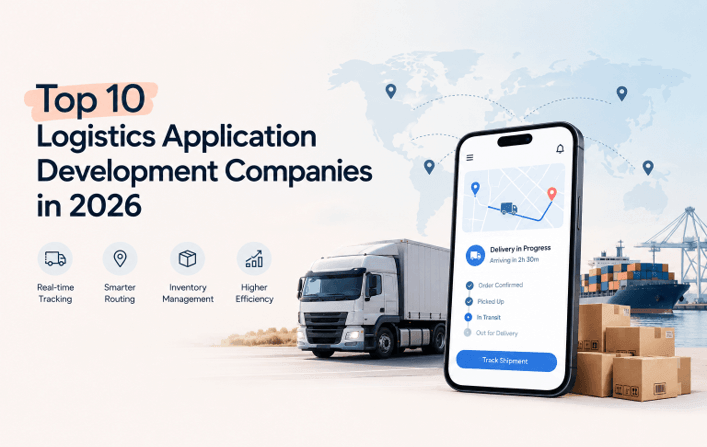
Top 7 Logistics Application Development Companies in 2026
Each profile begins with a brief company overview, followed by a list of the key services and the types of businesses that the services are most suited to.
1. Bacancy Technology
Bacancy Technology is a logistics application development company with more than 1,050 vetted engineers across 90+ technologies. They have dedicated developer and team augmentation models to scale out as your project grows. They use AI agents and LLMs to automate a whole raft of tasks including shipment status updates and document processing. They do both legacy modernization and new builds and work with cloud, mobile, data pipelines, etc. The breadth of their capability allows logistics companies to integrate their telematics, their ERP and their carrier systems into one workflow, so they don’t need to go out and hire a separate vendor for each of those pieces.
Services: Fleet management, TMS, shipment tracking, API integration, and logistics mobile apps.
Ideal for: Businesses building, integrating, or modernizing logistics platforms with flexible capacity.
2. Orases
Orases is a custom software house known for its enterprise logistics and transport solutions. They take a custom-first approach, which is ideal for the very specific workflows, reporting, and integrations that simply can’t be met by off-the-shelf software. The result is software that is built to fit the existing operating model. They go through a very thorough discovery phase where they map out the dispatch rules, the billing and the compliance requirements. This in turn minimises rework and gives the operations people a platform that is genuinely built for their own processes.
Services: Transportation management platforms, operations dashboards, and reporting tools.
Ideal for: Transportation organizations with established, complex operating models.
3. Intellias
Intellias builds TMSs that are specifically built for the client rather than just a generic template. The custom development means that the planning, dispatch and carrier processes are designed to reflect how the business actually works which in turn leads to far fewer workarounds post go-live and allows the team to operate from a single system. Their engineers integrate the TMS modules with telematics, ERP, and billing so the planner has a single view of orders, routes, and carrier performance. The real-time data from the vehicles and the shipments enables the team to make faster dispatch decisions and reduces the amount of manual handoffs.
Services: Custom TMS, dispatch and load planning systems, and carrier management portals.
Ideal for: Businesses that have outgrown off-the-shelf transportation tools.
4. N-iX
N-iX have a dedicated logistics and supply chain team. Their eLogistics suite contains proof of delivery and yard management modules so the supply chain team don’t have to build those fairly standard modules from scratch and can get a product to market much more quickly. The modules can be configured to match each client’s own way of working and N-iX’s data engineering capability is used to bring together warehouse, transport and tracking data into platforms that are ready for analytics. Shippers and 3PLs get a much better view of the milestones in their supply chain (from pickup through to proof of delivery).
Services: Proof-of-delivery apps, yard management tools, and warehouse and transport data platforms.
Ideal for: Organizations prioritizing end-to-end delivery visibility.
5. Cleveroad
Cleveroad is all about the driver, the courier, and the last-mile apps. The mobile-first nature of their solution is critical, as the field teams need a very simple interface for every delivery, and adoption is going to be directly related to how easy the app is to use on a day-to-day basis. Typical features would be route planning, in app navigation, digital signatures, photo confirmation and customer push notifications. Offline capability and simple screens are key to keeping drivers productive in areas of poor connectivity and that in turn has a positive impact on both adoption and data quality.
Services: Driver apps, courier applications, and customer delivery tracking.
Ideal for: Delivery businesses and fleet operators where field adoption decides success.
6. Zoolatech
Founded in 2017, Zoolatech manages the integration of carriers and system upgrades without ever halting daily operations so the flow of shipments is protected through the modernisation process. They do this in a phased manner, replacing the old components one at a time with rigorous testing at each stage rather than doing a full switch over. This minimises the risk for a business that needs to keep dispatching and delivering on a continuous basis and allows the teams to adopt the new tools in a gradual way. They also have a distributed team which provides flexible time zone coverage for the 24/7 operating businesses.
Services: TMS upgrades, carrier API integrations, and fleet management platforms.
Ideal for: Businesses that cannot pause shipments during a rebuild.
7. NineTwoThree
NineTwoThree is an AI consultancy with SOC 2 Type II certification. Intelligence is at the heart of their products from day one with machine learning and operational data being used to support forecasting, planning and automation. Their models learn from historical shipments, traffic and seasonality to improve ETAs and route decisions. The SOC 2 Type II certification also provides security-conscious logistics buyers with greater confidence when sharing their data.
Services: Demand forecasting engines, route optimization, predictive delivery estimates, and document automation.
Ideal for: Teams building AI-first logistics products or adding predictive capability.
Key Considerations for Choosing a Logistics Application Development Partner
The following factors typically define a dependable engagement:
- Domain experience: Documented TMS, WMS, and fleet delivery work, supported by verified Clutch reviews.
- Integration capability: Working knowledge of ERP, EDI, GPS, and carrier APIs.
- Security and scalability: Standards such as ISO 27001 or SOC 2, plus a cloud architecture ready for peak volumes.
- Support model: Defined post-launch maintenance, response times, and code ownership.
Final Thoughts
When you’re comparing vendors the hourly rate is often the thing you look at, but the actual cost of the software comes into play after you’ve launched it with all the integration fixes, driver uptake and the like. You can start with a very focused pilot (e.g. live tracking on one route) and then measure the performance before you go any wider. Vendors such as Bacancy Technology and the others on the list can of course add engineering capacity at that stage. You can then have very clear KPIs (on time delivery rate, cost per shipment etc) to measure against.
Popular on OTW Right Now!


About The Author

Gagan Bhangu
Founder of otechworld.com and managing editor. He is a tech geek, web-developer, and blogger. He holds a master's degree in computer applications and making money online since 2015.