
How AI-Assisted Testing Addresses QA Complexities in Fintech Applications
Fintechs push code daily, but writing manual tests for every single update takes longer than the release window itself. Rules change constantly (like compliance checks or payment gateways), and humans can’t write scripts fast enough for every edge case.
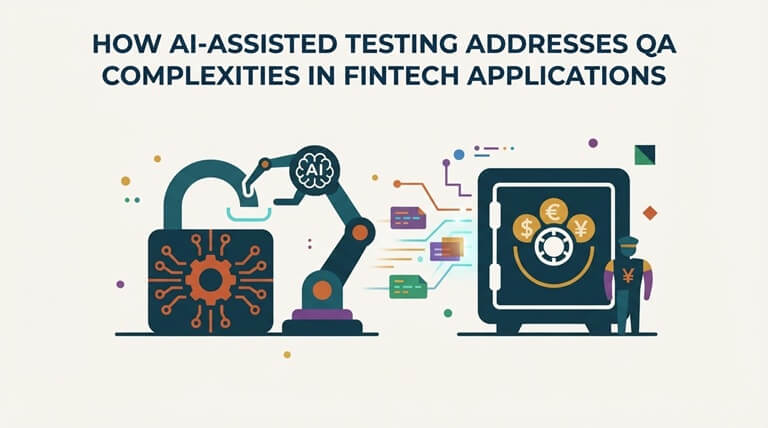
AI and ML testing services act like an adaptive pilot: instead of following a rigid checklist a human wrote last month. It reads the updated system behavior, figures out what could break in the money flow, and tests it on the fly.
Using AI to Prioritize High-Risk Software Test Scenarios
It isn’t necessary for every test case to receive the same level of attention since changes to a login screen and alterations to the interest-rate calculation logic have quite different potential impacts, even though many QA teams continue to treat them the same.
Risk-based testing is transformed by the use of AI. Machine learning models are able to examine changes to the code, the volumes of transactions, and historical defect data in order to identify the areas that are most likely statistically to fail. It is in this respect that AI contributes to software test optimization, since it does not simply carry out more tests but instead carries out the correct tests first.
- Flags modules with high defect-prediction scores based on past incidents
- Weighs financial transaction testing scenarios by dollar exposure, not just code coverage
- Surfaces fraud detection testing paths that manual planning tends to skip under deadline pressure
The number of tests doesn’t decrease; instead, the testing is more intelligently ordered so that the key payment workflow testing is carried out before the release window closes, not after.
AI-Assisted Test Maintenance for Frequently Updated Applications
Regression test suites tend to deteriorate. Anyone who has looked after a regression test suite for over a year will know this. When UI elements change, and the APIs are given new versions, suddenly about half of your scripts start to fail for reasons that are entirely unrelated to real bugs.
AI-assisted test maintenance deals with this by using self-healing test scripts, a form of automation that detects when a locator or element has changed and then modifies the test rather than having it fail completely. This is especially important in the fintech sector than in almost any other field since the testing environments for banking applications change in accordance with strict compliance and audit schedules rather than with convenient release dates.
Teams that use AI test automation when working on financial software find that they spend fewer hours on maintenance as a result of having to deal with false failures. The time that previously had to be spent on this is now redirected towards investigating actual defects, since that is a more appropriate use of a QA engineer’s judgment.
How Intelligent Testing Can Improve Test Coverage
Coverage gaps typically remain unseen until a fault slips through during production. By studying application flows, user behavior patterns, and historical bug clusters, AI can be used to generate test cases that people might not have thought of writing themselves.
| Testing Approach | Test Case Creation | Coverage Depth | Adaptation to App Changes |
| Manual scripting | Slow, expert-dependent | Limited to known flows | Requires manual rewrites |
| Traditional automation | Faster, still rule-based | Moderate, script-bound | Breaks on UI/API changes |
| AI-assisted testing | Auto-generated from data patterns | Broader, includes edge cases | Adapts via self-healing scripts |
This involves creating a broader range of scenarios for generating test data, covering malformed inputs, boundary values, and rare transaction sequences, as these are the ways in which real users and actual attackers behave.
Detecting Anomalies in Financial Software Testing
Anomaly detection is where AI genuinely outperforms rule-based QA. Static thresholds are only able to identify known types of failure; they cannot detect a transaction that is technically valid but statistically unusual, a kind of occurrence that points to a data integrity check having failed or to a fraud method for which no rule has yet been written.
Machine learning models, when trained on transaction history, are able to identify deviations in real time as part of testing, spotting these anomalies long before they get to production. This applies in the following areas:
- Financial data validation during batch processing tests
- API testing for third-party payment gateway integrations
- Security testing and compliance testing tied to regulatory reporting
It’s not a replacement for rule-based checks. It’s a second layer that catches what rules were never written to catch.
Combining Automated Intelligence with Human QA Review
The role of QA engineers is not eliminated by AI; rather, it alters the kind of work they carry out. Automated systems take on the task of handling large volumes of testing, such as performing performance tests when under load, testing scalability in different environments, and carrying out repetitive regression tests. It is humans who are responsible for making judgments—for example, determining whether this anomaly is actually a fraud signal or just a legitimate edge case—and also assessing whether this interpretation of a compliance rule is valid.
The regulatory and reputational implications of fintech products are unlike those of most ordinary software, which is why the step involving human review must remain, even though automation takes over the repetitive tasks underneath it.
Conclusion: Building a More Reliable Fintech Testing Process
The problem with regard to QA in the fintech sector wasn’t one of effort since teams have always put in a great deal of work; it was rather that scale and speed had outstripped manual methods. AI-assisted testing does not address this issue by working harder, but instead overcomes it by working more intelligently—by prioritizing risk, providing more extensive coverage, detecting anomalies that rule-based systems fail to catch, and enabling human reviewers to concentrate on the judgment calls that truly require their input.
It is not automation by itself but that combination which ensures that fintech testing is reliable at the speed required by the industry nowadays.
Popular on OTW Right Now!



About The Author

Gagan Bhangu
Founder of otechworld.com and managing editor. He is a tech geek, web-developer, and blogger. He holds a master's degree in computer applications and making money online since 2015.