
Seedance 2.5 vs Veo 3: Which AI Video Model Should You Use in 2026?
The 2026 AI-video race has narrowed to a few serious contenders, and two of them sit at opposite ends of the spectrum: Seedance 2.5 from ByteDance and Veo 3 from Google DeepMind. ByteDance previewed Seedance 2.5 on 23 June 2026 at its Volcano Engine FORCE conference, leading with a headline that breaks a real ceiling — native 30-second clips from a single prompt and up to 50 reference inputs. Veo 3, by contrast, is the model teams already ship with: generally available, audio-native, and built on Google Cloud. If you want to test either without locking into one vendor’s SDK, you can access it via OrcaRouter, an AI gateway that routes 200+ models through one OpenAI-compatible endpoint — including Seedance 2.5.
Quick take: Choose Seedance 2.5 for long, reference-driven, brand-consistent content and region-level edits. Choose Veo 3 for confirmed native-4K quality, proven synchronized audio with lip-sync, and production-ready availability today. Many teams will run both.
⚠️ Accuracy note: Seedance 2.5 is a preview. Its specs are vendor claims, not yet independently benchmarked. Public launch is targeted for early July 2026. On the Google side, the original Veo 3 models are deprecated and will be shut down on 30 June 2026; the current production member of the family is Veo 3.1, so this comparison treats “Veo 3” as that live model.
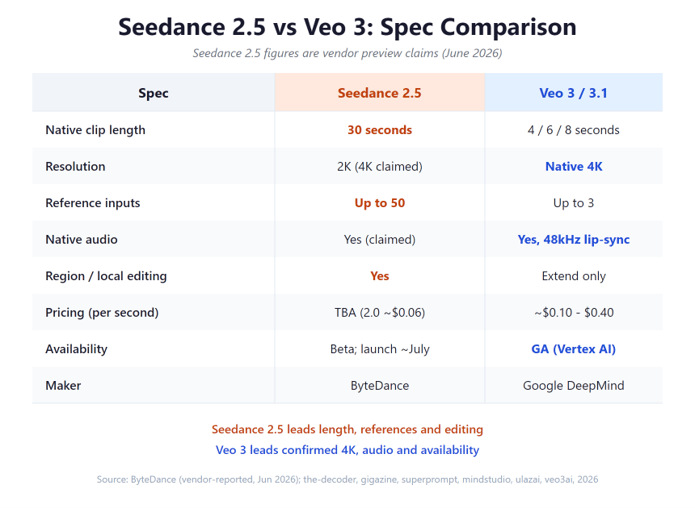
Seedance 2.5: length, references, and editing control
ByteDance designed Seedance 2.5 to attaAvideo’s”s two hardest problems — duration and consistency:
- Native 30-second single-clip generation — up from 12 seconds in its predecessor, enough for a full social ad with no stitch seams.
- Up to 50 multimodal reference inputs (images, audio, 3D white models, style references) to lock characters and sets across a whole clip — up from 12 references in Seedance 2.0. This is the single biggest gap with Veo.
- Region-level editing — fix one flawed area without regenerating the entire shot.
- 3D white-box previews for low-fidelity blocking before a full render, plus native audio co-processed in the same latent space as the visuals.
The caveat is that every striking number above is a preview claim. For context, the prior Seedance 2.0 earned strong independent results — reviewers cite native 2K, sharp textures, and a value-leading ~$0.06 per second — so the lineage is credible. Treat 2.5’s specifics as “expected,” not “proven,” until benchmarks land. Note,tooo,o that native 4K was a Seedance 2.0 feature and is not on the 2.5 headline slide, which leads with duration, references, and editing.
Veo 3: proven native 4K and frame-accurate audio
Veo 3 (now Veo 3.1) is the model to beat on confirmed, field-tested quality:
- Native 4K output at 720p/1080p/4K, reconstructing real texture detail rather than upscaling — fabric weave, skin and foliage hold up.
- Single-pass native audio — dialogue, sound effects and ambient sound generated with the video at 48kHz with sub-120ms lip-sync. This is the most polished audio in the category.
- Generally available via Vertex AI, which matters if your stack already lives on Google Cloud.
Its limits define the contrast: native clips top out at 4, 6, or 8 seconds (longer sequences need the extend workflow), and it accepts only up to 3 reference images — versus Seedance’s claimed 50. For multi-character, multi-asset campaigns, that reference gap is decisive.
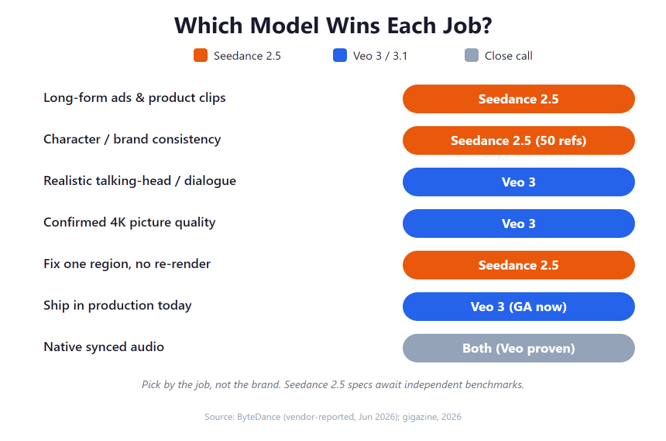
Head-to-head verdicts
- Clip length & storytelling → Seedance 2.5. 30s native vs Veo’s 8s; one pass beats chaining.
- Confirmed image quality → Veo 3. Proven native 4K beats Seedance’s unverified claim (its 2.5 slide leads at 2K).
- References & consistency → Seedance 2.5. Up to 50 inputs vs Veo’s 3 — purpose-built for campaigns.
- Native audio → Veo 3. Both generate synced audio, but Veo’s 48kHz lip-sync is proven; Seedance’s is a claim.
- Editing & revisions → Seedance 2.5. Region-level edits beat Veo’s extend-only approach (pending verification).
- Availability → Veo 3. GA on Vertex today; Seedance 2.5 is in beta until ~early July.
- Cost → Lean Seedance. Veo runs ~$0.10–$0.40 per second via Vertex; Seedance 2.5 pricing is unannounced, but 2.0 ran ~$0.06/sec.
Which should you choose?
Choose Seedance 2.5 if you produce 20–30s ads or product videos, need a character or brand to stay identical across the whole clip, want region-level edits, and can wait for the early-July launch.
Choose Veo 3 if you need realistic talking-head video with clean dialogue, want confirmed native 4K today, or already have built on Google Cloud and want a generally available, supported API.
Use both if you run a content team — block out long, reference-heavy drafts in Seedance, then finish hero shots and dialogue in Veo.
Frequently asked questions
Is Seedance 2.5 better than Veo 3? It depends on the job. Seedance 2.5 wins on length (30s), references (50), and region editing; Veo 3 wins on confirmed native 4K, proven 48kHz audio with lip-sync, and being generally available now.
When is Seedance 2.5 released? It was previewed on 23 June 2026, with an enterprise beta live anda public launch targeted for early July 2026.
Which produces longer videos? Seedance 2.5 — native 30-second clips versus Veo 3’s 4–8 seconds per generation.
Which has better image quality? On confirmed specs, Veo 3 with proven native 4K. Seedance 2.5 leads at 2K, and any 4K claim is untested.
How many reference inputs does each support? Seedance 2.5 claims up to 50; Veo 3 accepts up to 3.
Is Veo 3 still available? The original Veo 3 models are deprecated on 30 June 2026; use Veo 3.1, the current production version.
Popular on OTW Right Now!



About The Author

Gagan Bhangu
Founder of otechworld.com and managing editor. He is a tech geek, web-developer, and blogger. He holds a master's degree in computer applications and making money online since 2015.