
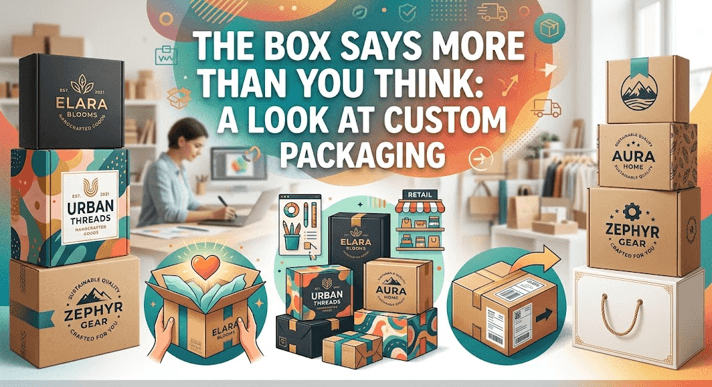
The Box Says More Than You Think: A Look at Custom Packaging
Receiving an online purchase in a box that felt premium is an amazing feeling that one cannot possibly describe in words. The sturdy size, the perfect fit, and maybe your name on a nice design printed on the outside. Was that a coincidence? An accident? No. Someone did that deliberately. Someone made that box on purpose just for you. This is the whole idea behind Custom boxes. It is packaging that shapes around the products.
The shortest definition of custom-style boxes is that they are boxes made around specific specifications. Their size, material, and colors all align with the brand or product that they represent. There is no space that goes astray and no mismatched branding. Also, there are no generic cardboards added to such boxes to do the bare minimum. If you pay close attention, you will notice that these boxes communicate and tell you about the product even before you open it.
It’s Not Just a Box
There are a lot of businesses out there who assume that packaging is just for functional purposes only. They feel that it is something that keeps the product safe just until it gets where it is going. That is true to some extent, but it is only half the story. The other half is what happens with that packaging the moment someone looks at it, either at their doorstep or on the store shelves.
When it comes to custom packaging, it does two jobs at once:
- Product protection
- It quietly and subtly tells customers about the brand behind the product.
None of these things are guaranteed to produce sales. Yet a close-fitting box, a well-thought-out design, and carefully selected brand content together build such trust that keeps people returning to the business.
Why Do Companies Actually Switch to Custom?
Most of the time, there is not just one simple reason that drives companies to switch to custom boxes. At times, it is a handful of small frustrations that add up, or too many returns or too much product damage during transit. At other times, there may be the fact that the current packaging looked fine, but it was very forgettable. Or it can be the social media pressure. Maybe the competitors’ unboxing videos are getting more shared.
We cannot exactly pinpoint the reasons but we know for sure the changes that come when a business moves to custom. They are:
- Fewer damages during shipments
- More Recognition
- Better Unboxing
- Smart use of Space
These things bring in no magical results. But they do manage to make the customers realize that the business took its responsibility seriously. And tried to deliver its products to them in appropriate and suitable packaging.
The Many Personalities of a Box
Most of us do not even know that boxes do have personalities of their own. There is not just one kind of custom box. There are many, and each one suits different kinds of products and different tools.
Mailer boxes, for instance, are workhorses for ecommerce. They can also double up as a retail presentation as well. Then come custom shipping boxes, which lean hard towards durability. They come with corrugated boards, which are made to ace a bumpy ride more than any other counterpart. We also have custom folding boxes, which are lightweight and budget-friendly. Most of the time, you see them holding cosmetics or small food items. Custom product boxes are for all those everyday-use, uniquely shaped products that otherwise can never fit properly and securely in generic or standard-sized boxes.
After regular use comes the premium end, for all those glittery, expensive premium items, we have custom rigid boxes. They are thick, substantial, and often used for jewelry and electronics. In short, they are meant to feel like a gift the moment that one opens them. Custom display boxes can also perform the same function. On top of that, they are also made in such a way that they can double up as their own in-store shelf setup.
When it comes to seasonal promotions and event gifting, custom gift boxes step into the picture. They have all the right decorations and add-ons that can make them relate to whatever event they represent. For sustainability drives, there are Kraft boxes that are made from natural paperboard. One can reuse them and recycle them; they are the best green choice available. For products that are bought on the basis of how they look yet are not strong enough to handle mishandling, there are window boxes. They have a cutout so that customers can look inside and decide whether it is the right color or type of product that they need.
Finding the Right Fit
Remember one thing: there is no such thing as a universal best box. Your end goals decide which option you should pick. Ask yourself a few honest questions, and they may guide you towards the right direction.
Find out if the product you have in hand is fragile or not. Is it fairly tough on its own? Can traveling a long distance disturb it? Will the unboxing experience matter to you, or would you like to have packaging that is mostly functional? At the end, and most realistically, what can be the budget that you can handle per unit? The answers to all of these questions can never give you a wrong answer about which box type you need to choose. However, never forget that it’s about matching the box to the product and the moment. You never need to chase after the fanciest option by default.
Making It Look Like You
Customization is the one thing that can make printed boxes look like a brand rather than a generic box. Businesses can have full-color printing on them that defines detailedartworks. They can also have spot colors, which can keep things simple and cost-effective. If you have simple or basic colors to work with on your box as per your marketing needs, you can still add some glitz and glamour with the help of finishes. A gloss finish can make even the dullest colors look bright and attractive to the eye. Matte laminations can give you a somber and more sophisticated look. With the help of embossing and debossing, you can add an attractive dimension to the text on your box or certain areas of its surface.
Laminations are not about appearance only. They also have a functional side to them. For example, spot UV can protect your box printing from fading, and it can also protect the products inside the box to some extent from UV contamination. As much as free lamination can not only keep your box clean, it can also protect the print from smudging off. The reason behind all of these practices is to make your product packaging look exactly like how you want it to be. A strong connection between product packaging and product manufacturer increases trust.
The Honest Answer on Pricing
It’s not a dodge when your packaging vendor asks you for your product specifications. When it comes to pricing, they cannot hand you a fixed price without knowing what you need. The costs of packaging depend on:
- size
- material
- printing
- finishes
Then comes the customization part:
- die cutting
- foil stamping
- Emboss/ Deboss
All of these elements have a direct impact on the eventual cost that you get for your custom order. The per-unit cost comes down considerably if you order boxes in large quantities. Furthermore, if your design is simple and moves through production faster, you may also get an affordable price. Going with online vendors mostly becomes profitable due to the fact that they have exhaustive customization options, way more than your local vendors may have. Furthermore, they have national and international facilities, which may allow them to offer you a reduced production cost.
What Happens After You Reach Out
It is a fairly simple process after you are done with finalizing your product details, size, weight, and other required necessities. If you have finalized an online vendor, you should submit your artwork to them, or you can ask them to create one for you to review. They will send you a digital or physical sample to approve and review. After that, they will send it into full production once you are satisfied with it.
Make a sensible choice regarding hiring online vendors. Check out reviews, hear the word of mouth, and do all the necessary research before making any payment whatsoever.
Ask for a Quote
If you wish for your brand to survive in the modern market, you need custom boxes. Go ahead and ask for a quote. The process is simple; it’s not scary at all, and most of all, it is not going to break your budget. It is something that your business needs, not something that is optional.
FAQ
1. Do we face delays if we work with online vendors?
There is a higher risk of delays with local vendors as well. However, online vendors do promise a fixed delivery time and also offer compensation if there is any delay.
2. Can a small business use custom boxes, or are they just for large orders?
Small businesses benefit more from custom boxes since they get the right recognition via their product packaging without investing too much.
3. What are the file formats that I need to have to submit my custom artwork?
Online vendors mostly ask for vector files like AI or EPS for logos and text-heavy designs. If you don’t have the print-ready file, there are many providers who offer design assistance to prepare one for you.
4. How do I know if an insert is necessary for my product packaging or not?
Inserts are mostly to secure delicate items or to package assortments in a single box. You probably do not need an insert at all if your product is solid and single.
5. Do I need to pay extra for design services?
If you are working with an online vendor, they mostly have a professional design service offer, which is absolutely free.
Popular on OTW Right Now!




About The Author

Gagan Bhangu
Founder of otechworld.com and managing editor. He is a tech geek, web-developer, and blogger. He holds a master's degree in computer applications and making money online since 2015.