
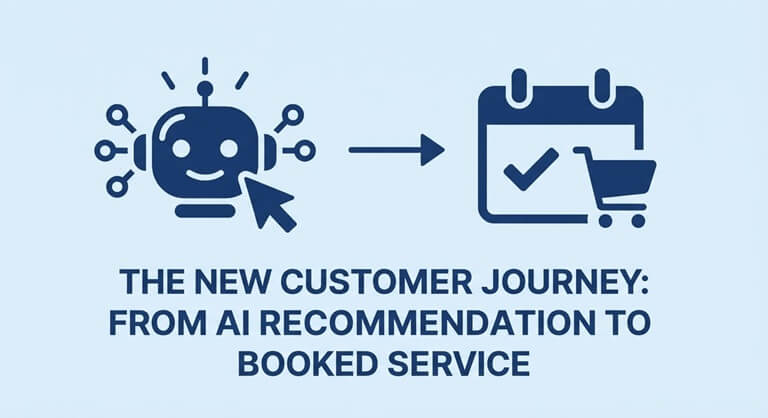
The New Customer Journey: From AI Recommendation to Booked Service
People searching for a service no longer always begin with a list of blue links. Many now type a detailed question into an AI assistant and expect a short answer with a few recommended options. That small change has reshaped the early stages of customer acquisition, with https://zeroclicklabs.ai/ reflecting the growing focus on visibility within AI-generated recommendations. A business first needs to appear in the sources and signals AI systems trust, then give the visitor enough confidence to make contact. After that, speed and organization determine whether interest turns into an actual booking.
The Search Often Starts With a Conversation
Traditional search typically starts with a relatively short string such as a service name, a problem, or a local provider. AI search fosters the use of longer questions. They may be very specific about the job, budget, the need’s priority, or the type of provider they are interested in, and request a referral.
This provides search engines and AI assistants with more context about how users are thinking. An AI answer typically whittles down the choices of links to just 10, whereas 10 similar links can be given. It could reference a few companies, list some of their benefits, or extract data from web pages, reviews, directories, articles, and more.
In the case of a service business, having a good ranking for a single keyword won’t be enough to be seen. The larger question is whether the business seems plausible and pertinent in the areas AI systems analyze.
AI Recommendations Depend on More Than a Homepage
A skinny web page doesn’t offer much content to the AI system. Pages that are very explicit about the services they offer, the cost structure, frequently asked questions, and service processes, comparisons, and specific points of expertise paint a fuller picture of the business.
Consistency is important, too. When one page’s description of a service differs from those of the external references, this can lead to a loss of confidence. Clear language, organized information, accurate service details, and third-party mentions can further tie a business to the topics it wants to be linked to.
Editorial content can also be helpful. A detailed article with a real customer question will provide search systems with more context than a page with a bunch of sales phrases being repeated. The best content is not just advertising, but like a knowledgeable professional telling a customer what they can look forward to.
Being Mentioned Is Different From Being Chosen
An AI recommendation leads a business to the short list, but the customer still goes to the next page to see if they like what they see. They can go to the website, read reviews, compare services, check on availability, or check if the company has a clue about their problem.
This is significant because it is crucial to ensure a smooth transition from the AI visibility to the website experience. After a strong recommendation, there will be friction when the landing page is vague. The next page should be clear and answer the questions that may have led the visitor to it.
It’s not just about quantity, but also quality. It may be more important to have a smaller number of visitors who have a clear intent to visit your site as compared to a much larger number of visitors who came through more general, loosely related searches. In the case of AI-driven discovery, it’s likely that the people are driven even further down the “research road” before ever landing on a business website.
The Inquiry Is Where Marketing Meets Operations
When a visitor fills out the website’s form, calls, or requests a quote, the marketing end has taken care of itself. The next step will be based on the response of the business to the inquiry.
This is where customer relationship and scheduling systems begin to become as important as they are in the service sector, where there are recurring appointments, field teams, estimates, follow-up, and lots of customer records. A lead sitting unnoticed in an inbox loses value quickly. The type of centralized workflow presented on the TCS website brings customer records, job notes, quote tracking, scheduling, reminders, follow-up messages, payment records, and team assignments together, reducing the chance that an interested prospect disappears between first contact and booking. For instance, if you are cleaning a business that is very busy, you might want to ask about the square footage, how often they clean, whether they need access to the business, the preferred time to have access to the business, any special requests, pricing, and availability of the worker. Staff has a much clearer route to confirming the job when the details are kept in one place, and there’s no need to make repeated calls or to note them down in a variety of places.
Fun fact: AI search is more often than not correlated with the top of the marketing funnel but has a larger impact. A highly targeted query that’s related to an AI question will likely generate significantly more buy intent as compared to a catch-all search term. If a person has not yet filtered their options before visiting a website, then they are asking for the right provider when seeking one.
A Faster Path to a Real Customer
Best Customer journeys are now discovery to execution. With AI visibility, a business gets into the conversation, useful website content helps to keep the interest alive, and an organized response process introduces an appointment.
Often the weak link is between those stages. Some businesses can achieve a high ranking but not respond quickly enough, or have operations that are top-notch but fall short in terms of visibility in AI-generated search results. The key to growing predictability is when both parties are involved – people find the business at the right time and then meet a clear and organized path to booking.
Popular on OTW Right Now!
-
 A Practical Workflow for Turning Technical Notes Into Clear AI Diagrams
-
 How AI Search Is Reshaping Content Marketing: Strategies to Get Mentioned by ChatGPT, Gemini and AI Assistants
-
 How Can AI Face Swap Create More Powerful Cinematic Stories in 2026?
-
 Invideo vs Luma AI: Which Is Better for AI Filmmaking?


About The Author

Gagan Bhangu
Founder of otechworld.com and managing editor. He is a tech geek, web-developer, and blogger. He holds a master's degree in computer applications and making money online since 2015.