
The Manual Work Crisis Killing UK SMEs — And the AI Fix Most Owners Miss
Picture Sarah, the operations manager at a 25-person solar installation company in Leeds. Every Monday morning, she opens three separate spreadsheets, manually copies lead data from an online form into a CRM, then emails the sales team a summary she built by hand. By 11 am, she hasn’t done a single thing that actually grows the business. She’s been doing this for two years. Her boss knows it’s a problem. He’s looked at “AI tools” online and walked away more confused than when he started. That story isn’t unusual. It’s the default operating mode for thousands of growing UK businesses right now — and it’s costing them far more than they realize. After struggling with repetitive manual workflows, many businesses like hers have partnered with this AI automation company to design and deploy custom automation systems within 90 days.
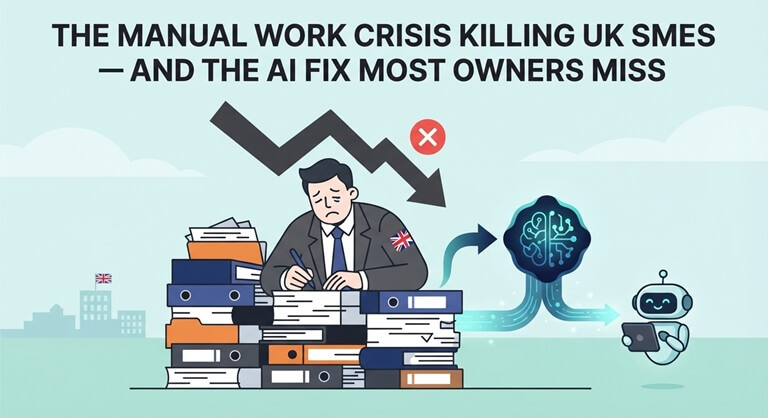
At small and mid-sized businesses, more than 70% of tasks can be automated today, according to McKinsey’s 2023 global automation report. But a survey by the Federation of Small Businesses found that fewer than 20% of UK small and medium enterprises (SMEs) use AI in their day-to-day business. The difference between “possible” and “done” is the difference that is where productivity goes to die.
Manual Workflows Are a Hidden Tax on Your Business
Most business owners would not consider repetitive admin as a cost to their business. To them it’s merely… work. But let’s do the maths. That’s 2 hours a day taken up by skilled-person time, for five people, on something that could be automated, like data entry, follow-up emails, report creation, updates to CRM, etc. – 50 hours a week of skilled-person time on something that doesn’t add value. Even if you have a relatively low average salary of £30,000 per year, you’re spending almost £36,000 in wasted working time each year. That is without taking into account the errors. Research published by the British Quality Foundation has found a 1-5% human error rate in manual processes. In a sales pipeline, a lost follow-up or a contact detail that is misspelled isn’t just a time-waster. It loses deals.
The spreadsheet is the most hazardous device in most small businesses. Not because it is bad software. Because it makes it look organized, but it’s actually not. If your CRM isn’t connected to your email platform, your email isn’t connected to your accounting platform, and you have to export your accounting data manually every month —you don’t have a tech problem. There is a gap in the integration. Each day that you fail to close it, the added cost grows.
When “Good Enough” Stops Being Good Enough
As businesses grow, there is a tipping point at 10 to 50 employees. At lower levels, manual coordination is a nuisance but not too difficult. On top of this, the same processes that worked in the past with 6 people turn into a restraint for your growth and even become a challenge. Your sales leads start to build up, and you can’t respond to them quickly enough. Customers have to wait 48 hours for someone to assign their complaints to the right department. A report that can be done in 1 hour takes 1 day: somebody needs to pull all the data from 4 different sources and manually create a dashboard.
It’s right when companies begin searching for the term “AI tools for business” and end up getting lost in a murky mix of conflicting information, pricey software demos, and consultants who talk in jargon. The joke is that the most automated businesses are the ones that need it the most but don’t have the skill sets to manage the vendor ecosystem themselves.
The Off-the-Shelf AI Trap Nobody Warns You About
This is a piece of software industry news that you don’t want to hear. Most AI tools available are designed to solve the typical use case. They’re intended for millions of businesses, so nobody is really their target. A product that costs a few hundred pounds per month and quickly goes up to thousands of pounds per month covers 80% of your requirements, but in the remaining 20%, you have to pay for extra expensive workarounds.
After that, the vendor switches to a different pricing structure. Or sunsets an integration you rely on. Or is bought and their product portfolio undergoes a complete makeover. This isn’t a hypothetical risk. In the past few years, several major SaaS companies, such as Salesforce, HubSpot, and Zapier, have implemented huge pricing changes, all of which caught their customers off guard. It’s always the businesses that relied exclusively on one vendor’s ecosystem, with no backup plan, that get targeted.
The Real Price Tag of Generic SaaS AI
Let’s be specific. The cost of a mid-size business with a widely adopted AI-powered CRM system, an independent marketing automation solution, and a workflow automation subscription could easily run £1,500 to £3,000 a month, but still involve manual work at critical touchpoints. That’s because tools are not natively designed to speak to one another. These are designed to be sold as a single item. So, you get to pay three vendors, have three logins, and copy and paste data between systems without having anyone build the bridge.
As far as functionality goes, custom-built AI agents—those created around the way your business functions—can often do the same things and more, for a much less expensive ongoing subscription, not due to poor-quality products. They don’t have to pay the costs of a worldwide software firm’s marketing expenses, shareholder returns, or sales team commissions.
Vendor Lock-In Is a Strategic Liability
There is a structural conflict of interest in single-vendor consultancies. It’s best if a company is a certified HubSpot partner, because then their incentive is to make HubSpot work for you, even if it’s not best for you to have a combination of Make for workflow logic, Pipedrive for sales tracking, and a custom-built intake agent in front of it. The truth is that it’s usually a combination of the two. However, there is no revenue to be earned from referral fees in hybrid solutions.
The structural alternative is whole-of-market access, which means the agency would recommend tools based purely on cost-effectiveness and fit, without considering who the partner is. It’s a harder task for the agency. It takes a good understanding of each of the key platforms to make real comparisons. But it’s the only model that always yields solutions that really fit!
What a 90-Day AI Deployment Actually Looks Like
The phrase “AI transformation” gets used so loosely that it’s almost meaningless. So let’s be precise about what a structured, expert-led automation engagement delivers — and in what timeframe.
Month One: Find the Waste
There is nothing built during the first 30 days. They’re focused on finding where time and money are going to waste. A good automation audit focuses on all repetitive tasks in sales, operations, finance, HR, and customer service. It pinpoints high-volume, low-complexity tasks that are ideal for automation. It also identifies the current tech stack and identifies opportunities for integration and redundancies.
This is at the point where most “do-it-yourself” automation projects crash and burn. The business owner does not make an audit; instead, they jump straight to purchasing tools. If you don’t have the map, then you can’t create the appropriate roads. You eventually automate the wrong things and fail to address the largest hangups.
Month Two: Build What Fits
The build phase involves custom agent development, integration configuration, and quality assurance. The first applications that usually become a priority for CRM pipeline automation are CRM lead routing and CRM pipeline automation. One might think that converting leads into sales is a lengthy process, but an automated lead scoring system that automatically assigns hot prospects to the salesperson who is best suited to sell them within minutes, instead of having to review a spreadsheet, can really make a difference in lead conversion in just a few weeks.
What sets professional deployments apart from rushed ones are the quality-assurance checkpoints during the build phase. Every automation is run against real-life edge cases prior to working with live data.
Month Three: Go Live, Carefully
The deployment phase requires running existing processes and new automations in parallel for some time. It’s not that the automation cannot be trusted; it is because running in parallel provides team trust. The primary reason automation projects fail is due to a failure among staff members. Systems that are used but not trusted, or that don’t work, don’t give any ROI.
A systematic handover, with written documentation and team training, changes that scenario. It’s not a random number; it’s been carefully designed to fit into a 90-day timeframe and cover the entire audit-to-live-to-staff-acceptance process. That’s why the money-back guarantee can be used. There are not too many people responsible for the timeline.
Where AI Automation Is Paying Off Across UK Industries
The £45 million in combined revenue generated by clients over the past two years isn’t attributable to a single industry or a single type of automation. It’s spread across sectors that share one thing in common: they were running manual processes well past the point where those processes were sustainable.
Legal and Professional Services
A law firm in London that spends paralegal time filling in intake forms, checking compliance with rules and regulations, and reminding clients about bills is paying solicitor wages for administration, and that’s a bad business model. Automating client intake, sending notifications of document triggers, and assigning compliance processes to the appropriate team member frees up qualified lawyers to bill more hours — this is the obvious benefit and something that most firms haven’t done.
Home Improvement and Trades
For companies like solar installation, boiler maintenance and window fitting, which charge low margins and high volume, it’s all about response time and the efficiency of their schedules. An installation team can save 10-15% of admin time due to automated quote follow-up sequences, job completion alerts to customers, and supplier order triggers. That’s no cost-saving in a business that’s dealing with thin margins. It directly boosts profits of each assignment.
E-Commerce and Retail
Order Management, Inventory Alerts, Post-Purchase emails, Customer Service Chatbot handling – all these are solved problems, provided they are connected. Most e-commerce operators run a Shopify store or WooCommerce separately from their CRM and email platform, which means manual exports and imports are needed, creating a risk of errors and delays. You don’t need to do it manually to connect those data flows. It’s the base-level requirement for being competitive on a large scale.
SaaS and Technology Businesses
AI automation tools such as trial-to-paid conversion automation, product usage data-driven churn detection triggers, and automated outreach when a user reaches a crucial engagement milestone are all revenue-driven examples of AI automation. For SaaS businesses, there’s a lot of data related to usage that’s likely languishing in a product and otherwise not accomplishing much. Integrating that information into a CRM and then making sure the sales team takes the appropriate action based on a behavioral indicator is an opportunity that most SaaS companies are aware of, but few have solved.
The Accountability Gap: Why Most Businesses Stay Stuck
There is a systemic problem that has a name. Automation makes the AI industry more complicated. Complexity is good for software vendors as it lends itself to paying higher subscription prices and lock-in. Routine consultancies are better off having longer, more expensive engagements, because there is a lot of complexity. These are the SMEs who attempted to do everything themselves and only purchased tools without using them, and who have just exited the scene with the conclusion that “AI doesn’t work for us.
AI doesn’t work; it just doesn’t work for everyone. It’s simply that the vendor ecosystem isn’t geared to support it. It is a sales tool to be used to sell licenses.
What Accountability in AI Deployment Actually Looks Like
The 90-day money-back guarantee isn’t a marketing ploy. It’s a subtle yet powerful commitment that the agency pays you for performance, and not simply for subscribing to their service. This alignment isn’t common in the industry. It’s the best indication that the party promising something has confidence in their process and is willing to put something behind it.
In fact, a growing number of SMEs in the UK are collaborating with specialist AI automation agencies, and not purchasing software on their own to cut operational costs and focus their staff on more valuable tasks. Those that are doing it via a structured and vendor-neutral engagement are realizing value in one quarter. Those who are yet to purchase the off-the-shelf tmply hope that they will figure it out themselves and are still using a manual method to transfer data from one spreadsheet to another.
The manual labor shortage is not insurmountable. It’s simply unsolvable – the companies who’ve needed it have been playing a game that was supposed to be confusing, not clarifying. Most owners don’t realize how easy it is to get out of the house. Unlike software trials, it begins with an audit!
Popular on OTW Right Now!


About The Author

Gagan Bhangu
Founder of otechworld.com and managing editor. He is a tech geek, web-developer, and blogger. He holds a master's degree in computer applications and making money online since 2015.