
How Cybersecurity Compliance Helps Companies Close Enterprise Deals Faster
Cybersecurity compliance company is a specific technology vendor that assists organizations in remaining compliant with security laws, setting up verifiable controls, and transforming cybersecurity requirements into a business-to-business customer to be evaluated prior to signing the agreement. That ability can be the key to winning or losing a large B2B sale, as security is no longer a technical issue that’s placed in the hands of the information technology department; it’s a part of the buyer’s risk assessment, procurement process, and ultimately the sales cycle.
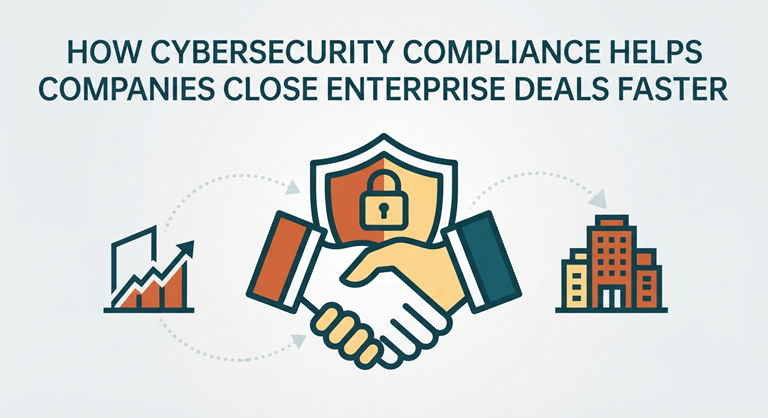
Enterprise buyers are more conscious of who they allow onto their systems and have access to their data. The opportunity can stall for weeks, or even go off the table altogether, if the vendor of a promising product is not able to prove sufficient security controls to satisfy the business. It’s not always a problem of buyers’ mistrust of sellers. In most cases, the vendor doesn’t have all the documentation required for the customer’s security, legal, and compliance departments.
That is where compliance becomes a sales accelerator.
Security Has Become Part of the Buying Process
Enterprises’ procurement process often does not stop after the successful demonstration of a product. The moment a potential customer feels that a solution may be the right one for their business, another evaluation of sorts begins.
Security questionnaires arrive. Legal representatives ask for paperwork. The IT department explores the architecture. Risk officers inquire about access controls, encryption, incident response, vulnerability management, data retention, and third parties.
This has the potential to become an unwelcome inconvenience for a vendor. The sales folks might be about to sign, and the security folks might still expect to see evidence.
Compliance systems minimize this friction. Various standards and certifications, like SOC 2, ISO 27001, PCI DSS, and industry-specific regulatory measures, provide a framework for evaluating if a supplier employs advanced security measures.
Compliance doesn’t make a company safe, but it does offer something else that’s as crucial as verifiable assurance during enterprise procurement.
Why Evidence Matters More Than Security Claims
Telling a prospective customer that “security is our priority” has little value during a formal risk assessment. Enterprise buyers need evidence.
That evidence might include:
- Security policies and procedures.
- Access-control documentation.
- Vulnerability assessment results.
- Penetration-testing reports.
- Incident-response procedures.
- Employee security training records.
- Audit reports and certifications.
- Business continuity and disaster recovery plans.
This changes the nature of the sales conversation. Instead of asking a vendor to explain why it should be trusted, the buyer can review documented controls and independent assessments.
For sales teams, this distinction is significant. Evidence shortens conversations that would otherwise depend on repeated explanations and manual verification.
Compliance Reduces Procurement Friction
Large enterprises often have standardized vendor-risk processes. A supplier that cannot satisfy mandatory security requirements may be excluded before its commercial advantages are even considered.
This creates a practical connection between cybersecurity and revenue.
Suppose two software vendors offer comparable functionality. One has mature security documentation, established controls, and relevant certifications—the other promises to provide the requested information after the contract is signed.
The first vendor has a major commercial advantage.
It can move through procurement with fewer unknowns, while the second may face additional assessments, remediation requests, contractual negotiations, or delays.
In other words, compliance can function as a form of sales infrastructure.
Compliance Can Shorten Security Questionnaires
Security questionnaires are notorious for becoming bottlenecks in enterprise sales.
A questionnaire can have dozens (or hundreds) of questions related to the authentication, encryption of data, cloud infrastructure, data governance, software development practices, employee access, incident management, disaster recovery, and more.
Well-established compliance programs will help organizations better answer these questions because the controls are already recorded and tested.
This is a significant advantage during the operation: sales and engineering teams don’t have to put together a patchwork answer to each prospect.
Instead, organizations can maintain a centralized security evidence repository containing policies, certifications, diagrams, audit materials, and standard answers.
The result is not simply faster paperwork. It is a repeatable process for supporting enterprise growth.
Compliance Also Strengthens Contract Negotiations
Customers can ask for concrete security measures with regard to breach notification, data protection, subcontractors, audit rights, vulnerability management, and business continuity.
If there is no security governance, then these negotiations can become challenging. In some cases, a vendor must make promises before learning whether its technical environment can fulfill them.
A mature compliance program flips that equation on its head.
Security controls, responsibilities, and limitations are documented, and therefore, legal, security, and commercial teams are able to negotiate from a common understanding of what the company can and cannot do.
This can avoid another typical sales difficulty: agreeing to contractual security needs that end up being costly engineering.
Compliance Is Particularly Important for SaaS Companies
The trust challenge is especially difficult for those providing software-as-a-Service. By outsourcing part of its technology infrastructure and possibly providing an outside entity with confidential data, customers are effectively outsourcing a piece of themselves.
Security maturity, in the case of a SaaS product aimed at enterprise customers, is thus an integral component of the product.
Architecture decisions matter. The customer feels at risk due to identity management, tenant isolation, encryption, logging, secrets management, secure software development, and cloud configuration.
The Compliance Program is the governance component between these technical mechanisms and policies and measurable controls.
That link is especially beneficial in regulated sectors like finance, healthcare, insurance, or government.
Compliance Should Start Before the Enterprise Sales Pipeline
A common error that expanding businesses make is waiting until a big prospect calls for certification.
By then, the organization may discover that crucial controls are missing or not fully in place. Once compliance is achieved, it can lead to an emergency project with architectural changes, policy development, remediation, employee training, and external audit.
A more effective way is to see compliance as a component of the company’s growth plan.
Organizations need to understand key business security needs that are most relevant to their desired target customers, and integrate these requirements in their business model before entering the business market.
Another benefit to this approach is that security can be scaled up more easily.
If new enterprise opportunities come in, the business doesn’t have to start from scratch with the compliance process. It is well rooted.
The Commercial Value of Security Maturity
The most interesting aspect of cybersecurity compliance is that its benefits extend beyond passing an audit.
Mature security practices can improve internal processes, clarify ownership, reduce operational risk, strengthen customer confidence, and make enterprise procurement more predictable.
For sales leaders, the commercial equation is straightforward. Every week spent waiting for security approval represents delayed revenue. Every unresolved questionnaire creates uncertainty. Every missing document creates another reason for a prospect to hesitate.
Compliance cannot guarantee a contract. It can, however, remove obstacles that have nothing to do with the actual value of the product.
Conclusion
Enterprise customers increasingly buy technology with both functionality and risk in mind. A strong product may open the door, but demonstrable security can determine whether the deal crosses the finish line.
The most effective organizations therefore treat cybersecurity compliance as more than an IT obligation. They use it as a trust mechanism, a procurement accelerator, and a competitive differentiator. A specialized Andersen cybersecurity compliance company approach, for example, can help organizations connect technical security controls with the documentation and governance enterprise buyers expect, turning compliance from a sales obstacle into an enabler of faster, more confident business growth.
Popular on OTW Right Now!

About The Author

Gagan Bhangu
Founder of otechworld.com and managing editor. He is a tech geek, web-developer, and blogger. He holds a master's degree in computer applications and making money online since 2015.