
Physical Security Trends for Modern Businesses
Physical security used to mean a lock, a camera, and a guard at the door. That model does not hold up anymore. Threats have changed. So has the technology built to stop them.
There are more risks for businesses today. Cyberattacks are not the only incidents on the list that can include break-ins, vandalism, insider threats,s and workplace violence. No longer can these be isolated issues for security teams. What they require is a single system that monitors all of them simultaneously.
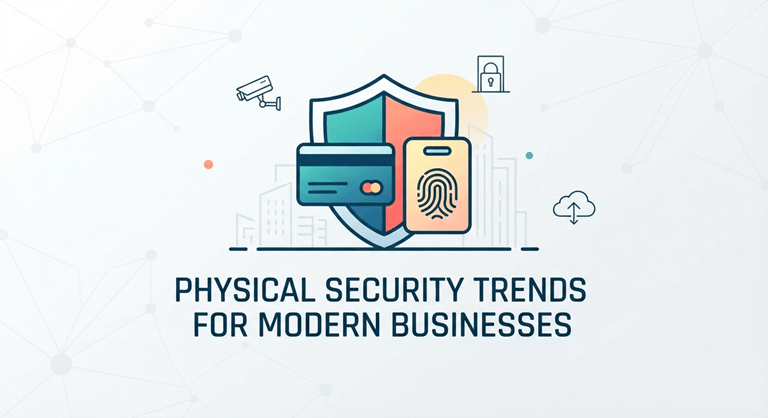
Why Fragmented Security Systems Fail
Not many companies designed their own security solutions. They continued to add pieces as they went. Here there is a camera system. An alarm panel is in place here—an independent access-control system to the main office.
Fragmentation occurs as a result. Cameras are operated on one dashboard. Another one is related to door access. Alarms notify a third app. When an incident occurs, staff are wasting time changing screens to respond rather than just responding.
There is a gap in the data as a result of this. More than 70 percent of organizations now are operating unified or integrated security systems, and 60 percent indicated that the primary driver for replacing legacy technology was to get new capabilities integrated, according to a global security industry survey conducted by more than 7,300 security professionals in 2026. The trend to consolidation is not a choice. This is a reaction to the frequency with which systems are disconnected, which slows down incident response.
For businesses evaluating a move away from fragmented tools, platforms built around a single, integrated architecture, like those covered in this breakdown of enterprise physical security systems, give security teams one place to monitor, investigate, and respond.
What a Unified Platform Actually Changes
A video, access control, and alarms integration into a single, unified security platform. This isn’t simply about comfort. It alters the speed of response of a team.
If a door alarm is triggered, the system is able to automatically bring up the matching camera feed—no manual searching. There were no radio calls requesting someone to get footage. It’s a quicker response time – and seconds count in an active incident.
Another lesser-talked-about issue that centralization resolves is audit trails. Compliance teams require clean records of access and an accurate timestamp of who accessed what and when. That’s a tedious and prone-to-error manual process with scattered systems. All log data is stored in one place on a single platform.
Key Technologies Driving the Shift
Several technologies are doing the heavy lifting behind this trend:
- AI-based video analytics that alert to suspicious activity, such as left objects, unauthorized zone entry, and loitering on all feeds.
- Automatic License Plate Recognition (ALPR) for monitoring cars as they drive through gated doors and parking spaces.
- Access control (role based permission with multi factor authentication) instead of single key or single badge system.
- Acoustic gunshot detection system that alerts without having to be actuated by a human first, and alerts within seconds.
- Mass notification system (MNS) alerts which are sent out via audio, mobile, and email channels during a lockdown or emergency.
No longer does any one of these tools work alone. All of them supply data to a common data system, and that’s what is really happening. The concept of integration and not some particular device is what modern physical security is defining.
Industry-Specific Pressures Are Shaping Adoption
These tools are being adopted by various industries, for various reasons.
Ensuring patient and staff safety and maintaining the accessibility and availability of facilities are key concerns for healthcare systems. But it’s important that manufacturing facilities have the ability to manage access to hazardous zones while maintaining shift transition efficiency. There are very strict regulations that apply to critical infrastructure operators in the area of perimeter protection. If an organization has several sites with campus locations, the same policy should be consistently enforced throughout all buildings.
The common denominator is size. Security can’t be put on as a patchwork of unmatched solutions as organizations expand. If it’s not a unified system, it begins to create the blind spots it’s supposed to prevent.
Where This Is Headed
Be prepared to see three things continuing to make big strides. First, it’s more AI, not only as a marketing buzzword but an actual working tool that decreases the number of screens a human must monitor. Second, cloud-based management growing alongside on-premise systems, giving teams flexibility without ripping out existing hardware. Third, increased physical security/IT security integration—when one is compromised, the IT security isn’t necessarily, and isn’t even likely, to be compromised as well.
Those that view physical security as a cost center are going to lose. It’s those who are making it a connected and data-driven function that are really creating real resilience. This change is happening and will continue.
Popular on OTW Right Now!

About The Author

Gagan Bhangu
Founder of otechworld.com and managing editor. He is a tech geek, web-developer, and blogger. He holds a master's degree in computer applications and making money online since 2015.