
How to Calculate White-Label Link ROI for Agencies (and the Top 5 Partners for the Best Returns)
Ask ten agency owners what their last batch of white-label links actually earned, and nine will quote you a price per link. That’s the cost. It is not the return.
Return on a backlink shows up months later, in rankings that lift a client’s money pages, in the organic traffic that follows, and in the revenue that traffic converts. A link bought in March might not pay for itself until October. If you measure it in April and call it a loss, you cancel the campaign right before it starts working.
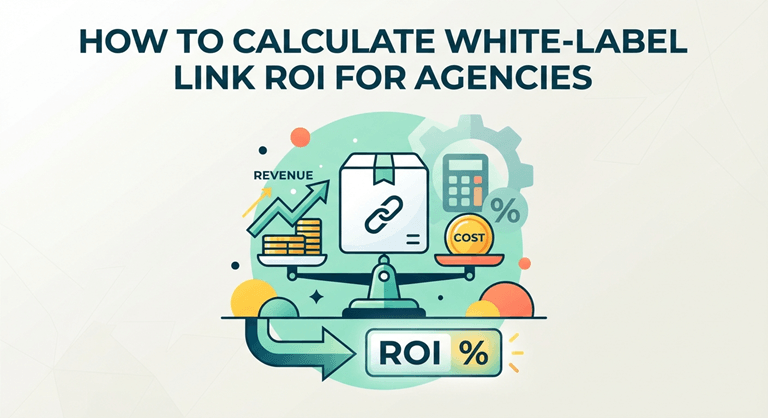
This guide is written for SEO agency owners who resell link building and need to defend the spend to clients and to their own P&L. First, we’ll walk through how to actually calculate white-label link ROI, including the agency margin layer that most formulas skip. Then we’ll rank five white-label partners on how well each one protects that return.
Pricing and review sentiment were checked in mid-2026 and can shift, so confirm a current rate card before you order.
How to Calculate White-Label Link ROI
Start with the honest cost. Most agencies underprice a link in their own heads because they only count what the vendor charged. The true cost of one placement is four things stacked together:
- The service fee (what the white-label partner charges for outreach and management)
- The publisher fee (what the host site charges to place the link, when it’s a paid placement)
- Content creation (often bundled, sometimes not)
- Your internal time (the account manager who briefs, reviews, and reports on it)
Add those up, and you have the real cost per link. Now the return side.
A backlink creates value through a chain: it lifts the authority of a target page, that page climbs for its keywords, the higher position pulls more organic clicks, and some of those clicks convert. So the value of a single link is roughly the incremental monthly revenue it drives, multiplied by the number of months it stays live and productive.
Here’s the working formula:
Link ROI (%) = ((Incremental monthly revenue x Active months) − True cost of the link) / True cost of the link x 100
A worked example makes it concrete. Say you place a DR40 guest post for a client. The service fee is modest, the publisher fee runs a couple of hundred dollars, content is included, and your team spends an hour on it.
Call the true cost $350. That link helps push a commercial page from position 8 to position 4, adding roughly 60 organic visits a month to a page that converts at 2% on a $200 product. That’s about $240 in incremental monthly revenue.
Over 12 months, that one link contributes around $2,880 in revenue against a $350 cost. The return works out to more than 700%, which lines up almost exactly with the 748% median SEO ROI that First Page Sage reported for 2026. The number only looks real once you measure across the full window.
That window is the part agencies get wrong. Most link-building campaigns reach measurable ranking impact in three to six months, with stronger compounding movement between months six and twelve. Average breakeven lands somewhere around the seven-to nine-month mark, which is exactly why a 30-day test tells you nothing.
There’s one more layer that applies only to agencies: markup. If you pay a white-label partner $350 for a link and bill the client $700 for it, your agency’s direct ROI on that transaction is 100% before the link even ranks. The link’s performance ROI (the client’s return) and your resale margin are two different numbers, and healthy agencies track both.
A transparent partner that shows you the real publisher fee makes the margin math trivial. A bundled “package price” hides it.
Three inputs decide whether the whole equation clears: how much you paid, how long the link survives, and whether it was ever on a page that could rank in the first place. That last one is where most wasted spend hides, and it’s the lens we used to rank the partners below.
How We Evaluated These Providers
We scored each partner on the factors that actually move link ROI for an agency, not on brand recognition. The six criteria:
- Cost transparency: Can you see the true per-link cost, including the publisher fee, so your margin math is clean?
- Wasted-spend controls: Does pre-approval or strict vetting stop you paying for links that were never going to rank?
- Permanence and replacement: Is the link protected across the compounding window, with a replacement if it drops?
- Link quality and relevance: Do placements sit on real, traffic-bearing, niche-relevant sites that produce a genuine ranking lift?
- Delivery reliability: Does the partner hit its stated turnaround so time-to-value is predictable?
- White-label depth: Does it protect your agency’s brand, margin, and client relationship end to end?
Pricing came from each provider’s own pages, cross-checked against independent reviews. Review sentiment was read across Trustpilot, G2, Clutch, Sitejabber, and DesignRush between June and July 2026, weighing repeated patterns over one-off complaints. ROI benchmarks are drawn from First Page Sage, Ahrefs, BuzzStream, and Editorial. Link 2026 data.
Quick Comparison: White-Label Link Building for ROI
| Rank | Provider | Best For | Pricing Model | Pre-Approval | Turnaround |
| 1 | Stan Ventures | Protecting returns over the full window | $37/$67/$247 by DR tier service fee+ publisher fee itemized | Yes, every domain | 20-day minimum |
| 2 | Loganix | Predictable, transparent returns | ~$200 to $300 per guest post, traffic-based | Yes, domains and pages | About 1 month |
| 3 | Authority Builders | Buying exact metrics at a visible price | ~$100 to $800+ per link, managed from ~$1,000/mo | Self-select fromthe marketplace | 2 to 6 weeks |
| 4 | LinksThatRank | Highest quality ceiling per link | $177 to $375 per link, packages from $697/mo | Approve final placement | Under 1 month |
| 5 | Page One Power | Enterprise authority gaps | ~$600 per link, retainers $3,500 to $12,000+/mo | Yes, proposed sites | Slower, custom kickoff |
Detailed Rankings: White-Label Link Building for ROI
#1. Stan Ventures – Built to Protect the Return, Not Just Place the Link
Stan Ventures is a reliable fulfillment partner for agencies, and the white-label link-building provider leads on the two ROI factors that are hardest to find together: stopping wasted spend before it happens, and protecting the link after it lands. Every candidate domain is presented to the agency for approval before a single outreach email goes out, so you never pay for a placement you would have rejected.
Best For: Agencies that want to approve every domain and keep a link earning across its full compounding window.
Pricing: $37 for DA/DR 30+, $67 for DA/DR 40+, and $247 for DA/DR 50+, with the service fee and publisher fee shown separately and content included.
What Works:
- A free replacement on lost links inside the guarantee window, so a dropped placement does not become dead ROI
- Mandatory domain pre-approval, which removes the single biggest source of wasted link spend
- The publisher fee is shown next to a flat service fee, making agency margin math straightforward
- 100% white-label with an NDA and a named account manager on every account
The Trade-off:
It is not the cheapest option for high-volume, low-DA links, and the model suits agencies billing real retainers more than the smallest one-off budgets.
What Customers Say: Trustpilot and DesignRush sentiment leans strongly positive, with repeated praise for named account managers, on-time delivery, and relevant placements. The recurring gripe is that quality can vary between team members, so a tight brief helps.
#2. Loganix – Predictable Returns With Clean Pricing
Loganix is the pick for ROI predictability. Its pricing is tied to a site’s real organic traffic rather than a DR number alone, which keeps you from paying premium rates for “authority” sites that no human actually visits.
Best For: Agencies that want transparent, mid-market pricing and reliable delivery they can forecast against.
Pricing: Guest posts commonly run about $200 to $300, HARO-style placements from $850, with monthly packages starting near $200.
What Works:
- Traffic-based pricing aligns cost with the audience that actually drives ranking value.
- Domain and page pre-approval before placement, which cuts wasted spend
- A link-live guarantee with free replacement if a placement drops inside the covered window
The Trade-off:
Delivery averages around a full month, so it is not the pick for a client who needs links live next week.
What Customers Say: Reviewers consistently praise Loganix for detailed reporting, prompt support, and a clean reputation, with endorsements from well-known SEO names. The most common critique is limited control over the fully managed tiers and metrics on some marketplace listings that could be stronger.
#3. Authority Builders – Cost Control by the Metric
Authority Builders runs a marketplace of roughly 2,000 pre-vetted sites where you filter by DR, traffic, and niche, then order the exact placements you want. For ROI math, that visibility is useful: you see the price and the metrics before you commit a dollar. The founder’s practitioner reputation adds credibility that a lot of anonymous vendors lack.
Best For: Agencies that know precisely what metrics they need and want to buy them at a visible price.
Pricing: Entry links from about $100 to $170, mid-tier $200 to $400, high-authority editorial $400 to $800+, with managed campaigns starting near $1,000 per month.
What Works:
- A transparent marketplace where cost and site metrics are visible up front
- A stated 1,000-monthly-visitor traffic floor on placements
- Both self-serve ordering and a managed campaign path
The Trade-off:
Catalog-style buying can create link footprints if you’re not careful, and recent reviews flag delivery and quality issues on the separate Digital PR line, so stick to the vetted marketplace placements and audit what lands.
What Customers Say: Marketplace and guest-post buyers generally report strong results and useful control. A documented 2026 complaint on the Digital PR product (zero delivery and a share of links under the stated traffic threshold) shows up across multiple sources, so treat that specific service line with caution.
#4. LinksThatRank – The Highest Quality Ceiling
LinksThatRank is the quality obsessive of this list. Every placement passes a 23-point check; the team runs a public blacklist of tens of thousands of known link farms, and content is verified as human-written. For ROI, strict vetting means fewer links that quietly fail to move anything, which is a real form of wasted-spend protection.
Best For: Agencies running high-stakes client accounts where one bad link could cost trust.
Pricing: Individual links from $177 for DR20-34 up to $375 for DR50-80, with done-for-you packages starting at $697 per month.
What Works:
- A rigorous 23-point quality review on every placement
- A 365-day link replacement guarantee, which covers most of the compounding window
- A published blacklist and human-verified content that keep placements clean
The Trade-off:
You approve the final placement but cannot pre-select specific domains, and a few reviewers argue the premium is steep versus buying similar sites directly.
What Customers Say: Most reviews highlight needle-moving quality, responsive support, and durable links. A minority on Trustpilot disputes the value, arguing some placements resemble sites available cheaper elsewhere.
#5. Page One Power – Custom Campaigns for Big Authority Gaps
Page One Power builds bespoke, research-driven campaigns rather than productized orders. Every engagement starts by analyzing the site, its competitors, and its goals, then handcrafts manual outreach. When a client faces a genuine authority gap in a competitive niche, that depth can justify the spend.
Best For: Established brands and agencies with real budgets and complex, competitive campaigns.
Pricing: Around $600 per content-based link, with managed retainers typically running $3,500 to $12,000 or more per month.
What Works:
- Fully custom strategy with manual, relationship-led outreach
- A dedicated project manager and transparent monthly reporting
- Strong white-hat reputation and content quality that clients are proud to show
The Trade-off:
High minimums and a slower, custom kickoff make it a poor fit for small budgets or short campaigns, and some clients note that the reporting tools are basic.
What Customers Say: Clutch reviews praise the honesty of project managers, quality content, and genuine partnership. The consistent critiques are cost, speed to launch, and reporting that leans on manual documents.
How to Choose a White-Label Link-Building Partner for ROI
Price per link is the wrong first question. Start with wasted spend: does the partner let you approve the domain before outreach, or do you only find out where your client’s link landed after it’s live? Pre-approval is the cheapest ROI insurance in this industry.
Next, ask about permanence. A link that drops at month nine, right as it hits peak compounding, takes its entire return with it. A replacement guarantee that covers the full ranking window is worth more than a slightly lower sticker price.
Then check the fee structure. If you can see the real publisher fee separately from the service fee, your resale margin is easy to calculate and defend. Bundled pricing hides the number you most need to run a profitable agency.
Finally, confirm the partner is fully white-label under NDA and never contacts your client, because one direct email can cost you the account.
What’s Shaping Link Building ROI Right Now
- Links now do double duty. They lift Google rankings and shape whether ChatGPT, Perplexity, and Google AI Overviews cite a brand, so the same placement can pay off on two search surfaces.
- Publisher fees have climbed since 2022 as real editorial inventory has stayed fixed and demand has risen, pushing the average quality backlink into the $370 to $500 range.
- Traffic is beating raw DR as the quality signal that matters. A DR70 site with no real audience produces no ROI, and buyers are pricing accordingly.
- Compounding is the whole game. Links placed in the first half of a campaign keep generating traffic in months 12 and 24, which is why breakeven windows of seven to nine months are normal and healthy.
- Footprint risk from catalog buying is a live penalty concern, so relevance and placement variety protect returns better than volume.
FAQ
How do you calculate ROI on a single backlink?
Take the incremental monthly revenue the link helps generate, multiply it by the number of months it stays live and productive, subtract the true cost (service fee, publisher fee, content, and your management time), then divide by that cost. Measure across at least nine months, since most links break even in the seven-to nine-month range.
Why is a cheap link often a bad ROI?
Because the highest cost is not the price, it’s a placement on a site that never had the traffic or relevance to rank. A $50 link on a dead site returns zero, while a $350 link on a real, relevant site can return several times its cost over a year.
What turnaround should an agency expect?
It varies by model. Productized providers often deliver within 20 to 30 days; custom campaigns take longer to launch because of the research phase. Predictable delivery matters for ROI because it sets a reliable time-to-value.
Does pre-approval really affect returns?
Yes, more than almost anything else. Pre-approval lets you veto a weak domain before you pay for it, which removes the most common source of wasted link spend and protects the return before the campaign even starts.
How should agencies handle markup in the ROI math?
Track two numbers. The client’s performance ROI (what the link earns them) and your resale margin (what you bill minus what you paid). A partner that itemizes the publisher fee makes the second number easy to calculate.
The Bottom Line
For agencies chasing the best return, Stan Ventures takes the top spot because mandatory pre-approval kills wasted spend before you pay for it, and a free lost-link replacement protects the return across its full compounding window. Loganix is the close runner-up on predictability, tying cost to real traffic and backing links with a replacement guarantee. Match the partner to the client in front of you, measure across nine months rather than 30 days, and the ROI math almost always clears.
Last updated: July 2026. Pricing and review sources: provider pricing pages and independent reviews across Trustpilot, G2, Clutch, Sitejabber, and DesignRush, read June to July 2026. ROI benchmarks: First Page Sage, Ahrefs, BuzzStream, and Editorial.link 2026 data. Figures change often, so confirm a current rate card before ordering.
Popular on OTW Right Now!


About The Author

Gagan Bhangu
Founder of otechworld.com and managing editor. He is a tech geek, web-developer, and blogger. He holds a master's degree in computer applications and making money online since 2015.