
Beyond IT Maintenance: How an MSP Australia Partnership Drives Digital Transformation
Digital transformation is one of the most overused phrases in business, and one of the most misunderstood. For many organisations, it conjures images of large-scale technology overhauls, significant capital expenditure, and months of disruption before any benefit is realised. In practice, the most successful digital transformations are not single dramatic events. They are sustainable, progressive developments that are propelled by the appropriate technology partner, coupled with the business over time.
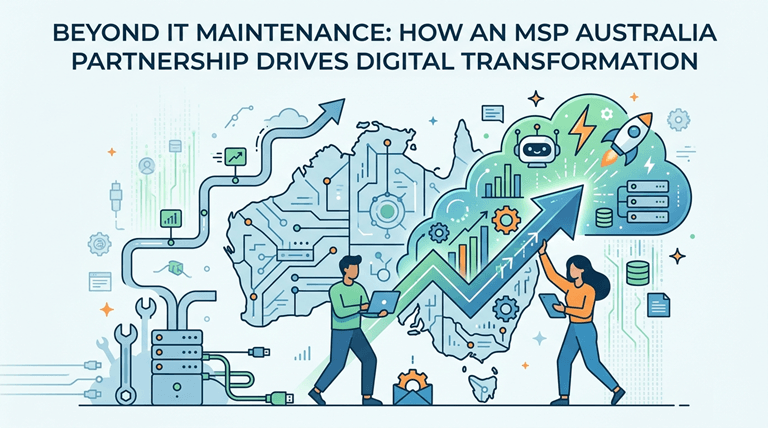
When the managed service provider relationship is at its best, this is where it becomes more valuable than a support contract. One of the most powerful enablers of meaningful digital change available to Australian businesses today is an MSP with the understanding of your business that’s as deep as that of an internal technology team, and with more resources and expertise to access than most internal teams.
The Maintenance Trap
The majority of organizations that have an MSP are reaping real benefits from the operational relationship with their MSP. Systems remain available, security issues are addressed, and day-to-day technology is stable. It’s nothing. Operational stability is the bedrock of all the other components, and those that have suffered the cost of business downtime know its worth in an instant.
However, operational stability is not the top. But those companies that see their MSP relationship as simply a service contract are missing out on value. They’re spending money on capabilities that aren’t being used, and crucially, they aren’t receiving the strategic input that has the potential to be transforming how their technology is helping them to achieve their growth goals.
It feels safe to be stuck and in the maintenance trap. Structured costs, scope, and results. But technology doesn’t turn 40; businesses that don’t continuously upgrade their technology capability are not keeping up. They’re slowly losing their minds.
What Strategic MSP Engagement Actually Looks Like
The one main characteristic of a transactional MSP relationship from a strategic one is the place where the talks take place. The relationship of transactional is in support ticket and renewal talks. Strategic ones occur in boardrooms and planning sessions where technologies are being utilized based on business goals and not on incidents in the business.
A strategic MSP in Australia brings a perspective that most internal teams struggle to maintain: the combination of deep familiarity with the client’s environment and broad exposure to how comparable businesses are solving similar challenges. That mix creates technology recommendations that are built on reality,y not theory, and based on what is actually working in the market, not what one internal team has been able to investigate.
That kind of engagement needs an MSP that takes time to get to know the business, rather than the infrastructure. The nature of the industry, business plans, employee composition, consumer focus, us, and other competitive factors all impact the definition of what good technology decisions are in a particular organisation. An MSP that takes part at this level isn’t offering a service. It’s really doing what it says on the tin and is a technology partner in a genuine way.
Digital Transformation as a Continuous Process
A key enabler to understanding the digital transformation is to approach it as a capability rather than a one-off project with a specific end goal. What may have been the most impressive technology-investing successes of the past few years do not necessarily correspond to the businesses that invested the most. These are the ones who developed the infrastructure, culture, and partnerships that enable them to adopt, adapt, and improve continually.
The continuous improvement model is a better way of structuring an MSP relationship and can be compounding. The technologies that are advanced add upon one another. Security posture gradually gets better. The amount of operational overhead is reduced by automation incrementally. Systems are connected and continually improved over successive cycles, thereby increasing data capabilities. The organisation is more technologically competent, since it undergoes a transformation that is always going on, although not at a massive pace.
Cloud, Security, and the Modern MSP
The scope of what Australian managed service providers deliver has expanded significantly over the past decade. Cloud strategy and migration, cybersecurity, compliance, data management, and business continuity planning are all now part of MSPs’ core service offering, which has been putting in the effort to stay in step with the market.
A well-equipped MSP has a deeper expertise in these areas, generally a greater depth of expertise than an internal team of a similar size could support. For cybersecurity, maybe the most telling example is that threat evolution is so rapid that it is hard to keep up with the internal team’s capability without making substantial training and tool investments that are continuous and regular. An MSP that has a security practice itself provides this capability via the partnership, not as an extra headcount or cost.
This broader perspective is adopted by Otto IT in all of their client interactions, and technology strategy is not a “one and done” solution, but a continuous dialogue.
Choosing the Right Partner
Not all MSPs are suited or equipped to run at the strategic level. Many are great at operational management and are really good at supporting businesses that require infrastructure support, reliability, and cost-effectiveness. This is important when a company is seeking a partner who will help with genuine change and not just keep the status quo.
When assessing an MSP for a strategic partnership, it is important to ask the right questions relating to how the MSP interacts with its clients outside of the day-to-day. What are their methods of keeping up to date with technological advances in their industry? What is their plan for the discussion of what your technology will be in three years? What is their definition of success other than uptime and the resolution time of tickets? The answers will indicate if you’re dealing with a vendor or a partner, and that will impact everything from there.
Popular on OTW Right Now!



About The Author

Gagan Bhangu
Founder of otechworld.com and managing editor. He is a tech geek, web-developer, and blogger. He holds a master's degree in computer applications and making money online since 2015.