
10 Use Cases and Real Examples of Generative AI in Healthcare
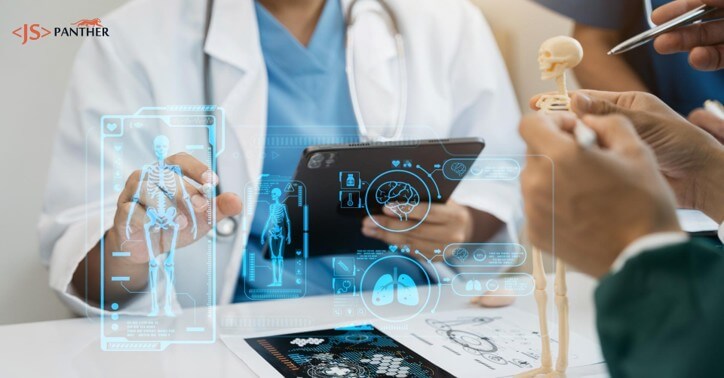
Generative AI has moved past the demo stage in healthcare. It’s drafting clinical notes in real time, designing drug candidates that reach human trials, and helping hospitals catch diagnostic details a tired radiologist might miss on a long shift. Below are ten use cases where generative AI is doing real work in healthcare today, along with actual organizations putting it into practice, not hypothetical scenarios.
If you’re a healthcare executive evaluating where AI in healthcare software development fits into your product roadmap, this is meant as a practical map of what’s actually working, not a hype piece. The technology has real limits too, which we’ll get into further down.
What Are the Top 10 Generative AI Use Cases in Healthcare?
1. Automating administrative work.
Scheduling, intake forms, insurance verification, and claims processing eat up enormous clinician time. Ambient AI scribes now sit in on patient visits and generate structured notes automatically; some health systems report clinicians getting hours back each week.
Building this well usually takes custom healthcare software development services, tailored to a specific EHR and workflow, rather than an off-the-shelf tool that assumes every hospital’s intake process looks the same.
2. Medical training and simulation.
The traditional drug development process takes 10 years and can cost billions, and of the billion or so candidates developed before the market, most fail.
Generative AI helps suggest new molecular designs and computationally evaluate interactions, significantly accelerating the discovery process by years and eliminating candidates that would not have become drugs even if developed.
3. Drug discovery and development.
Traditional drug development can take a decade and cost billions, with most candidates failing before reaching the market.
Generative AI proposes new molecular structures and screens interactions computationally, cutting years off early-stage discovery and reducing the amount spent on candidates that were never going to work in the first place.
4. Diagnostic imaging enhancement.
Generative models could enhance the quality of lower-quality MRIs, CT scans, and X-rays, helping radiologists detect abnormalities that may be missed. A decade ago, the adoption of AI-powered imaging tools was mostly confined to pilot initiatives and select health systems. Still, today, most of the large health systems have embraced these tools as a standard part of their clinical workflows, specifically in radiology and pathology departments. High-quality training data is also essential for these systems, and medical annotation services can help accurately label medical images so AI models can learn to identify abnormalities and support more reliable diagnostic workflows.
5. Synthetic medical data generation.
Privacy laws and data scarcity, particularly in rare diseases, hinder much of healthcare research. Generative AI can generate synthetic patient data that is statistically representative of the real world but doesn’t involve sharing real patient records, allowing researchers to conduct studies that would otherwise languish for months on the waiting list for data sharing approvals or IRB review.
6. NLP for electronic health records.
Generative language models can read and interpret doctors’ notes, summarize complex charts, and provide replies to inboxes within the EHR, helping reduce the documentation burden that contributes to physician burnout. The ROI becomes apparent almost right away with clinician hours saved, making this one of the quickest to move into the mainstream of use cases to sell internally.
7. Medical chatbots and virtual assistants.
If used correctly alongside EHR information, AI-powered assistants can schedule appointments, remind patients about their medications, and follow up on them after discharge — with personalized interactions rather than pre-programmed responses. A good one versus a bad one typically depends on the depth of that EHR integration: A chatbot that can’t see the patient’s history is just as bad as a phone tree.
8. Personalized treatment planning.
With a patient’s history, genetics, and lifestyle data, generative models can help clinicians determine a treatment approach that is customized to the specific patient, rather than an average of a population, which is especially helpful in oncology, where genetic markers can help identify very different treatment paths for what appears to be the same diagnosis on paper.
9. Restoration of lost capabilities.
Researchers are working on translating brain signals into text or movement for people who are paralyzed or can’t speak thanks to generative decoders that interpret meaning from raw signal data. It’s an early stage, but the trials that are going on with real patients, not simulations, and the speed of progress has accelerated, especially in the last couple of years here.
10. Accelerating medical research.
Generative AI can skim the entire trove of medical research, identify patterns, suggest new research directions, and uncover genes or proteins associated with various diseases, which would take human researchers considerably longer to do manually, particularly when it comes to discovering connections between previously unrelated studies that never imagined they would be able to be compared.
What Are Real-World Examples of Generative AI in Healthcare?
- Mass General Brigham built an AI-powered voice triage system during a period of overwhelming call volume, then expanded into ambient documentation tools now used by thousands of its clinicians to cut after-hours charting.
- Insilico Medicine has created a drug candidate for a lung disease that has entered clinical trials in humans, a real-world proof point that molecules designed by AI can make it to humans and not just simulations.
- Improved communication with speech-impaired patients relies on generative language models, which produce more natural and context-appropriate patient responses, rather than $10,000+ devices.
- The number of large pharmaceutical companies successfully partnering directly with AI labs for molecule design and generation of drug candidates has transcended the experimental stage, marking a significant shift toward more integral use of AI in the pharmaceutical R&D strategy.
What Are the Biggest Risks or Limitations of Generative AI in Healthcare?
To be straightforward, it’s not as simple as plugging in the healthcare sector, and it’s how projects get ruined. Models can hallucinate, meaning they produce plausible-sounding but wrong clinical information, and this is a problem if a clinician uses an AI-generated note without carefully reading it. Another reality is data privacy – any tool that deals with protected health data must be designed to be HIPAA compliant from the ground up rather than built to be compliant later on.
And Integration is not as easy as a sales deck. A wonderful model in a demo becomes troublesome when it needs to integrate with a real hospital’s EHR, complete with all its oddities and legacy data formats. None of this is to say that the technology itself is not worth adopting, but it does mean that the technology must be built by people who understand both the AI and the clinical environment it’s entering.
What Should You Look for in a Custom Software Development Company for Healthcare AI in the USA?
Not every vendor that says “AI” understands healthcare’s compliance load, data sensitivity, or clinical workflow quirks. A custom software development company in the USA without healthcare experience will usually underestimate how much of the work is EHR integration and compliance, not just model output.
Request details: What EHRs they have integrated with, how they manage PHI in their training pipelines, and have they sent anything through a security or compliance review before that? If a vendor can’t offer them a specific answer, he hasn’t done it.
How Do Generative AI Development Services Fit Into a Healthcare Roadmap?
What most healthcare organizations require isn’t an AI vendor; it’s generative AI development services to leverage a specific clinical use case, such as ambient documentation, synthetic data generation, or an AI-powered patient-facing assistant. Start narrow. A streamlined tool that performs one workflow efficiently and seamlessly with current software is better than a general AI tool that doesn’t always work as you’d like.
The teams that are now actually adopting are the ones that have addressed that one painful, specific problem, and they’re building as they go once they’ve gained the trust of clinical staff.
Popular on OTW Right Now!
About The Author

Gagan Bhangu
Founder of otechworld.com and managing editor. He is a tech geek, web-developer, and blogger. He holds a master's degree in computer applications and making money online since 2015.