
Why Your Browser Is Becoming a Gaming Platform Again
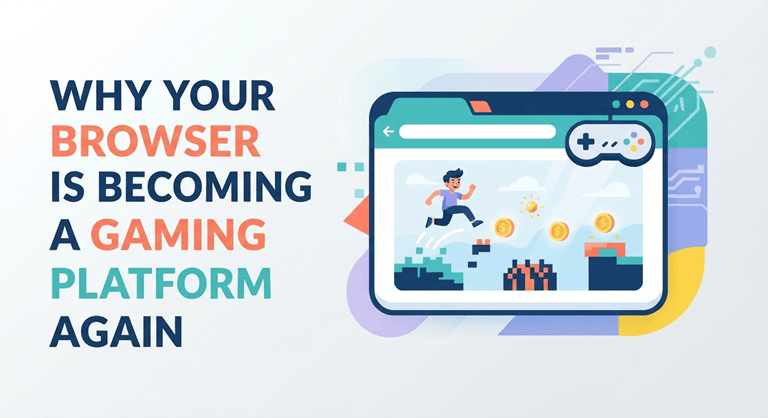
A modern browser renders hardware-accelerated 3D, mixes positional audio, reads a connected controller and holds a low-latency connection open to a server on another continent. It does all of that with no plugin involved, which is why the tab has turned back into somewhere people go to play rather than somewhere they sit while a download finishes. The shift happened gradually enough that most of us noticed the result long before we noticed the cause.
What actually runs in a tab now
Far more than the reputation suggests. Physics-heavy platformers, card and board adaptations, competitive shooters holding a few dozen players in one lobby, city builders that autosave to a server, and catalogue platforms with hundreds of titles sitting behind a single login. Frame rates hold up on ordinary laptops because the graphics work is handed straight to the GPU instead of being faked in JavaScript, and because the heavy code paths are compiled ahead of time rather than parsed line by line every time the page loads.
Audio is no longer a single looping track either; the Web Audio API gives developers a proper mixing graph, which is why a browser title can duck its music under a sound effect the way a console game does.
There is a second advantage that gets far less attention than the technical one. For a lot of people the browser is the only surface available at all. Locked-down work machines, school Chromebooks, shared family desktops and phones with two gigabytes of free storage will all run a browser and refuse almost everything else. A game that lives at an address survives an IT policy, a full storage drive and a device that was never yours to install software on in the first place. That is a distribution advantage no storefront can match, and it costs the developer nothing beyond hosting.
One login, many small sessions
The catalogue-style platforms are the clearest sign of where this is heading, because they are designed around short visits rather than long ones. PlayFame, a sweepstakes casino that runs entirely inside the tab, is a fair example of the shape: one account, a library you scroll instead of install, and titles built to hold four minutes of attention rather than forty.
That design only works when loading is close to instant, which happens to be the exact constraint the web imposes and the exact constraint native clients have never had to respect. A launcher can make you wait through an update. A URL cannot.
Your browser already ships with games
Google made this argument long before anyone in marketing did. The offline dinosaur runner sits inside every Chrome installation, and it has grown an entire culture of speedrunning, mods and console-injected cheats around it. oTechWorld’s guide to digging into it documents the JavaScript that disables the game-over routine, freezes obstacles in place, drops gravity to a fraction of normal or hands the controls to a short auto-jump script, along with the reason older versions of those commands stopped working after Chrome changed when the game engine loads.
Microsoft answered with a surfing game tucked behind an internal Edge address, complete with time trials, a zigzag mode and a Kraken that eats you if you fall behind. On paper both are throwaway easter eggs. In practice they are among the most-played titles on the planet, shipped by default on billions of machines, and between them they trained a generation to treat a browser window as a place where games happen rather than a place where games are advertised.
Standards did the unglamorous work
WebGL is the reason any of this renders at a watchable frame rate. Khronos released the 1.0 specification in March 2011, and it took until September 2014, roughly three and a half years, for the standard to clear 80 percent browser availability. Version 2.0 repeated the pattern almost exactly: it shipped in Firefox and Chrome back in 2017, then spent years waiting on Safari, and only once Safari 15 added support on macOS and iOS did the working group confirm the standard had landed everywhere it needed to.
The distance between “a specification exists” and “developers can rely on it” is where browser gaming lost most of a decade. Studios had to keep a fallback renderer for the older graphics context, which meant building the same visuals twice and testing both against every combination of browser version and graphics driver. Once that fallback stopped being necessary, the maths of shipping to the web changed.
It changed again when WebAssembly let existing C++ engines compile down to something a browser could execute at close to native speed, which is how full commercial engines ended up with a web export button sitting next to the console ones.
The back catalogue came back too
Recovery of the old library happened at roughly the same moment. Jason Scott, the Internet Archive’s software curator, has written that Flash dwarfs every other environment the Archive emulates in terms of what people upload, thousands upon thousands of contributions against a relative handful for everything else.
He also makes the case that keeping them playable grows more urgent each year, pointing to the shutdown of Cartoon Network’s website, which erased hundreds of games and animations that existed nowhere else and will never turn up on a disc or a streaming service. Flash itself started sliding in 2009, squeezed by bugs, by HTML5 arriving with overlapping features, and by Apple refusing it on iOS.
The tab has to earn the click every time
Nothing about a browser game is sticky, and that is the interesting part. There is no icon on a home screen, no launcher idling in the background, no fourteen gigabytes on a drive quietly arguing for one more session. A title that lives at an address gets judged on its first five seconds and vanishes the instant a tab closes.
That is a harsher test than any storefront applies, and it explains why the games doing well on the web tend to be far sharper about their opening minute than anything sitting behind an install queue. The plumbing question is settled now. What is still open is whether a tab can hold attention it never locked down to begin with.
Popular on OTW Right Now!

About The Author

Gagan Bhangu
Founder of otechworld.com and managing editor. He is a tech geek, web-developer, and blogger. He holds a master's degree in computer applications and making money online since 2015.