
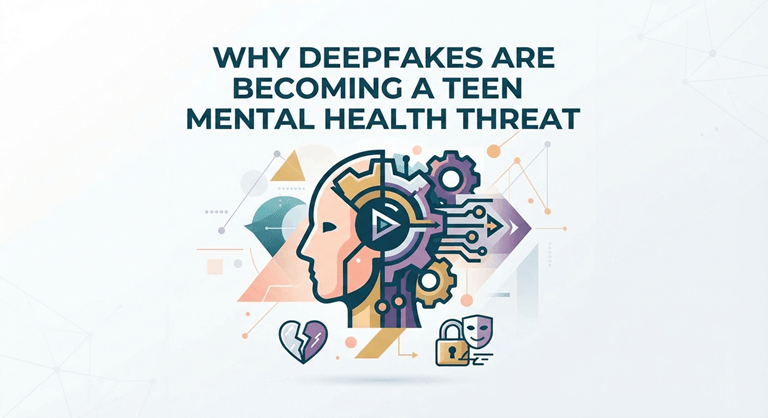
Why Deepfakes Are Becoming a Teen Mental Health Threat
For teenagers, the line between what happens online and what happens in real life has never been especially clear. A rumor posted in a group chat can follow someone into school the next morning. An embarrassing photo can spread through several social circles before lunch.
Deepfakes are making that problem much harder to contain.
AI tools can now create convincing fake photos, cloned voices, and altered videos with surprisingly little effort. Someone does not need advanced editing skills or expensive software. A few images, a short audio clip, and access to the right tool can be enough to build content that looks or sounds real.
That has created a new form of digital harassment, one that can put teenagers in the uncomfortable position of having to prove that something showing their own face or voice never actually happened.
A Fake Video Can Create Very Real Stress
Traditional cyberbullying often starts with words. Deepfake harassment adds something more powerful: apparent evidence.
A fake video can make it look like a teenager said something offensive, cheated on a partner, insulted a classmate, or took part in behavior that never occurred. Altered images can place someone’s face onto another person’s body. Voice cloning can create fake recordings that sound close enough to confuse friends, teachers, and family members.
The technology changes the basic psychology of a rumor. People tend to trust what they can see and hear, even when they know digital manipulation exists.
For the person targeted, that creates a strange kind of panic. They are not only dealing with humiliation. They are also watching other people debate whether the humiliation is real.
That uncertainty matters.
A student can delete an insulting message. It is much harder to erase the memory of a video that appeared to show their face.
Teenagers already face intense social pressure during years when reputation, friendships, appearance, and belonging carry enormous emotional weight. When online harassment becomes persistent, the resulting anxiety can mix with depression, substance use, or other behavioral problems. In more complex cases, families sometimes encounter care models such as a dual diagnosis treatment center, where mental health and substance-related problems are addressed together rather than treated as unrelated issues.
Deepfake Bullying Moves Faster Than School Discipline
Schools have spent years building policies around cyberbullying, harassment, threats, and inappropriate social media use. Deepfakes complicate nearly every part of that process.
First, staff members have to work out whether the content is fake.
Until the video is believable, the original has been posted multiple times, and no one seems to know who posted it. A school can only be provided with screenshots and not the original content. Pupils can demand that the film is genuine. People might say it’s fake to stop an unfriendly person.
In the meantime, the content keeps on moving.
A few days of disciplining can seem like an agonizingly long period of time when a fake image is sent to hundreds of students in a matter of hours. When adults draw their conclusions about what is going on, the social damage can be far from campus.
Another point is there, as well. Incidents of deepfakes don’t always fall into current school policy.
Is the material homemade? Has a student used a school device? Is the fake a public or a personal one? Is it bullying if the maker states it was a joke?
Those are questions that don’t impact the life of the administrator, but the teen who is the focus of the incident has a simpler thing to deal with: everyone has seen it.
The Fear Does Not End When the Post Comes Down
Removal is beneficial, but it is not a complete solution.
If a teenager is the victim of fake photos, an embarrassing sound recording, or a digitally distorted video, they might begin to ask, “Where is another copy of this?” After accounts are deleted, screenshots will remain. Videos can be stored on local storage. It would be difficult to get a full record of private exchanges.
That engenders a new kind of digital anxiety.
This is no longer a threat that people “saw this.”
It mutates to “Who still got it?”
The uncertainty may impact school attendance, friendships, dating, sleep, and concentration. The teen can start to be frightened when the cell phone rings near him. They may refrain from going to social events and assume people are speaking about the fake content. Others give up social media altogether and find that classmates will talk about what they saw on social media even after they leave the platform.
Being humiliated online for an extended period of time can be a significant health issue for teens facing emotional issues or substance abuse. Depending on the severity, some people have different amounts of treatment. A partial hospitalization program for addiction, for example, represents a more structured level of care than ordinary outpatient appointments while still allowing some patients to spend part of their time outside a residential setting.
It’s not always easy to draw a clean connection between a digital incident and subsequent behavioral issues. Humans don’t do things like that. Being humiliated, isolated, afraid, and without control over your situation for an extended period of time can be a lot of pressure for an already difficult person.
AI Has Lowered the Cost of Impersonation
It seemed like deepfakes were just a cautionary tale for politicians, celebrities, and large corporations at the time. This is an old picture.
Artificial media has gone mainstream with consumer AI.
They enjoy playing with AI filters, AI image generators, voice generators, and editing apps due to their fun, weirdness, and usability. The majority of those experiments are harmless. The issue arises when the same instruments are used as instruments of conflict in individual conflicts.
The heartbreak may result in a false picture.
A voice note can be created from any argument between classmates.
A joke in a group chat can be a video that goes beyond the group to circulate throughout a whole school.
The emotional repercussions are significant, and the technical hurdle continues to diminish.
But unlike traditional photo editing, AI can create multiple fake versions of photos in no time. There is no need to begin anew from time to time for a harasser to change their clothing, backgrounds, voices, captions, and scenarios.
That was what made the extent to which deepfakes bullied their targets so much more real than standard rumor spreading.
For some teens, chronic stress may lead to alcohol or drug use, especially if they’re already under other emotional or family stresses. Severe substance problems can eventually lead families toward services such as medical detox and residential treatment, especially when withdrawal risks or daily substance use require a more controlled environment.
As with the first instance, the deepfake isn’t necessarily the end of the story. It can be a trigger to one of the larger events that is destabilizing.
The Victim Has to Prove a Negative
The weirdest thing about deepfake harassment is that it’s on the impersonated person.
Typically, if you are accused of spreading a fake rumor, you need to bring evidence. In the case of deepfakes, the individual featured in the video usually has to prove the video is a fake.
For any grown-up, this is a challenging situation. This can be too daunting for a 14-year-old.
Suppose that you enter class having watched a fake clip the night before and know a few people in the class who also did. Suppose that you enter class and you know several people in the class who also watched a fake clip the night before. Some believe you. Some do not. To others, it doesn’t matter if it’s real; the joke has worn out.
This is because of the social dynamic, which shows that deepfake abuse is not a technological problem.
It’s a reputation problem, a privacy problem, a school safety problem, and a mental health problem.
When harassment is prolonged (weeks or months), it becomes a serious issue. Vulnerable teens may withdraw, lose interest, get angry, or become numb to emotions when they suffer repeated online attacks. When substance dependence becomes severe enough to require 24-hour support, a residential drug and alcohol rehab represents one form of intensive treatment used for people who need care away from their everyday environment.
Deepfakes Change What Teenagers Have to Worry About Online
Rumors, bullying, impersonation and cruel jokes have always been big parts of the lives of teenagers. AI hasn’t created them.
It has altered their scope of activities.
Now, a lie can come with a face!
Rumors can make themselves heard in one’s voice.
An embarrassing story may be a video that looks convincing enough to endure a few seconds’ glance before being shared, and it is these seconds that social media users typically give it.
It alters the emotional stress young people are under when they are online.
The “can people detect fake media” aspect of the debate will be only a small part of what comes next in the fight against deepfakes. The more difficult question is what comes after making the fake, seeing the fake, copying the fake, talking about the fake, and believing it?
That is becoming increasingly significant to teens. May contain fake content.
The shaming, fear, and consequences are not.
Popular on OTW Right Now!



About The Author

Gagan Bhangu
Founder of otechworld.com and managing editor. He is a tech geek, web-developer, and blogger. He holds a master's degree in computer applications and making money online since 2015.