
The Room-Use Audit: Match Cleaning Effort to What Actually Happens There
Room names can be rather unhelpful when it comes to cleaning.
Although a dining room is only used for dinner twice a week, it can also be used as a home office every weekday. Similarly, a spare bedroom may seldom accommodate visitors but can store luggage, seasonal clothing and exercise equipment. Also, one bathroom may be used by several people every morning while another is only occasionally opened.
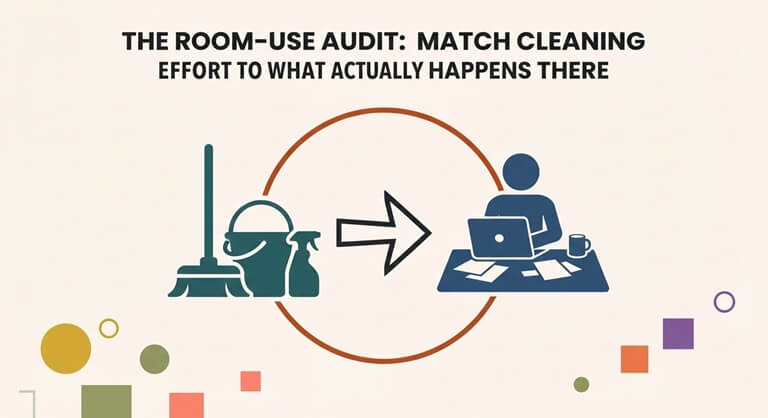
The floor plan gives these rooms fixed names.
Daily life does not.
A review of how rooms are used goes beyond just looking at the label to see what actually takes place in each area. This simple change can explain why some places lag behind even though they are cleaned regularly, while others are given more attention than is necessary.
Begin With Activity, Not Square Footage
The fact is that large rooms don’t necessarily mean there is more cleaning work.
A bedroom that is mainly used for sleeping can undergo gradual changes, while a small kitchen in which people cook their three meals, unpack groceries, work at the counter, and gather during the day can build up a number of kinds of residue within a short time.
Rather than take the time to measure the room, just observe what is going on in it.
How often do people come in?
What do they carry?
Which furniture gets used?
Does food go into that space?
Are shoes worn there?
Are there any pets, textiles, paperwork, or equipment in the room that are frequently handled?
Those questions explain cleaning demand much better than just looking at size.
Watch the Room Through an Ordinary Day
An audit is easiest when normal life is taking place.
Check out the room in the morning, in the afternoon, and in the evening.
A kitchen can start off with some breakfast crumbs, become quiet at noon, and then deal with heavy cooking in the evening.
The family room can stay as it is until the children come back home, when then the toys, the snacks, the blankets, and the pet’s activity will all overlap.
Looking at the room for a whole day means that a single moment cannot determine the entire cleaning plan.
It is usually during the busiest time that the majority of the buildup originates.
Find the Surface That Changes First
It is usual for any room that is active to have an early warning surface.
In the kitchen, it could be the preparation counter.
In the bathroom, it is possible that the sink and the mirror will change first.
Buildup can be seen around the sofa before the shelves appear to be dusty.
Traffic is usually noticed first inside the door at an entrance.
Identify that surface.
It is able to advise you that the room is beginning to need attention without needing a complete inspection each time.
Separate Traffic From Contact
The number of people walking around and the touching that takes place result in different cleaning patterns.
Even though a hallway has a great deal of foot traffic, it has very few surfaces that are touched.
In a home office, there is a restriction on walking since the desk, the area around the keyboard, the arms of the chair, and the nearby storage are in constant contact.
The distinction is different when it comes to effort.
The areas that see a lot of traffic should be given attention when dealing with walking paths and the edges.
In the case of areas that involve a lot of contact, it is necessary to carry out more thorough inspections of the handles, work surfaces, controls, and the objects that people use repeatedly.
It is possible for a room to be high in one respect and low in the other.
Identify What the Room Produces
Different actions leave different traces.
The process of cooking results in crumbs, a film caused by grease, spills, and fragments of packaging.
The areas used for sleeping produce hair, lint, and textile fibers.
Bathrooms contain moisture, grooming residue, dust, and hair.
The entry provides information about grit from external sources.
A play area can include food debris, craft materials, and a large number of movable objects.
Once the dominant residue is identified, cleaning becomes more specific.
There is less reason to give every surface the same treatment simply because it sits inside the same room.
Rewrite the Room Name in Plain Language
That’s where the audit proves to be useful.
Don’t use the term “dining room.”
Weekday laptop area, homework table, and evening meal area.
Do not use the phrase “spare bedroom.”
A low-traffic storage room with occasional guests.
Do not write “entryway.”
Write: “shoe-removal point, package drop, pet-walk return rou”e”.
The explanation given in that “ranslated description tells us a great deal regarding cleaning requirements.
A useful bridge to Alto Cleaning Services is this activity map rather than a simple room count: each space is defined by what happens there, what gets left behind, and which surfaces change first.
The cleaning priorities then come from real use instead of architectural labels.
Notice Where Two Activities Share One Surface
Multi-use surfaces need special attention.
A table that is used both for working and for eating picks up paper clutter, drink rings, crumbs, fingerprints, and the cables from devices.
A kitchen island can function as a place for preparing food, as a breakfast table, as a spot where homework can be done, and as a place to drop off packages.
Those surfaces usually seem hard to keep clean since various activities leave traces before the earlier one has been completely removed.
While carrying out the audit, note these overlap points.
More often than not, they need brief resets between uses rather than intense cleaning.
Give Quiet Rooms Permission to Stay Quiet
Some rooms simply do not change very fast.
That is useful information.
A guest room which is seldom used only requires occasional dusting and care of the floors but does not need much attention on a daily basis. While the family room is constantly in a state of change, the formal sitting area can stay clean.
One should not produce anything just because a room is there.
A review of room usage should not only cut down on unnecessary cleaning but also spot areas that have been overlooked.
The amount of effort that can be saved in a quiet area can be put towards the surfaces which actually require it.
Look at Furniture as Part of Room Use
Furniture has the ability to control both activity and access.
A sofa shows people where to sit, where to eat snacks, and where to lose hair or textile fibers.
The desk brings the contact together in a single small area.
The bed occupies a large portion of the floor and at the same time has defined edges on the sides.
Storage furniture can produce narrow spaces in which dust stays undisturbed.
Rather than viewing the furniture as something that obstructs the room, treat it as part of the audit.
Find out what activity the item supports and what cleaning pattern develops in connection with it.
Recheck the Room After a Life Change
The need for cleaning can change even if there is no renovation.
The dining area can be turned into an office by working from a distance.
Having a new pet results in different floor routes.
Each child every day makes use of a spare bedroom.
The guests remain for several weeks.
Cooking habits change.
The previous cleaning routine might not suit the room any longer.
After making significant changes, carry out the audit rather than continuing with the cleaning according to an outdated version of the home.
Use Buildup to Correct Your Assumptions
The initial audit won’t be perfect every time.
That is fine.
Let the room give its feedback.
If the area of the floor next to the sofa becomes dirty more often than the rest of the living room, then you should increase the attention paid to that area.
If a shelf still appears to be almost untouched each time it is put on for cleaning, then extend the interval between cleanings.
Even if two bathrooms are the same in type, if one of them has to be worked on more often than the other, don’t regard them as being equal.
Cleaning patterns must be adjusted on the basis of observation and not defended on the basis of habit.
Do Not Turn the Audit Into a Complicated Chart
The process must stay practical.
There is no need for spreadsheets, elaborate scoring systems, or a written list of all the surfaces.
A few observations are all that’s necessary.
Find out which activities are the most prominent in the room, where the people move, on which surfaces there is the most contact, what kind of residue shows up, and what changes first.
They usually show where the cleaning should take place.
If things are made any more complicated, there will be another maintenance task rather than the existing one being simplified.
Match Effort to the Life Inside the Room
The floors of a house are not used in accordance with the labels on the floor plan.
People work at dining tables, have their meals in the living rooms, keep items in the guest bedrooms, get together in the kitchens, and convert the unused corners into areas for exercise or for studying.
Cleaning should come after the real functions.
Observe the room during a typical day. Find out which of its surfaces change most quickly. Tell the difference between traffic and contact, note any overlapping activities, and pay less attention to areas that are quiet.
The outcome is therefore not a more rigorous cleaning schedule.
That one is more accurate.
Once effort follows what actually happens in each room, fewer tasks feel arbitrary—and the parts of the home doing the most work receive attention before they become the places that fall behind.
Popular on OTW Right Now!




About The Author

Gagan Bhangu
Founder of otechworld.com and managing editor. He is a tech geek, web-developer, and blogger. He holds a master's degree in computer applications and making money online since 2015.