
Why Apparel Brands Lose Money Before Shipping One Unit
A 30-style collection can burn through $150,000 in sampling costs alone before a single garment reaches a customer. Most founders never see it coming. They budget for production and shipping, then watch money disappear in sample rounds, revision loops, and communication delays that were entirely preventable. The problem is not creativity or ambition. It is a structural gap in how product development gets managed between the first sketch and the factory floor. This article walks through exactly where those losses happen, what the real numbers look like, and what you can do this season to stop the bleed.
The Pre-Production Cost Problem Is Bigger Than You Think
The global apparel market reached US$1.84 trillion in 2025, and the competition for margin inside that number is brutal. Brands at every scale are chasing the same seasonal windows with similar factory networks. The ones that survive are the ones that stop hemorrhaging budget before bulk production even starts.
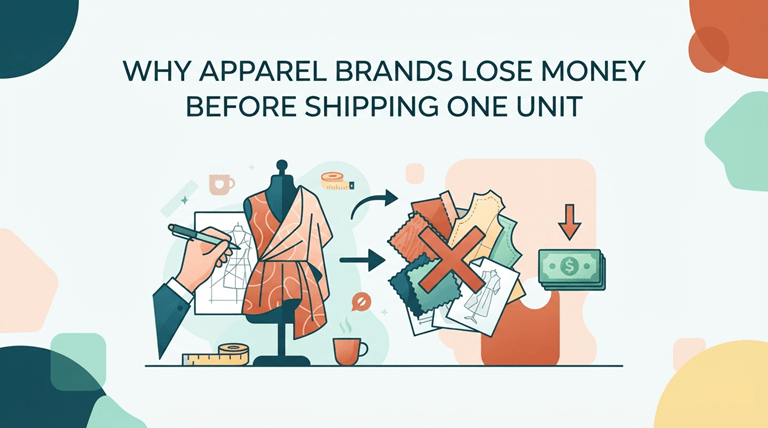
A single physical garment sample costs $200 to $1,500 per style per round, and most styles require 2 to 4 rounds before production approval. Total pre-production sampling costs reach $900 to $5,000-plus per style, meaning a 30-style collection can cost $27,000 to $150,000 in sampling alone. Read that figure again: $150,000 spent before a single unit ships to a customer.
And the waste inside that spend? Common Objective’s supply chain research found that 60% of all physical samples produced during development never make it to production, meaning the majority of this spend results in garments that are manufactured, shipped, reviewed, and discarded.
Here is the thing that most brand audits miss: sampling cost is only the most visible layer. The invisible layers are timeline compression, margin erosion, and the missed wholesale windows that never show up on a line sheet.
Where the Money Actually Goes: Four Leak Points
The losses cluster around four repeatable failure modes. Most brands experience all four in the same season without connecting them.
Leak 1: Incomplete Tech Packs
This is the original sin of apparel development. Tech-pack completeness is the strongest predictor of first-sample acceptance across apparel production data. Incomplete packs generate 2.3 times more back-and-forth with manufacturers, each round adding 7 to 14 days. Seven to fourteen days sounds manageable until you multiply it by a 30-style collection and realize you have burned three months of calendar time you did not budget for.
Based on accumulated industry experience, factories that receive an incomplete tech pack lose between 1 and 3 weeks just requesting missing information. The factory is not idle during that wait. Their slot fills with someone else’s order. Your project slides.
Most of the new brands think that a couple of reference images or more or less sketchy designs are sufficient to begin producing. Vague specifications result in miscommunication, wrong samples, and unforeseen production problems. One activewear company had sent in just a picture of the garment and was sent a sample that had the wrong fabric and no reinforced seams, which took weeks to fix.
Leak 2: Late Design Changes
Accounting for the costs of changing your mind after sampling is expensive in ways that it rarely does. The average designer who changes their line-sheet after sampling is paying 11% more per unit for re-sampling, re-cutting patterns, and re-ordering trims. On a production run of 500 units at a $40 cost-of-goods, that 11% is $2,200 per style—10 changed styles: $22,000 of avoidable overage.
The psychological trick is that changes feel free when they are still in the development phase.—a minor modification to one measurement, a minor change to another. None of them seems to be a costing choice. All of them are.
Leak 3: Sampling Round Accumulation
The industry average is 2 to 4 rounds of sampling for production approval; more rounds are needed if the garment is complex. The sampling stage is the stage that is the least understood. The one round is completed in 3-6 weeks. In 2 rounds, you can expect to be sampling for 6-12 weeks before any bulk production.
Every round is more than just a monetary expense. Making the physical samples requires multiple departments to work and wait together. This could be several weeks from cutting and sewing to the model being booked for fitting. A 12-week sampling on a Spring collection, which is available for sale in March, is not a delay. It is a miss.
Leak 4: Siloed Communication Across Teams
Communication is an essential part of the process when different teams such as designers, technical staff, pattern makers, and manufacturers are closely working with each other. If there are no effective digital platforms, information can easily be miscommunicated or lost, leading to errors or delays. Missing delivery deadlines or making costly changes because of misunderstandings about technical details or design changes is common.
It’s almost never the people. It is the format. Email threads containing measurement corrections. Photos taken on WhatsApp of fabric swatches—spreadsheets currently three versions out of date. If your product data is stored in four different locations, someone’s always working off the wrong one.
The Cost Leak Audit: A Framework for Finding Your Number
Before you fix anything, you need to know your actual exposure. Run this four-part audit at the start of your next development cycle. I call it the Cost Leak Audit, and it takes about 90 minutes with your tech design and production lead in the room.
- Tech Pack Completeness Score. Get your 3 most recent tech packs. Count how many requests for clarification regarding the factory came before the first sample. Count how many times there were before the first sample when a factory asked for clarification. Your packs have gaps if the average of emails per style is over 3. To keep the number of clarification emails to zero, create a standard form with fields pre-locked for construction callouts, stitch type, and point-of-measure tables.
- Design Change Lo. Review your recent email and Slack conversations. Record any measurement, trim, or color change after the first sample is taken. Calculate 11% of your cost of goods, then multiply by the number of styles you changed. This is the late change fee for the season.
- Sample Round Count by Style. Collect your sampling log. Take the average of the rounds for each style. Industry standard is 2.3. If the average is
- Communication Channels Count. Determine how many different platforms there are for product development conversations. These include email, Slack, WhatsApp, shared drives, and spreadsheets. If there are more than three channels, it is a sign of information fragmentation.
Score yourself honestly. For most brands, 2–3 of the 4 leak points are active in one season. That is normal. If you know which ones, you have a direction to focus on.
What Brands With Tight Development Processes Do Differently
The brands that consistently hit delivery windows and protect margin share a few habits that look boring from the outside but matter enormously in practice.
They Lock the Line Before They Sample
Design lock is a formal sign-off where all the silhouettes, colors, trims, and fabrics in a collection are locked down after a certain date. It sounds bureaucratic. It’s truly one of the best leverage decisions a small brand can make. According to WGSN (2025), 70% of production problems downstream are caused by confusion that occurs in the first three stages of development: design lock, tech pack, and sourcing fabrics. Early line closing does not stifle creativity. It channels it to the right phase.
They Centralize Product Data
From a file-driven to a record-driven approach, everything changes in how decisions are made by any team. An efficient, organized fashion product development process enables brands to stay agile with the latest trends, avoid costly mistakes, and increase customer satisfaction. This efficiency doesn’t stem from working harder. It is obtained from a simultaneous view of the same document by everyone.
This is exactly the gap that purpose-built tools address. Brands researching centralized product development options often compare generic project management tools against dedicated PLM software apparel platforms, and the difference shows up in how those systems handle version control, BOM updates, and vendor-facing communication rather than just task tracking.
They Treat Samples as Confirmation, Not Discovery
The costliest sample is the one that shows you a choice that you should have made in week two. Disciplined development uses sampling to be sure that the product is locked. Design lock, tech pack, and fabric sourcing typically take about 8 to 12 weeks of a production schedule and determine the bottom line of the entire collection. Doing that work upfront reduces later rounds and lowers the cost floor.
The Numbers: A Side-by-Side Look at Controlled vs. Uncontrolled Development
| Metric | Uncontrolled Development | Controlled Development | Source
|
| Avg. sample rounds per style | 3.5 to 5 | 1.5 to 2.3 | Adstronaut AI, 2026; Vistoya, 2026 |
| Sampling cost, 30-style collection | $90,000 to $150,000 | $27,000 to $50,000 | Adstronaut AI, 2026 |
| Back-and-femailsmails per incomplete tech pack | 5 to 9 per style | 0 to 1 per style | Vistoya, 2026 |
| Delay from incomplete tech docs | 1 to 3 weeks per style | None | Portugal Clothing Factory, 2026 |
| Late design change cost premium | 11% per unit average | 0% | Common Objective via Vistoya, 2025 |
| Wholesale delivery misses from sampling delays (2024) | 61% of brands that missed | Avoided with locked timelines | Statista via Vistoya, 2025 |
That is not a rounding error in that table! That is not a rounding error in that table! It’s the difference between a brand that makes it the first two years and one that doesn’t. Passion and creativity do not seem to be the key factors behind the failure of more than 70% of new clothing brands, as there are avoidable operational and strategic mistakes that are made from the start itself.
A Concrete Scenario: Two Brands, Same Collection Size
Take two DTC brands that are going to market with a 20-style Spring Collection, both using factories overseas. Brand A has email, calendar, and shared Google Drive folders, and a group WhatsApp with the factory contact to coordinate development. Development takes place centrally at Brand B, with tech packs, sample comments, and BOM revisions all displayed in one location for all parties involved.
Brand A has a tech run with an incorrect measurement on a top because the designer changed the spec via email, and the factory was still using a Drive file from 2 weeks earlier. This error becomes apparent at the first sample. Orders are given for a second round. Round one already waited 2-3 weeks since pattern making is before cutting and sewing. The second round (5-8 business days) adds 2 more weeks. More critically, the season becomes increasingly narrow.
A retailer can only floor place a product 11 days after the brand ships it.
The same potential measurement problem is picked up before the pack even reaches the factory in an internal review within their system. The spec is corrected, one copy goes to the factory, and the first sample acceptance occurs in round one. Brand B is shipped on time and achieves the retailer’s placement. Same product category. Same collection size. A completely different result as a result of one change in data governance for products.
What to Fix First if You Are Starting Now
You do not have to overhaul everything at once. Here is where to focus if you are mid-development cycle and want to reduce bleed before the next delivery.
- Standardize your tech pack template this week. Lock in required mandatory fields: All measurements, all points of measure, Type of stitch, Construction callouts, Approved fabric composition, Trim details with supplier code. Make sure your factory always receives files in the same format by using Techpacks.co or your CAD platform’s native export.
- Institute a design freeze date for next season. Choose a calendar date, 8 – 10 weeks prior to the first sample submission. If there are changes to the measurement, fabric, and/or trims after that date, it will take the written approval of 2 people. See how seemingly random changes come to a halt quickly.
- Count your communication channels and cut to two. In-house and communication with the factory. Anything else is a distraction and is causing version issues.
- Build a sample round budget before development starts. Take a conservative middle ground of $400 for each style per round, times your style count and then times 2.5 rounds. If that feels too high, you have been developing without a proper budget.
Vistoya’s 2026 production timeline guide, quoted in Harvard Business Review, 2024: Tech-pack completeness is the best predictor of first-sample acceptance when it comes to apparel production data. The Vistoya quote in the 2026 production timeline analysis from Harvard Business Review is the best distillation of the data from many sources: the quality of the document coming into development is the cost and time the document will require when it comes out. All the other aspects – the factory relationship, fabric selection, price negotiation – all follow that one variable.
The Overlooked Cost: What Delays Do to Seasonal Positioning
Most post-mortems on a bad season focus on sell-through rate and return volume. Not many people consider the price of being tardy. According to industry data from Statista (2025), 61% of brands that missed a delivery to wholesale attributed the failure to sourcing/sampling delay. When you miss a wholesale delivery, you’re losing the money on that order plus the lost opportunity to do more business. It’s a strained retailer relationship, a possible delisting, and a potential gap in the comp period makes next year’s buyer conversation more difficult.
If your first delivery arrives late, the seasonal sales window shrinks. If the fit is inconsistent, returns increase—both outcomes compound. Late arrival plus inconsistent fit in the same season can functionally end a small brand’s retail relationships in a single cycle. Market.us apparel industry data from 2025 underscores how much pressure brands are already operating under in a market where consumer behavior is shifting faster than seasonal calendars were designed to handle.
The Question Worth Sitting With
It is during the pre-production stage that brands set their cost floor, schedule, and define the relationship with each factory involved in their production. The vast majority of the decisions that shape those outcomes are made on an ad hoc basis, in emails and group chats, without the structure to raise tensions, issues, and conflicts before they turn into “expensive corrections.
You can build that structure incrementally. An improved tech pack template will come free of charge. A design fix date is a discussion. It’s much cheaper than a third sample round to have this centralized information. The question isn’t about whether you can afford to do a better job of your development process. It’s whether you can afford not to fix it again. What would 10% reduced sampling cost and 2 weeks on your delivery schedule cost for your brand these days?
Popular on OTW Right Now!


About The Author

Gagan Bhangu
Founder of otechworld.com and managing editor. He is a tech geek, web-developer, and blogger. He holds a master's degree in computer applications and making money online since 2015.