
Best Two-Post Car Lifts in 2026: Ranked by Capacity, Ceiling Clearance, and Real-World Shop Fit
Whether you’re a weekend warrior cramming one more project into a tight garage or running a busy professional shop, the right two-post lift is a dealbreaker. Get it wrong, and you’re fighting tight door clearances, bumping your head on low ceilings, or—worst case—questioning the safety of the whole setup. Get it right, and the lift practically disappears into your workflow, letting you focus on the job, not the equipment.
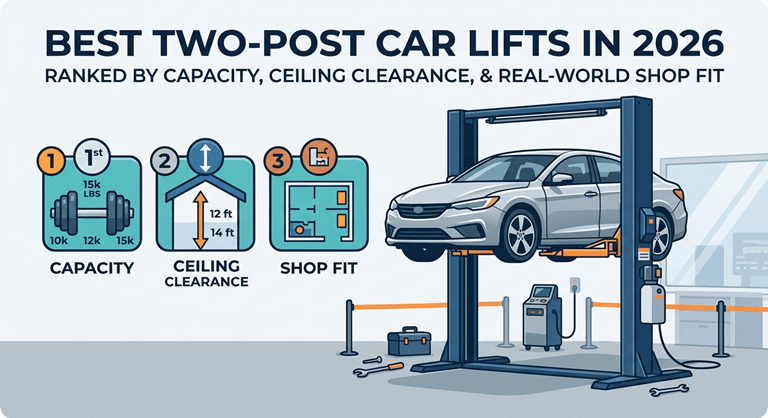
This listicle ranks lifts through three practical lenses:
- lifting capacity
- minimum ceiling clearance
- symmetric versus asymmetric design.
Methodology: How We Evaluated the Lifts
We didn’t just read spec sheets and call it a day. Each lift was evaluated against criteria that reflect how you’ll actually use it in your garage or shop.
- Lifting Capacity Tier: We focused on the most common range—7,000 lb for compact cars and light SUVs, up to 10,000 lb for heavy-duty pickups and work vans.
- Minimum Ceiling Clearance: Using the formula Lift Height + Vehicle Height = Minimum Clearance, we checked each model against typical garage heights.
- Symmetric vs. Asymmetric Design: Symmetric columns are a natural fit for long, heavy vehicles with centered weight; Asymmetric columns shift the vehicle rearward and give you way more door-opening clearance. That’s a lifesaver when you’re working on a sports car or front-wheel-drive sedan where every inch counts.
- Additional Criteria: ALI/ETL certification matters for commercial insurance and peace of mind.
- Use-Case Focus: Home-garage mechanics with low ceilings or tight bays, and professional shops needing daily throughput and versatility across mixed vehicle fleets.
The Best Two-Post Car Lifts of 2026
1. Wrenchers-Sold Challenger CL10V3 Versymmetric – A Top-Rated Two-Post Lift
The Challenger CL10V3 Versymmetric two-post lift from Wrenchers, is the kind of tool that makes you wonder why every lift doesn’t work this way. It combines a 10,000-lb capacity with true symmetric-and-asymmetric versatility, plus an industry-first feature called directSPOT that basically eliminates the annoying shuffle game of positioning a vehicle just right.
For home mechanics who want one lift to rule them all—or pros who need speed and reliability on every job—this is a top-rated choice.
- 10,000 lb lifting capacity; rise height of 74.125 inches
- Overall height 11 feet 2 inches or 11 feet 8 inches; designed for a 12-ft ceiling
- Versymmetric design switches between symmetric and asymmetric operation depending on the vehicle
- Three-stage front and three-stage rear arms with direct SPOT technology mean you don’t waste time rolling the car back and forth to find lift points
- Quick Cycle performance: 27-second rise, 17-second lower
- ALIis certified for safety and commercial insurance requirements
Best for: High-throughput professional shops and serious home garages that need fast, foolproof arm positioning across everything from compacts to 1-ton trucks
Less ideal if: Your ceiling is strictly 11 feet, or your budget caps out below $7,465.00
You can find the CL10V3 at Wrenchers—where free shipping, a price-match guarantee, and expert phone support Monday through Friday take the stress out of ordering major shop equipment, making it the perfect starting point for your lift search.
2. Rotary SPOA10-AV – A Top-Rated Commercial-Grade Asymmetric Lift
Rotary has been building lifts since 1925, and the SPOA10-AV proves the company hasn’t coasted on reputation. This is a true asymmetric lift with 30-degree rotated columns and the lowest profile arm height you’ll find in a 10,000-lb two-post model.
For technicians who spend all day under vehicles, the combination of durability and clever design is hard to beat.
- 10,000 lb capacity; max rise of 81.5 inches
- Overall height 11 feet 11.5 inches; requires a 12-ft ceiling (12 feet 6 inches with the Shockwave power option); minimum bay size 12 by 24 feet
- Exclusive “Double-S” column design adds structural strength and keeps carriage operation smooth over the years of daily use.
- True asymmetric arms with an 18-inch minimum front arm reach—perfect for compact cars and BMWs whose lift points can be frustratingly narrow
- ALI Gold Certified
Best for: Professional shops servicing sports cars, SUVs, and light trucks daily—buyers who value USA-made durability and industry-leading design
Less ideal if: Your budget is tight, or your ceiling is exactly 12 feet and you need the Shockwave power option
Anyone who’s going to be under a car needs to consider durability and safety.
3. MaxJax M7K – A Top-Rated Portable Lift for Low Ceilings
Most two-post lifts laugh at garages with 8- to 10-foot ceilings. The MaxJax M7K doesn’t just fit those spaces—it thrives there, and then wheels out of the way when you’re done.
For home garages where permanent installation isn’t an option and ceiling height is the limiting factor, this portable lift solves both problems without sacrificing the core two-post experience.
- 7,000 lb lifting capacity
- Overall height 89.5 inches; max lift height 47.25 inches (pad only), minimum pad height 4.75 inches—fits comfortably under 8–10 ft ceilings
Best for: Home garages, renters, or anyone with ceilings at or under 10 feet who needs a stowable lift
Less ideal if: You need to stand fully under a lifted full-size SUV, or regularly work on vehicles exceeding 7,000 lb
4. BendPak XPR-10AS – A Versatile Dual-Mode Lift
The BendPak XPR-10AS is built around a simple idea: what if one set of arms could do both symmetric and asymmetric lifting without swapping hardware? The answer is Tru-Metric, a design that lets you adjust arm positions to load vehicles either centered or shifted rearward.
For multi-vehicle home garages or small shops that see a mix of sedans, SUVs, and pickups every week, that flexibility is a genuine time-saver.
- 10,000 lb capacity; overall height 145 inches (12 feet 1 inch) or with optional 24-inch extension, max lift 79 inches
- Requires approximately a 4.25-inch concrete slab thickness
- Tru-Metric arm design lets you switch between symmetric and asymmetric configurations without disconnecting anything
- ALI/ETL certified; backed by a 5-year structural, 2-year hydraulic, and 1-year electrical warranty
Best for: Home mechanics and small shops lifting a mix of SUVs, pickups, and cars—anyone who wants a single lift to cover all bases
Less ideal if: You have under 12 feet of ceiling height or a tight budget (lift runs about $5,365.00 (as of May 2024))
For a versatile ALI-certified lift that handles just about anything you can throw at it, the XPR-10AS delivers where it counts.
5. APEX AL9LC – A Floorplate Lift for Low-Ceiling Shops
Some garages barely scrape past 9.5 feet of ceiling height, and in those spaces, an overhead-style two-post lift simply won’t work—there’s no room for the crossbar and cables up top.
The APEX AL9LC takes a different approach. It’s a floorplate design that routes everything through a drive-over enclosure at ground level, keeping the space between the tops of the posts wide open. If your shop ceiling is more basement than warehouse, this is your lift.
- 9,000 lb capacity
- Floorplate (baseplate) design runs hydraulic lines and cables through a low-profile drive-over enclosure, leaving the vertical clearance unrestricted abo.ve
- The APEX AL9LC fits 10 ft. ceilings with an overall height of 109.5 inches.
- List price around $3,895; backed by BendPak engineering
Best for: Basement workshops, townhome garages, or any shop where 9.5–10 feet of clearance is the hard limit
Less ideal if: You need 10,000-plus-lb capacity or the ability to walk fully under a raised full-size pickup
The floorplate concept isn’t new, but it’s a proven fix for low-ceiling environments where every inch matters. The APEX pedigree through BendPak adds a layer of confidence for tight-quarter installs that can’t afford to compromise on safety.
6. Atlas PV-10PX – A Top-Rated Value 10,000-lb Lift for Budget-Minded Shops
Not everyone needs a premium brand name on the column. The Atlas PV-10PX delivers commercial-grade 10,000-lb lifting at a price that leaves room in the budget for the rest of your shop build-out.
For the home mechanic or small shop owner who wants new equipment without the premium markup, Atlas has carved out a reputation as the practical choice.
- 10,000 lb capacity
- Dual-arm configuration typically supports both symmetric and asymmetric operation (verify current specs before ordering)
- Available in non-ALI and ALI-certified variants (the Platinum PVL-10), so you can choose based on whether your insurance requires certification
- Overall height usually around 11 feet 11 1/8″ to 12 feet 3″; confirm exact dimensions with the manufacturer
- Total installed cost roughly $4,499.00 (as of 2026)
Best for: Home garages and budget-conscious shops servicing a wide variety of passenger vehicles and light SUVs
Less ideal if: You need heavy-duty 12K-plus capacity, or your shop’s insurance mandates ALI certification (go for the certified variant instead)
Caveats & Counterpoints: What to Know Before You Buy
Before you pull out the credit card, a few realities deserve your attention. These details don’t make the spec sheet, but they absolutely affect your install and long-term happiness.
Concrete Requirements: The minimum slab thickness for a 7,000-lb lift is generally 4.25 inches, but heavier models or those with higher ratings may demand 6 inches. Older garage floors poured decades ago often fall short. Measure before you order, because cracking or spalling after install is not the kind of surprise anyone wants.
Clearance Math: The formula Lift Height + Vehicle Height = Minimum Clearance matters more than the lift’s overall height alone. A full-size SUV at 6.2 feet plus a 72-inch rise gives you roughly a 10.2-foot minimum, but toss in a taller truck at 6.2 feet and a lift with an 81.5-inch max rise, and you’re suddenly brushing 13 feet. The vehicle height guidelines from Derek Weaver Co. give you solid reference points: compacts 4.5–5.2 ft, sports cars 3.9–4.5 ft, luxury cars 4.2–4.9 ft, compact SUVs 4.9–5.6 ft, full SUVs 5.2–6.2 ft, trucks 5.5–6.2 ft.
Bay Space: Position your lift 9 to 12 feet from any wall, and plan for 3 to 4 feet of clear perimeter. Some lifts have specific minimum bay sizes—the Rotary SPOA10-AV, for example, needs 12 by 24 feet.
ALI Certification: Not required for home use, but commercial shops often need it for insurance. The new ANSI/ALI ALCTV:2025 standard becomes effective April 1, 2027, replacing the 2017 standard. Buying an ALI-certified lift now future-proofs your shop and keeps inspectors happy.
User-Reported Quirks: BendPak’s customer service gets mixed reviews—some praise it, others report slow response times. MaxJax occasionally ships with initial hydraulic leaks, usually solved by proper bleeding. And that 20-amp circuit requirement for the M7K is non-negotiable; a 20-amp line is necessary for proper operation.
Installation Budget: All-in costs range from $3,800 for a budget-tier setup to $8,000 (as of 2026) for premium options, factoring in concrete work, electrical, and professional installation. If anchoring heavy steel into concrete to hold thousands of pounds overhead isn’t in your comfort zone, hire a pro.
Building a Complete Shop: What to Pair with Your Two-Post Lift
Once your lift anchors are set and the first car is in the air, you’ll quickly realize the next bottleneck: tires and wheels. A tire changer and wheel balancer turn your bay into a truly full-service garage, letting you handle mount-and-balance jobs without farming them out.
Also worth noting: when you’re shopping for big-ticket shop equipment, look for retailers offering free shipping and price-match guarantees. That alone can knock a significant chunk off the total investment, especially when freight charges on heavy steel lifts can run hundreds of dollars.
Looking Ahead: The Tech-Driven Shop of 2026
The automotive service world isn’t just about bigger lifts and stronger steel anymore. Predictive maintenance algorithms, augmented-reality-guided repairs, and integrated shop management platforms are quickly becoming standard kit in forward-thinking garages.
Your new lift is the backbone, but pairing it with smarter technology can transform how your whole shop operates.
[For a look at where the industry is headed, read our article on how technology is revolutionizing automotive aftersales service.]Final Thoughts
Two-post lifts aren’t one-size-fits-all, and that’s actually a good thing. Whether your priority is raw capacity, fitting under a low ceiling, or switching between symmetric and asymmetric at will, there’s a model built exactly for your scenario.
The Challenger CL10V3 balances all three categories well, while each specialist on this list owns its niche. Measure twice—ceiling, slab, and electrical panel. Check your concrete thickness before anything shows up on a pallet.
A well-chosen lift pays off over a decade or more of safe, efficient work. Rush the decision, though, and you’ll be reminded of it every time you duck under that crossbar.
Popular on OTW Right Now!




About The Author

Gagan Bhangu
Founder of otechworld.com and managing editor. He is a tech geek, web-developer, and blogger. He holds a master's degree in computer applications and making money online since 2015.