
Why AI-Native Businesses Will Outgrow AI-Enabled Businesses
Every business today claims to use AI in some way, but not all AI use is created equal. Some companies simply bolt a chatbot onto their website or add an AI writing tool to their marketing team, treating artificial intelligence as one more app in a long list of tools. Other companies take a very different approach, building their entire operation around AI from the very beginning. This second group, often called AI-native businesses, is starting to pull ahead of the first group in ways that are becoming impossible to ignore. The gap between these two groups is quickly becoming one of the clearest predictors of which businesses will still be growing five years from now.
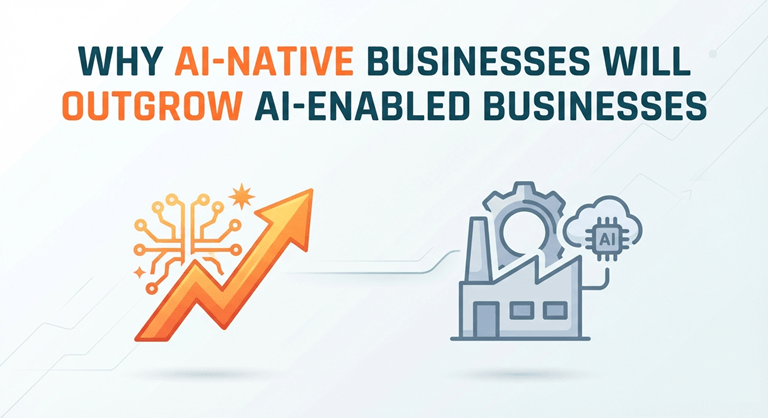
At first glance, the difference can be hard to spot. Both types of businesses might use similar software, mention AI on their websites, and talk about innovation in the same hopeful language. But look closer at how decisions actually get made inside each company, and the difference becomes obvious. One group treats AI as a feature. The other treats it as the foundation everything else is built upon.
The difference between these two approaches is bigger than it might first appear. An AI-enabled business adds AI to an existing process, hoping it speeds things up without changing much else. An AI-native business rebuilds the process itself around what AI makes possible, often discovering entirely new ways of working that would not have existed otherwise. This is not just a matter of using better tools. It is a fundamentally different way of thinking about how a business operates, how decisions get made, and how quickly a company can adapt when the market shifts beneath it.
This distinction matters because speed and adaptability have become the real currency of modern business. A company that simply adds AI features on top of old systems still moves at the pace of those old systems underneath. Meanwhile, a company built around AI from day one can analyze data, test ideas, and adjust strategy at a pace that older systems simply cannot match. Nowhere is this gap more visible than in how each type of business handles data — specifically, whether reporting and analytics are reactive tools or active drivers of strategy. Businesses exploring AI for Business Intelligence often find that the shift from passive dashboards to real-time, decision-ready insights is where the structural difference between AI-enabled and AI-native becomes most tangible. Over time, this gap compounds. What starts as a small advantage in speed becomes a massive advantage in market position, customer experience, and overall growth.
Think of it like the difference between renovating an old house and building a new one from scratch. A renovation can make an old house more comfortable, but the foundation, the wiring, and the layout still reflect decisions made decades earlier. Building new means every choice, from the foundation up, can be made with today’s possibilities in mind. AI-native businesses are essentially building new houses, while AI-enabled businesses are still renovating around walls that were never meant to support this kind of weight.
Founders from a wide range of industries, including network infrastructure, marketing services, and mobile app development,t are learning the same thing. AI-driven businesses are not only faster, but they’re better. Their structure is different;t, they can learn and get better in ways that businesses with AI as an add-on can’t. The understanding of this difference is quickly becoming a must-have for any founder who is trying to determine where their business actually lies in a fast-changing environment.
Building AI Into the Foundation, Not Bolting It On Top
You can have examples of businesses that incorporate AI into their operations and those businesses that use AI to enhance their current operations, but the best way to distinguish between the two is by observing how each one actually uses artificial intelligence in its daily operations. An AI-powered business usually views AI as some kind of implementation of an existing task that can be completed more quickly. An AI-native business sees AI as the power that makes their business run and makes decisions based on AI before a human ever gets a second look.
It’s not a trivial technical point. It impacts the speed at which a business learns from its own information, how confidently a business can test out new concepts, and how much of the business’s day-to-day functions require human interaction. To illustrate this, here are some examples of how this is applied in very different industries.
Jake Brander, Founder of Brander Group Inc., built his entire IPv4 brokerage business around a proprietary AI-driven system designed to find dormant internet address blocks that traditional methods would never uncover.
“We built our proprietary system to hunt down dormant IPv4 blocks around AI from the very beginning, not as an afterthought. That system now helps us facilitate close to a billion dollars in transfers since 2016, moving faster than any manual process ever could. Competitors who bolt AI onto old spreadsheets are still playing catch-up while we are already three steps ahead. Being AI native from day one is exactly why we can operate across 60 countries without slowing down.”
This same principle applies just as strongly to marketing agencies, where AI can either sit on the surface of a campaign or shape its entire strategy from the start. Emma Sansom, Founder of Flamingo Marketing Strategies, rebuilt her agency’s lead generation process around AI rather than simply adding it as an extra step.
“We rebuilt our Prospect100 lead generation process around AI from the ground up, not as an add-on tool. That shift let us analyze audience data and personalize outreach far faster than our old manual research ever allowed. One client saw a 300 percent return on investment within two years because our targeting got sharper every single month. Agencies that simply sprinkle AI on top of old workflows will always move slower than teams built around it from day one.”
Why This Gap Keeps Growing Over Time
The true competitive edge is no longer about whether companies use AI, but how integral AI becomes to their operations. The question of whether a company uses AI or not is becoming less relevant; it’s about how much AI is embedded into the core of companies. Companies that incorporate AI at the outset of processes tend to benefit more as every decision that’s made enriches the system with new data. When AI is only an add-on, there is a risk that they will fall behind as their processes were never built with AI in mind.
Mike Kordvani, Founder and CEO of SemNexus, has seen this gap play out directly in how startups approach mobile app development and user acquisition.
“When we design an app for a startup, we build AI into the user acquisition strategy from the very first sprint, not after launch. That approach helped one client cut their cost per install significantly while scaling faster than their competitors expected. Teams that treat AI as a bolt-on feature always lag behind the ones that build their entire process around it. Being AI native means every decision, from ASO to ad testing, gets smarter with each cycle instead of starting from scratch.”
It is observed throughout all sectors of the article—network infrastructure, marketing, app development and more. Not all of the fastest-growing companies are necessarily investing the most in AI tools. They are the ones ready to rethink their whole process and what AI can actually do, instead of adapting AI to a process that was designed for a different time. That’s the kind of thing that’s usually the best indication of which companies will be the leaders in their industries in the years to come.
The Lesson Every Founder Should Take Away
The three stories that unfold here—from the Internet infrastructure to the marketing to the app—actually all go towards the same end. While there are tools that can be added to an AI-enabled business that yield immediate benefits, AI-native businesses create a structural advantage that compounds over time. The difference does not lie in the amount of money being spent on technology by one company compared to another. It’s about the organization willing to re-develop their process rather than just tacking a new process on top of an old one.
The question that should be asked by founders who are wondering about their own business is a simple one. Is business AI helping your business do the same things just a little faster, or is it changing what your business can do? It’s not about the first question; it’s about the second: If a business can answer the second question, they are most likely to outperform its competitors in the years to come, not because it had the first AI technology, but because it designed its entire business around what AI can do.
The companies that appear in this article didn’t just install new software and sit back and wait for the numbers to come in. They reimagined their systems, their processes, and even their business models with regard to what AI can really do in their business. What’s really important to take from their stories is their willingness not to seek small improvements, but to rebuild. It isn’t about which companies employ the most AI tools, it’s about which ones use the ones that are the right ones. It will be part of the companies that are developing AI into their core from the get-go.
Popular on OTW Right Now!
-
 Best AI Lead Qualification Tools (2026): Lead Scoring vs Conversational Qualification
-
 From Dashboards to Decisions: Why Most Business Reporting Stops Halfway
-
 What Trends Shape AI Website Generators Going Into 2027
-
Best AI CRM for Service Businesses: Automation Examples for HVAC, Plumbing, Cleaning & More


About The Author

Gagan Bhangu
Founder of otechworld.com and managing editor. He is a tech geek, web-developer, and blogger. He holds a master's degree in computer applications and making money online since 2015.