
How Many Devices Can a Portable Power Station Run?
A portable power station can run several devices at once, as long as their combined wattage stays within the unit’s output limit and the battery has enough capacity to support the desired runtime. Power consumption differs greatly between small electronics like phones, tablets, and laptops and appliances such as refrigerators, microwaves, and power tools. When estimating how many devices you can use, consider total wattage, surge requirements, and battery capacity. Those numbers are the station’s limits of safe operation and duration.
Factors That Determine the Number of Devices You Can Run
Check the Total Wattage of Connected Devices
Start by adding the running wattage of every device you plan to use at the same time. If a laptop draws 60W, a router uses 10W, and two LED lights use 20W total, the combined load is 90W. Your portable power station must support at least that amount continuously. This is the easiest way to determine how many devices it can support. This allows more low-watt devices to run simultaneously, and fewer high-watt devices will take up more of the output, and fewer ports will be used.
Consider Continuous Power and Surge Power Requirements
The increased startup power requirement of many appliances is for brief periods only. This surge power is the startup requirement of refrigerators, pumps, compressors, and certain power tools. A power station can supply a device’s normal power but still fail to deliver the surge if it exceeds the device’s peak power. Before using larger equipment, double-check both numbers. Models with Massive 4,000W Peak Power can handle more robust startup loads with greater reliability, allowing for increased diversity of devices to operate without protection backup or interrupting operation during the startup sequence.
Understand Battery Capacity and Expected Runtime
The output gives you information on what a portable power station can power on at one time, whereas the battery capacity gives you information on how long it can power those devices. The capacity is measured in Wh (watt-hour). This means that a 2,000Wh battery can power a 200W load for approximately 10 hours (without taking efficiency losses into account). Higher capacities allow more use throughout the day or during a power outage. Up to 4kWh expandable units offer greater flexibility for overnight use, extended camping, or powering multiple essentials for longer durations.
Examples of Devices a Portable Power Station Can Run
Small Electronics: Phones, Laptops, and Cameras
Small electronics can easily be used in portable power stations as they require low wattage. For example, a smartphone uses a few watts when charging, a laptop can consume anywhere between 45W and 100W, and camera batteries typically consume even less. You’ll be able to charge multiple phones, a laptop, and camera equipment at one time, without ever drawing near to the output limit. These are some of the most lightweight loads to run on for travel, work, or emergencies. They also consume less battery power, thus prolonging battery life.
Home Essentials: Routers, Lights, and Refrigerators
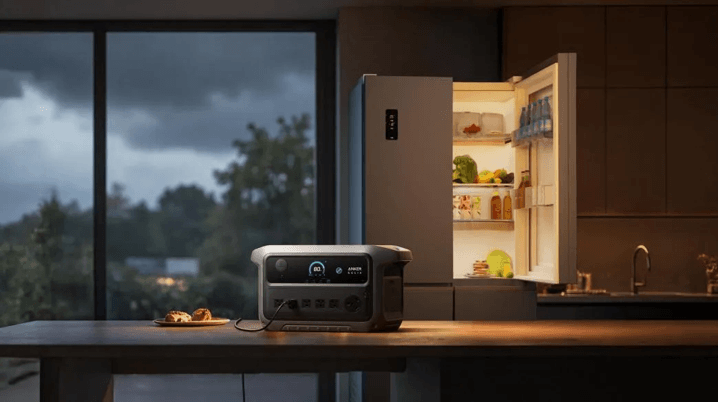
With the right management techniques, a portable power station can keep your main household appliances running during a power outage. Routers and modems typically consume very little power, and LED lights consume even less. So they can be easily powered for long durations. The refrigerator is tricky and on/off, and may use more start-up watts than refrigerators that remain on. Nevertheless, many portable power stations can power a router, multiple lights, and/or a refrigerator simultaneously. That’s why they can help you store food securely and provide quick backups.
Outdoor Equipment: Camping and RV Appliances
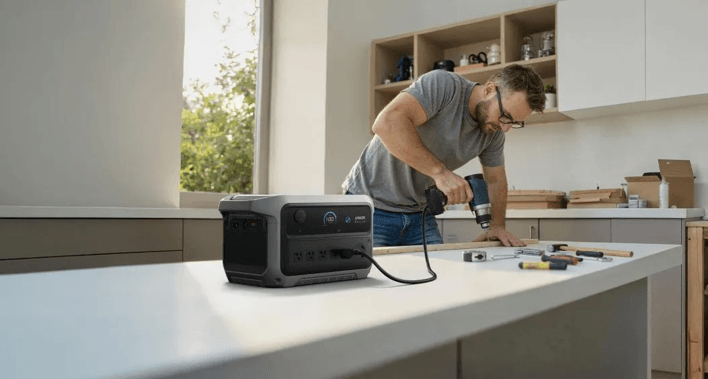
Portable Power Stations can power a variety of items, including electric coolers, fans, portable projectors, coffee makers, and small cooking appliances, depending on the power station’s output. Lower-wattage equipment, such as lanterns, cell phones, speakers, and GPS devices, generally works well. Higher-draw appliances require closer inspection, particularly if you plan to use several simultaneously. When it comes to commercial applications, a portable power station is most effective when you determine what you need to run first and what items you can add later to maximize the convenience with limited battery power.
Anker SOLIX C2000 Gen 2: Powering Multiple Devices
2,400W Output for Everyday Appliances and Electronics
Available in 2,400W, the Anker SOLIX C2000 Gen 2 can power multiple devices simultaneously to support everyday appliances and electronics during power outages, travel, and outdoor applications. This is enough to power combinations like a refrigerator, router, lights, laptops, and phone charger, so long as the running wattage of all these items does not exceed the limit. It also provides a huge peak power of 4,000W to assist with devices that use startup power for start-up. In real-world use, that means flexibility for low-draw electronics and larger equipment—such as at home or for camping.
2,048Wh Capacity for Extended Backup Power
Featuring a powerful 2,048Wh battery, the Anker SOLIX C2000 Gen 2 can power up essential devices for hours rather than minutes. For instance, moderate combined loads like internet devices, light, laptop, and charging devices can be carried throughout most of the day or night as used. The system can be expanded to 4kWh to extend backup time during power outages and off-grid trips. This extra storage capacity is particularly advantageous for running multiple devices for a long time.
Conclusion
Whether it’s several small electronics or a combination of household necessities and outdoor appliances, the portable power station can be used anywhere provided that the load matches the power output, surge protection, and battery capacity. The simplest method to gauge performance is to sum the running watts, verify the startup requirements, and calculate the possible operating time in watt-hours. For those who need multiple power sources to be reliable, a model with strong output and expandable energy storage is more flexible, offers more backup time, and provides better power support in both daily use and emergencies.
Popular on OTW Right Now!




About The Author

Gagan Bhangu
Founder of otechworld.com and managing editor. He is a tech geek, web-developer, and blogger. He holds a master's degree in computer applications and making money online since 2015.