
What to Look for in an AI Consultant
These days, nearly every business is being told it needs AI. Far fewer have a clear idea of where it would actually help, or where it would just cost money and cause headaches. That’s usually the point where people start looking for a reliable artificial intelligence consulting company in Australia: someone who can tell the useful ideas from the expensive experiments. The tricky part is knowing what good advice looks like when you hear it, especially if you’re not technical yourself.
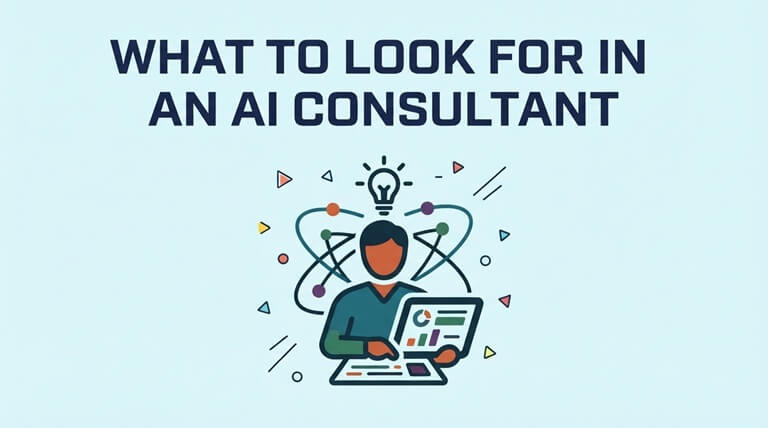
What Does an AI Consultant Actually Do?
An AI consultant will help you work out whether AI is right for your business and, if so, where it makes sense. Equally important, they’ll tell you where it doesn’t. They’ll spend time getting to grips with your problems, look at your data, consider the cost, the risk, and whether the effort is justified.
If it does make sense to go ahead, they’ll help choose the right kind of technology. That might be machine learning, a large language model, a simpler automation, or plain old software. They’ll help you plan the implementation in such a way as not to create problems for the rest of the business. A significant part of their role is in facilitating communication between the managers and the developers. The managers will be talking about sales, staff time, complaints, etc. The developers will be talking about data, models, and systems. The consultant’s job is to make sure that they understand each other.
Honest Advice Beats Hype
Watch out for your very first conversation with a consultant. Do they ask you about your business, your customers, and what’s not working? Or do they immediately jump into demos and the usual salesy stuff? The good consultants will start by looking at your problems, not just jumping straight to the demo of their favorite thing.
Why Data Readiness Matters
If you feed a piece of AI with bad data, you’re going to get bad results. Some of the errors are going to be glaringly obvious; some of the answers are going to look perfectly fine and yet still be wrong, and that can be an even bigger problem. If your data is incomplete, out of date, or spread across a number of disparate systems, then that needs to be addressed first.
A good consultant will be asking you loads of questions about your data. Where is it stored? Who looks after it? How reliable is it? Are there any privacy constraints on its use? They’ll be very clear about what needs doing first. The most useful thing you may get from them is a to-do list for your data. Once that’s in place, the rest of the work becomes a lot easier.
Managing Risk and Governance
Gen AI and LLMs can be extremely useful, but they come with risks. One of the most common is “hallucination,” where the system fabricates information and presents it as if it’s true. Sensitive data can be inadvertently passed through the prompts or the outputs if no one has actually checked where that data is going. The results can also be biased by the data that the model was trained on. Depending on your sector, there may be rules in place around privacy, record-keeping, and who is ultimately liable if something goes wrong.
None of this means you should avoid AI. It means it should be set up with care. A consultant who waves these worries away isn’t someone you want building your system.
Questions to Ask a Potential Consultant
When you’re looking at which AI consulting company in Australia is the right one for your business, asking a few simple questions can go a long way.
- Can you show me some actual projects you’ve delivered rather than just demos?
- How do you know when AI isn’t the right tool?
- How do you secure our data and keep it private?
- What do you put in place to catch the wrong or misleading outputs?
Clear and specific answers are a good thing. If all they’ll do is talk in the abstract about ‘transformation’ and ‘unlocking value ‘, then that’s not really of any use. If you can, ask for the contact details of a past client who had a similar project and give them a ring.
Fitting AI Into Existing Systems
If it doesn’t connect to your existing systems, then it’s just another login for staff to forget. It should be able to work with your software, your databases, and your cloud services, and it needs to be maintained. A consultant with more general software development experience can ensure that the new tool actually fits into your environment rather than being yet another disconnected system.
Make sure you ask who’s going to provide support for the solution when it goes live and what that support will cost.
Starting Small
Lots of organizations do best by starting with a fixed-scope discovery or strategy phase. It’s a modest commitment that gives you a clear picture of the opportunities, the risks and the likely costs before you make bigger decisions. It’s also a good way to see what a consultant is like to work with before handing over a larger project.
Practical, Not Flashy
Most good AI work is very ordinary up close. It’s about listening carefully, giving honest answers about what’s possible, taking sensible precautions, and building tools that people will actually use months or years down the track. It may not be the most exciting thing in the world, but that’s what will ultimately make the investment worthwhile.
Popular on OTW Right Now!

About The Author

Gagan Bhangu
Founder of otechworld.com and managing editor. He is a tech geek, web-developer, and blogger. He holds a master's degree in computer applications and making money online since 2015.