
What Actually Happens to Your Lungs When You Live in a City
The average city dweller inhales roughly 2 billion particles of pollution every day. Not a vague statistic about air quality indexes. Actual particles, entering actual lung tissue, every time you breathe. Most people who live in cities have adapted to how the air feels without noticing what it’s doing at the cellular level. At Herbal Lab, we work with many people who are surprised to learn that “the air feels fine” and “the air is fine” are two completely different things.
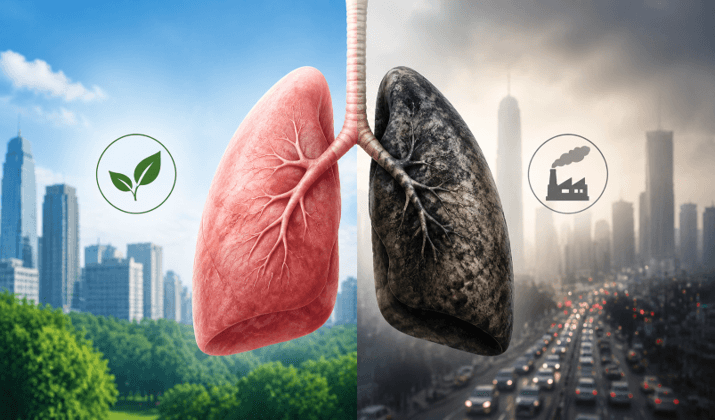
Here’s what’s actually happening.
The Air You’re Breathing — What’s Actually in It
Urban air contains several categories of pollutants that affect the lungs in different ways.
PM2.5 is fine particulate matter under 2.5 microns in diameter. To put that in context: a human hair is about 70 microns wide. PM2.5 particles are invisible. You cannot see them, smell them, or feel them entering your lungs. They come from vehicle exhaust, construction, industrial activity, and even cooking indoors. On a visually clear day in most cities, the PM2.5 count is still measurable and still entering your airways.
Coarser particulate matter, called PM10, can be trapped in the upper airways and stimulate mucus production. The vehicle exhaust contains nitrogen dioxide (NO2), which directly irritates the lining of the airways and weakens the resistance of the airways to infection. Ground-level ozone (O3) is a product that is generated when sunlight interacts with vehicle exhaust and can cause damage to the airways (airway epithelium). The black carbon particles from diesel engines stick within the lung cells that have to clean up and never get out of there.
Well, the majority of people who are aware of the air quality worry about the air being foul-smelling or if there is haze visible. Both are unreliable indicators of PM2.5 exposure. The worst air quality in fine particulate concentration can be fully transparent.
What These Particles Do Inside Your Lungs
The damage isn’t dramatic. That’s part of the problem. It accumulates over years through three specific mechanisms.
The Cilia Problem
Cilia are very fine hairs that line the airways of the nose down into the bronchi. Their task is to rhythmically beat and sweep out of the lungs the debris (dust, pathogens, mucus). Under normal conditions, they work very well!
PM2.5 and NO2 hinder the cilia’s function. As it happens, the cilia don’t beat as well with chronic exposure, and particles stick around instead of flushing. It’s the same mechanism that is compromised by smoking, but slower. One of the best physical changes former smokers report after giving up smoking is the return of cilia. When city dwellers who have been exposed to pollution have impaired cilia, they usually do not notice the problem as it has developed over time. No one has had a point of reference against which to compare.
The Macrophage Burden
The alveolar macrophages are the cells of the immune system that reside in the air sacs of the lungs. Once a particle makes it to the alveoli, it is taken up by the macrophages and removed; they are okay doing this in the normal day-to-day. They’re always on the job, and over many years they are accumulating black carbon under urban pollution conditions.
Chronic low-grade inflammation occurs in lung tissue when there are overloaded macrophages. Not the inflammation that accompanies an infection, but a continuous background inflammation that over time leads to lung dysfunction/lung immune response in the airways.
The Blood Barrier
This is what is not known by most people. The airway filtration efficiency decreases as airflow gets smaller and smaller, with the smallest air flows (ultrafine particles < 0.1 microns) entering directly into the bloodstream. They don’t remain in the lungs. That is why there is a link between long-term exposure to air pollutants and cardiovascular disease, as well as respiratory disease. These particles settle in the arterial walls and cause inflammation here as well—and the same atherosclerotic processes that smoking causes.
The Symptoms People Normalize
Urban lung load is insidious because it is easy to pinpoint symptoms as being due to anything else.
Constant morning mucous or throat clearing (which is often thought to be “post-nasal drip” mucous). Decreased exercise capacity, which many people would consider to be a part of the aging process or fitness level. More frequent respiratory infections attributed to stress or to exposure to children—delayed healing of colds. If the chest tightness comes and goes, then it’s just a symptom of anxiety.
None of these constitute “lung damage. All these may be indicators of the load on the respiratory system. But not everyone living in a city is a hypochondriac: It’s just that these symptoms are difficult to tie to air quality when they happen gradually, and seem small on their own.
What the Lungs Can and Can’t Clear on Their Own
The lungs are very well organized for self-cleaning. There are mucociliary clearance mechanisms, macrophage activity, and antioxidant defense systems to address this specific issue. They will perform as expected when used under normal conditions.
Urban environments push past normal conditions in three specific ways.
- Volume: In most cities, the amount of particles is too great for macrophages to do an efficient clearance. They aren’t failing; they’re being overloaded by an amount that wasn’t in the environment they evolved in.
- Chemistry: NO2 and O3 don’t simply contribute to the particle burden. They specifically chemically damage the mucociliary clearance mechanisms themselves. The system which is supposed to remove the pollution is getting polluted.
- Chronicity: Whereas daily exposure in cities is continuous without recovery windows, as in the case of acute exposures. Lungs rest is not possible. There are measurable differences in lung function among long-term residents of the city and similar groups of matched rural residents, regardless of whether they have a diagnosed respiratory disease.
Supporting Urban Lungs Practically
Practical Support for Urban Lungs
A few things that actually make a difference, and one that doesn’t.
- Air quality monitoring: free apps such as AirVisual and PurpleAir provide current air quality in the street. Exercising inside on high pollution days can be helpful in reducing exposure. HEPA filter removes PM2.5 from indoor air, which can be more polluted than outdoor air in urban areas as a result of cooking, combustion, and particles being trapped. Contrary to popular opinion, indoor plants have only a small impact on indoor air quality.
- Mucociliary support is where herbal medicine has something real to offer. When cilia function is chronically impaired by pollution exposure, supporting the mucociliary clearance system directly makes sense. Mullein (Verbascum thapsus) has been used in both European and North American herbal traditions for respiratory mucus clearance for centuries. The saponins and mucilage compounds in the plant support airway membrane function. Among available options, the best mullein extract for lungs is a liquid tincture format — the saponins that matter most are better preserved in liquid extraction than in dried capsule form. HERBAL LAB Mullein Leaf Extract uses 1000mg of organic Verbascum densiflorum per serving in an alcohol-free glycerin base.
- Antioxidant support helps to neutralize the effects of ozone and nitrogen dioxide. Vitamin C and E help minimize this damage. Pollution exposure depletes glutathione, the lung’s main antioxidant, and NAC supplements replenish it.
Final Thoughts
The respiratory cost of living in cities is unrecognized by most people, and it is invisible. The 2 billion particles per day is not meant to be frightening — it doesn’t mean that people with normal lungs will get serious respiratory illness when they take in the city air. However, ‘not developing disease’ and ‘’ot accumulating damage’ are not synonymous.
People who do worse and worse over the decades of urban life are the people who assume the air is fine, and it is. It isn’t always. Practical steps include monitoring, supporting the mucociliary clearance with appropriate herbal remedies, and maintaining antioxidant status. None of them is difficult. The majority of them are simple.
Popular on OTW Right Now!
-
 How Motorcycle Defects Can Create Another Legal Issue After a Crash
-
 Global Finance Names Uzbek Digital Bank Among Asia-Pacific’s Top Financial Innovators for AI-Powered Customer Experience
-
 Robotic Laser Welding Cell Safety: Class 4 Guarding, Interlocks, Viewing Windows & LSO Requirements
-
 Rapaport Trade Launches Rapaport MarketIQ, Deepening Its Shift to a Tech-First Platform




About The Author

Gagan Bhangu
Founder of otechworld.com and managing editor. He is a tech geek, web-developer, and blogger. He holds a master's degree in computer applications and making money online since 2015.