
Web App vs. Mobile App: 2026 Startup Decision Guide
Introduction
Despite the narrowing gap between “Web” and “App” experiences, the stakes in the web app vs. mobile app debate are still high. For emerging startups, this decision is not limited to choosing a technology stack; it also matters to your burn rate, customer acquisition cost (CAC), and long-term retention goals. And failing to make the right decision can strip you of your budget even before you hit product-market fit.
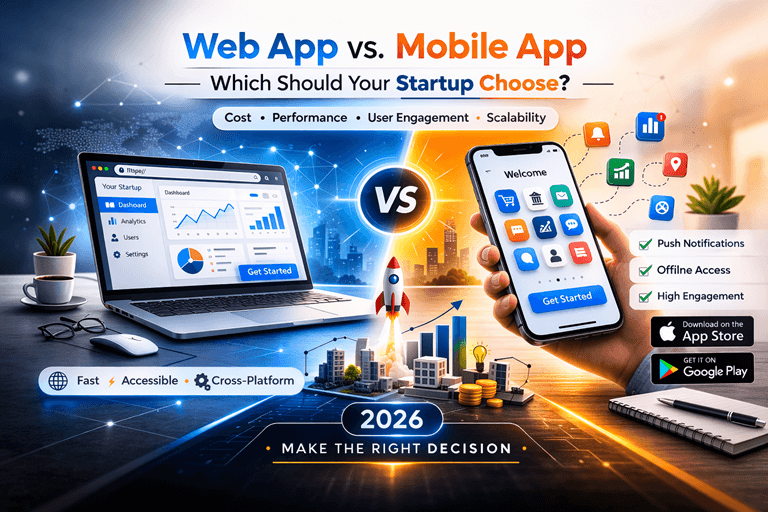
In 2026, this decision still haunts startups because choosing the wrong architecture can make you lose users, either due to the hassle of an app store download or the “out of sight, out of mind” nature of a browser tab. Take this guide as your knowledge base (KB) to weigh in on the ideal app architecture for your startup. We will discuss the core differences between web and mobile apps, the technologies that guide them, and the costs associated with each.
Exploring Web Apps as the Choice
Web apps are software programs that run on browsers. In other words, they are platform-agnostic and work with a “write once, run anywhere” philosophy.
Key Features of a Web App
Web apps are known for providing instant access (with an internet connection), cloud-based data syncing, and high SEO discoverability. Together, these web app features enable ‘virality’: users can share openly accessible links to a specific feature, and recipients can directly use it without visiting an app store.
Technologies Used for Web App Development
From a technical standpoint, the web app ecosystem is quite mature. Prominent web app technologies include HTML/CSS and frameworks such as React, Angular, and Vue for creating highly interactive, user-facing interfaces.
On the server side, Python, Java, PHP, and C# are widely used programming languages for back-end development. Based on them, Django, Laravel, Node.js, and .NET are the robust frameworks that make sure every data layer is secure and optimized, even if you decide to build a native companion later.
Web App Development Cost
A web app is cheaper to develop than a mobile app, which can range between $20,000 and 30,000 depending on the type of app or an MVP.
Why Startups Choose Web Apps?
For startups and most early-stage founders, speedy validation and a cost-effective start are the ultimate hedge against uncertainty. A win-win solution would be an application that would relieve them of the burden of having to create iOS and Android-specific codebases and will enable them to save at least 50 percent due to a single stack. Some of the startups are able to invest their money in the acquisition of customers instead of maintaining a complicated tech stack by adding this to the reduced web app development costs.
Real-World Example
Netflix, the OG media streaming application, started off as a subscription-based web application in 2007. It is the web app that was developed and perfected in terms of its user experience and recommendation engine that made it take 2-3 years to venture into mobile app development in 2010. That allowed them sufficient time to confirm their product-market fit without spending hundreds of thousands of dollars on mobile apps.
Exploring Mobile Apps as the Choice
Unlike web apps, mobile apps are software that runs on mobile devices, such as tablets and smartphones. Therefore, indigenous mobile apps are platform-specific. Nevertheless, a cross-platform mobile application which is able to operate on any platform (iOS, Android) is becoming a trend in many organizations.
Key Features of a Mobile App
Mobile applications have unlimited access to the capabilities available at the device level and can be used even when not connected to the Internet, as it caches data locally, which makes them a preferred choice to use on the go. The only disadvantage is that they have to be downloaded using the App Store/ Play Store.
Technologies Used for Mobile App Development
To build native mobile apps, specialized programming languages such as Swift for iOS and Kotlin for Android are often used. Many, however, are using cross-platform frameworks such as React Native and Flutter, and hybrid frameworks like Ionic and Cordova, to streamline multi-platform development while optimizing mobile app development costs.
Mobile App Development Cost
The primary reason startups refrain from investing in mobile apps, especially when starting out, is the relatively high cost. In 2026, expect mobile app development costs to start at $30,000 for a single-platform MVP and can exceed $150,000 for complex builds. That’s just for app development; mobile apps also incur annual deployment fees of about $99 (Apple) and $25 (Google).
Why Startups Choose Mobile Apps?
With mobile usage averaging nearly 6 hours and 40 minutes per day, missing this attention window can be costly. It’s an external source link. If you allow hyperlink then keep it; otherwise, you can remove the hyperlink and use it normally as plain text. It totally depends on you. Adding to this, they retain 32% of the audience (over a 90-day period), compared to 20% of the same for a web-based application. The reason is simple: on-demand usage and convenience.
Real-World Example
Instagram is a classic example of a startup that went mobile-first. Unlike other platforms that began in browsers (or on desktops), Instagram was released as a mobile app in 2010. Its founders are known to have deliberately skipped the web version to capitalize on the “instant” hook of mobile photography, particularly around the launch of iPhone 4’s improved camera capabilities.
Why is this decision relevant in 2026?
At the beginning of the 2020s, founders might experience the ability to start on the web and later port to mobile without much friction. Such a story is no longer true today since the web app vs. mobile app argument is not limited to the location where the actual coding resides. It is concerning the economics, data issues, and the fact that intelligent features are required.
The offline access, on-the-fly utility, and convenience are features that can not be inherently achieved by web-based applications but can be provided by mobile applications. On the other hand, web applications, a platform-neutral solution, have a broader coverage despite having less technical complexity.
If the web vs. mobile app choice feels like a trade-off between “reach” and “convenience,” a Progressive Web App (PWA) is a hybrid solution to consider. It is a quality site that utilizes the most current browser features to behave like native apps. That is why, rather than deciding between a web app vs. a mobile app, you create an experience that is gradually transformed into an app. Other perks include:
- No-Hassle Market Entry: Users can “install” your app directly from their browser.
- Cost Efficiency: Because you are building with a single web-based codebase, a PWA can reduce your initial web and mobile app development costs by up to 50–70% compared to native builds.
- Instant Deployment: You can push critical updates or bug fixes to all users immediately through your server.
Summarizing the Differences
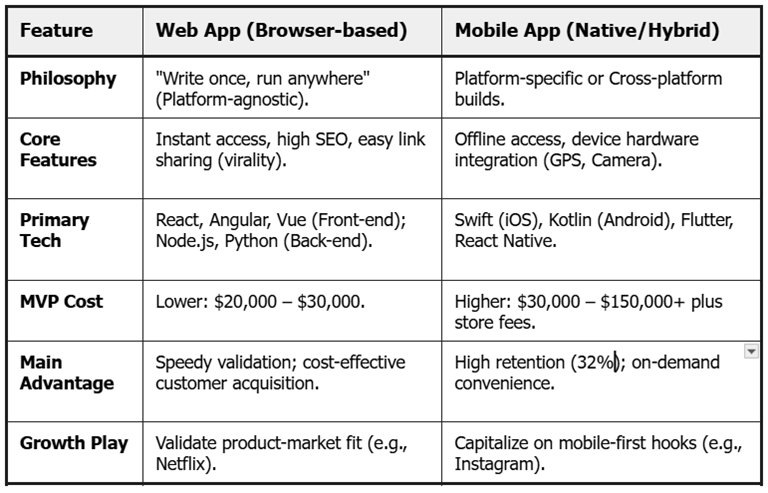
Web vs. Mobile Apps: Decision Framework
Balancing Reach with Retention is the core behind the web app vs. mobile app decision. Here is an expert decision framework to help you through it.
1. Evaluate your Acquisition Criteria
Determine how you want your users to find you. If you prefer organic discovery and a global reach, web apps are a clear choice. The user can simply click and reach out to you without the “download barrier.”
2. Assess Performance and Hardware Needs
The decision between a web app and a mobile app is often indicative of the performance requirements. In case your solution must be butter smooth even as your user base is increasing or you need to have access to the hardware, use mobile apps.
3. Consider Budget and Timeline
The choice of cost is the right choice for many early-stage founders. And it is obvious that the cost of web app development is much lower than that of mobile application development.
4. Validate Retention Economics:
For a web app, once a user closes the tab, they are “lost” until they return organically or are retargeted. The average cost per re-engagement (with re-targeting ads) falls in this range: $0.50 – $2.50+. Comparing this to the <$0.001 cost of API delivery associated with a mobile push notification clarifies the win.
5. See if You Need On-Demand AI
Users now consider AI features as competent-only features, with modern smartphones having chips capable of executing on-device Large Language Models. Web applications, on the other hand, use cloud-based intelligence, which is costly, with latency (waiting on a server), and more expensive (per user query API fee).
6. Consider the Gatekeeper Tax
Monopolies of app stores, on the other hand, make it difficult to start up using a mobile app distribution channel. In case the price to maintain your solution on the Apple/Google store does not seem an appropriate thing to invest in, then creating a web application would be more suitable.
7. Factor-in Post-MVP Pivot Cost
Most startup founders look at the initial price and regret it at a later stage. Take into consideration the cost of the post-MVP pivot to scale efficiently. Test out a solution such as PWA, which will ease the transition between the web and mobile without a write-up.
The Bottom Line
The web-application vs. mobile-application debate determines the way your business will make maneuvers in the modern world, where customers demand everything: AI, convenience, and single-access navigation. Regardless of which strategy you give more weight to, a discovery-rich web app development or a high-engagement mobile app, it is these expectations that you need to aspire to meet.
There isn’t an “ideal” choice; the only choice is one that preserves your best interest while maximizing user value. So take time to validate your retention economics and technical requirements now and prevent the costly “architectural debt” that kills nearly half of modern startups. Consider consulting an app development company if making this choice feels like a gamble; an expert perspective can help you bridge the gap between a lean MVP and a scalable powerhouse.
Author Bio

Amelia Swank is a seasoned Digital Marketing Specialist at SunTec India with over eight years of experience in the IT industry. She excels in SEO, PPC, and content marketing, and is proficient in Google Analytics, SEMrush, and HubSpot. She is a subject matter expert in Application Development, Software Engineering, AI/ML, QA Testing, Cloud Management, DevOps, and Staff Augmentation (Hire mobile app developers, hire web developers, and hire full-stack developers, etc.). Amelia stays updated with industry trends and loves experimenting with new marketing techniques.
Popular on OTW Right Now!




About The Author

Gagan Bhangu
Founder of otechworld.com and managing editor. He is a tech geek, web-developer, and blogger. He holds a master's degree in computer applications and making money online since 2015.